As of the morning of 16 October, air quality in Kyiv and most major cities in Ukraine is good, although there are exceptions where levels are slightly above normal. However, this level of air pollution does not pose a risk to people.
This is evidenced by data from the international monitoring platform IQAir.
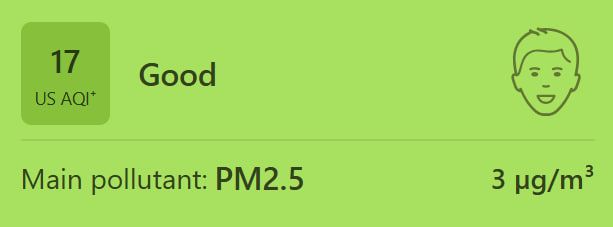
On average, the air quality in the capital is good. The main pollutant is PM2.5 fine particulate matter, with a concentration of 3 µg/m3. According to the World Health Organisation, the upper limit for this indicator is 5.5 µg/m3.
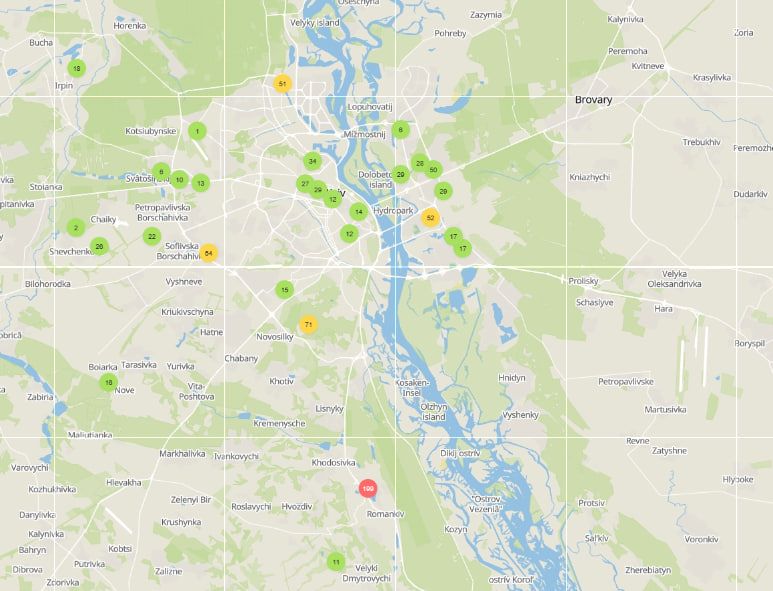
Within Kyiv, slight exceedances with moderate levels of pollution have been observed at several locations — on Regeneratorna Street (9.5 µg/m3) and near Akademika Zabolotnoho Street (19.8 µg/m3).
The air is currently moderately polluted in areas close to the capital as well — in Sofiivska Borshchahivka (10.7 µg/m3) and in Vyshhorod (9.1 µg/m3).
Air quality in Kharkiv (13.1 µg/m3) and Rivne (12.9 µg/m3) falls within the ‘yellow’ zone, indicating moderate pollution.
The remaining regional centres have good air quality, with the following average dust concentrations:
- Ternopil — 9.1 µg/m3;
- Cherkasy — 8.3 µg/m³;
- Zaporizhzhia — 6.9 µg/m3;
- Chernihiv — 6.5 µg/m3;
- Dnipro — 6.1 µg/m3;
- Khmelnytskyi — 5.9 µg/m3;
- Ivano-Frankivsk — 5.9 µg/m3;
- Poltava — 5.2 µg/m3;
- Kherson — 5.2 µg/m3;
- Chernivtsi — 4.5 µg/m3;
- Mykolaiv — 3.8 µg/m3;
- Vinnytsia — 3.6 µg/m3;
- Lutsk — 2.8 µg/m3;
- Zhytomyr — 2.6 µg/m3;
- Uzhhorod — 2.6 µg/m3;
- Lviv — 2.5 µg/m3;
- Odessa — 1.9 µg/m3.
It should be noted that, as a result of enemy attacks, air pollution levels may rise locally, in some cases by up to ten times.