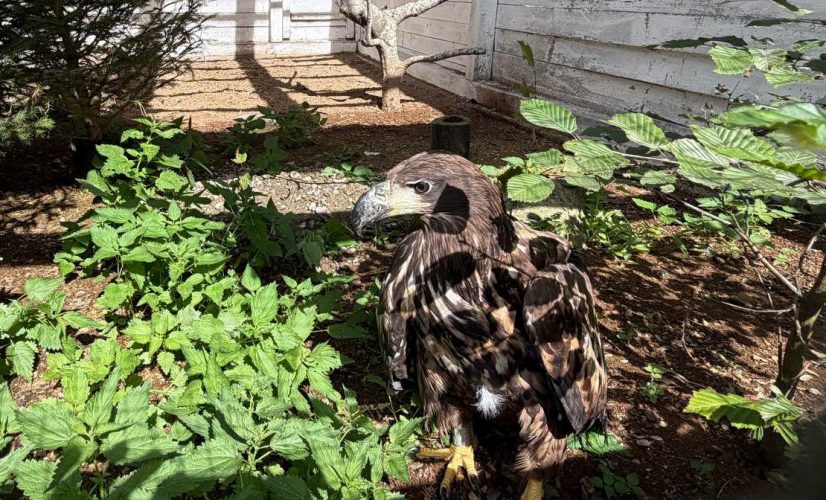
An exhausted white-tailed eagle, one of the largest birds of prey in Eurasia, was found in the forests of Zakarpattia. It is now being cared for at the ‘Kvasovets’ wildlife rehabilitation centre.
This was reported on the Facebook page of the Synevyr National Nature Park.
A rare find
A exhausted and weak golden eagle was found by forest rangers from the Ternivsk Forest District. The bird was exhausted and clearly in need of specialist medical care.
The forest rangers realised that the animal needed to be rescued, so they handed it over to ‘Kvasovets’, which is under the authority of the Synevyr National Park.

Source: Synevyr National Nature Park
The Road to Recovery
Immediately upon arrival at the centre, the white-tailed eagle underwent a veterinary examination. This made it possible to assess the animal’s general condition and determine what needed to be done next to help it regain its strength and recover.
The bird is currently undergoing rehabilitation. Staff from the centre are keeping a constant watch over it. This beautiful bird has been provided with suitable living conditions and is being well fed and cared for.
For the time being, vets are unable to give a precise prognosis regarding the golden eagle’s recovery. They say that this depends largely on its overall state of health, as well as its ability to rediscover the skills needed for life in the wild after prolonged contact with humans.
"The conservation of rare and vulnerable species of wildlife is one of the key areas of nature conservation work. Every instance of a wild animal or bird being rescued is the result of people’s responsible attitude towards nature and effective cooperation between nature conservation organisations and the forest rangers," the nature conservation organisation emphasised.
EcoPolitic reported that Australia had become the latest continent to be affected by the deadly bird flu. It was decided to vaccinate rare birds.
The war is having a significant impact on the bird population. In regions close to the front line, injuries caused by explosions – including acoustic ones – remain the greatest threat to birds.