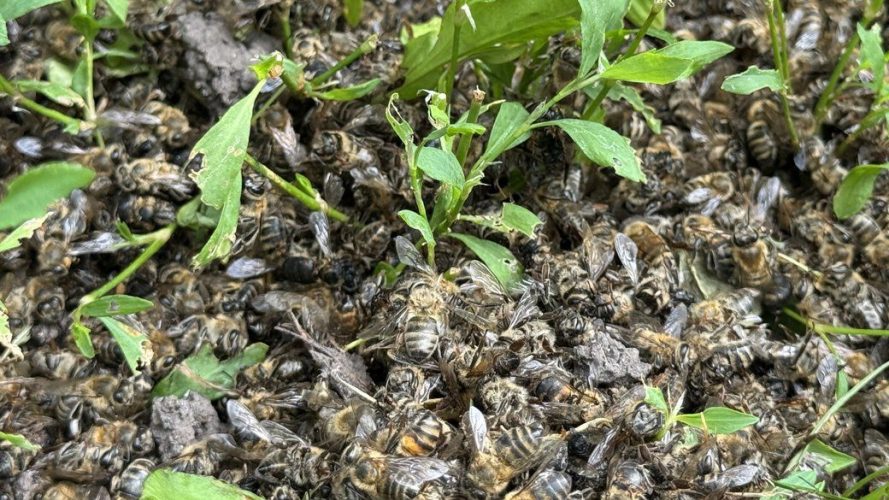
On 10 June, a mass die-off of bees began in two villages in the Kirovohrad region. In total, people have lost over 32 million bees, and scientists are predicting a more far-reaching impact on the local ecosystem. The suspected cause is the spraying of an insecticide on a pea field. However, it now remains to prove the agricultural company’s involvement and seek compensation for the damage.
This story was reported by the media outlet ‘Suspilne’.
A slow death
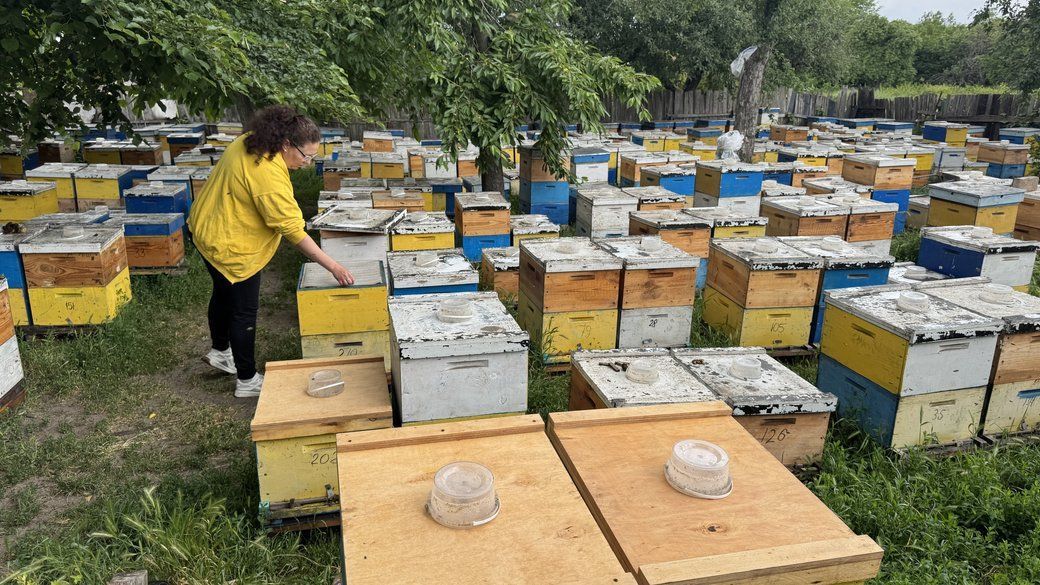
At Natalia Chernysh’s apiary in the village of Bohdanivka, half of the 250 bee colonies died within a week. The woman is horrified by the way the insects are dying — gradually and in convulsions. In the first few days, 30 per cent of the apiary was lost; later, a further 20 per cent.
At least 14 other beekeepers have suffered a similar fate, including some from the village of Kucherivka. In total, around 400 bee colonies have died, amounting to approximately 32 million insects. Whilst searching for the cause, people learnt that a pea field three kilometres from Bohdanivka had been sprayed.
“The agronomist himself told us that they carried out the treatment during the night of June 9 to 10. We called the police, the police recorded the incident. Then, we contacted the Subottsi community, and there a commission was formed. The commission worked on Friday, and they drew up reports on the mortality,” said Ms. Nataliya.
The agronomist also told people the name of the chemical used. The commission collected dead insects, as well as soil and pea plant samples.
Residents are outraged that they lost their entire source of income in such a short period. Nataliya Chernysh had been engaged in beekeeping for 15 years, but had never witnessed such a massive die-off. Beekeeper Volodymyr Bohun, who lost all 20 of his bee colonies, cannot even afford to pay for an analysis, as it costs 26,000 UAH.
Source: “Suspilne”
Toxic insecticides
A bee die-off of this scale could only be caused by the treatment of fields with insecticides, and the impact extends far beyond just bees. This is the opinion of Mykola Kovalov, Associate Professor at the Department of General Agriculture at the Central Ukrainian Technical University.
“The bee is not just an element of the ecosystem; everything is interconnected here. That is, the bee lies dead after exposure to the insecticide. The next link in the food chain consumes it, so this essentially spreads throughout the entire ecosystem. This includes rats, hedgehogs – that is, mammals and birds as well,” emphasized the scientist.
It is still difficult to fully assess the overall impact of the chemicals on the ecosystem. Even the cow belonging to Bohdanivka resident Oksana Strutynska was poisoned, likely due to grass mown for feed near the field.
Judging by the chlorosis (chemical burns) observed on the pea plants, the dose was most likely excessive. There were no other insects found in the field, not even ants.
Response of authorities and the field owner
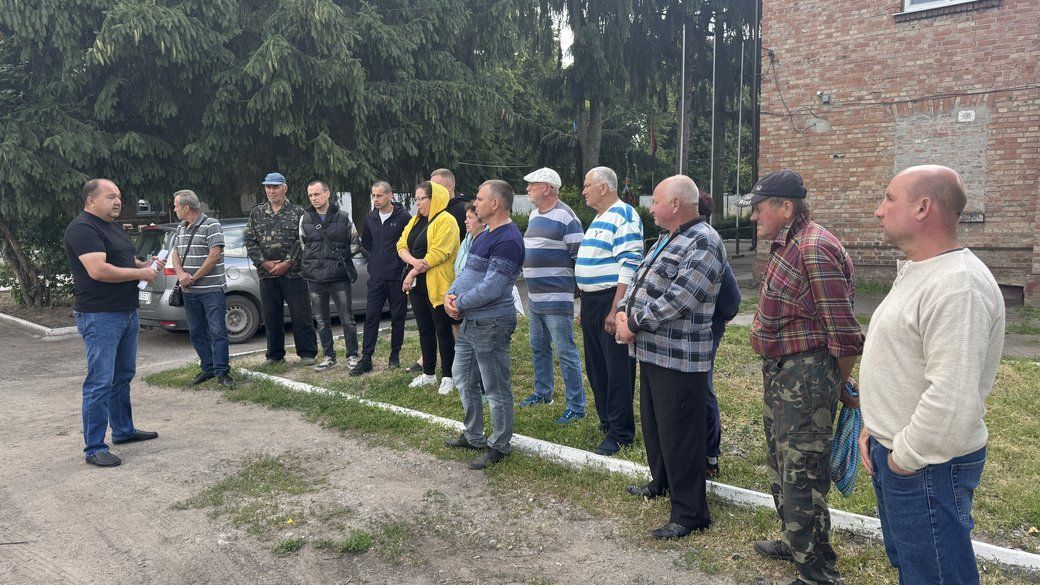
The authorities of the Bohdanivka district began receiving reports of bee deaths as early as June 11. Notably, farmers did not provide advance notice about the planned treatment. Previously, such warnings were issued, and the local authorities, in turn, informed villagers via public announcements in the Facebook group.
Source: “Suspilne”
"According to our data, the cause of the bee deaths was the treatment of the pea field during flowering. This was also confirmed by the chief agronomist of that agricultural company. Samples of soil, flowers, and bees were taken for analysis. They told us to take them to court. They admit their guilt and confirm the facts. However, they are not willing to negotiate," Inna Kostandinides, the chief specialist of the Subottsi village council, told Suspilne.
The head of the agricultural company, Serhii Melnyk, did not meet the journalists, but did speak with some of the affected beekeepers. According to them, he was not aware of the scale of the incident and promised to consider the possibility of compensation.
All 14 affected beekeepers filed complaints with the police. As a result, administrative materials were drawn up after review. The head of the Subottsi community also contacted the State Service of Ukraine on Food Safety and Consumer Protection.
Will liability be toughened?
Currently, violations of agrochemical use regulations are governed by Article 83 of the Administrative Code. The liability is a fine of 51–119 UAH for individuals, and 119–170 UAH for business entities. If guilt is proven, the issue of damages for lost property is settled in court.
The Committee on Agrarian and Land Policy of the Verkhovna Rada is currently considering a draft law aimed at strengthening responsibility for such violations.
"We are optimistic about this autumn. The goal is to bring legislation, particularly regarding liability, in line with European requirements. So far, this has not been achieved, that is, the legislative initiatives exist as basic drafts, but have not passed the first reading," Deputy Minister of Economy Taras Vysotskyi told Suspilne.
EcoPolitic previously reported that after the ban on pesticides in France, the population of insectivorous birds began to recover gradually.