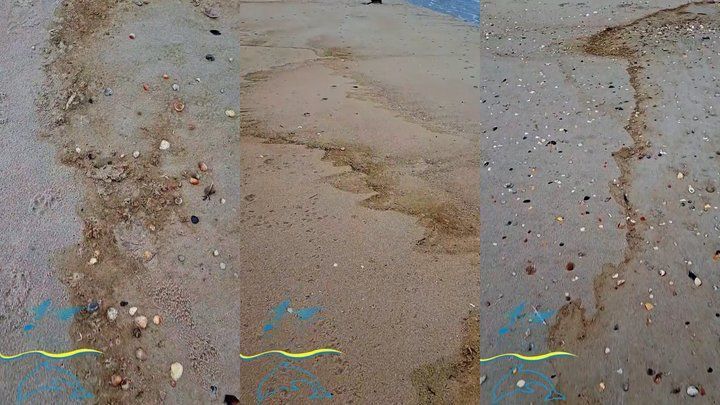
Back in April 2026, after a Russian strike on the port of Chornomorsk, sunflower oil entered the sea. Part of it washed up on the coast of the Tuzly Estuaries National Nature Park, where about 10,000 m2 of the sandbar was polluted. However, on October 26, six months after the attack, another release of oil onto the park's shores occurred following a severe storm. The total area of pollution now reaches almost 100,000 m2.
This was reported by Ivan Rusev, head of the research department of the Tuzly Estuaries National Nature Park.
Why the pollutant has reappeared
The oil that entered the sea has not disappeared without a trace. In a comment to the media outlet "Suspilne", the scientist added that after a spill it forms a film that settles on the seabed in shallow areas.
Strong storm winds can break up this film and make it "migrate". In the form of small droplets, the oil mixes with water and is washed ashore again.
"A powerful wave stirs up all the layers lying on the benthal zone, the seabed at depth. It lifts this oil, which gets back into the water and then comes ashore. If it were not for the storms, it would not be visible," the scientist said.
A calm summer sea makes the pollution almost invisible, while autumn storm waves restart the circulation of the pollutant.
Impact on nature
The oil soaks into the sand and remains between its layers, and it can "break out" during the next storms.
On the coast, this substance poses a threat to small organisms living in the sand, including microalgae, fungi and invertebrates.
"It immediately forms as foam, then gradually settles, penetrates the sand through cracks and destroys small microbiocenoses," Ivan Rusev said.
The oil is also a threat to the seabed, as it blocks the penetration of oxygen and light. According to the scientist, after previous oil spills, many dead animals were found in the sea: crabs, mussels, jellyfish and seahorses.
According to Rusev, this threat will not disappear for years.
"Given such a large volume – tens of thousands of tonnes – as well as the accident at Adzhalyk, when the Russians destroyed the tanks, and twice in Chornomorsk, we are talking about a significant amount of oil. It has settled in the shelf zone all the way to Romania. And periodically, for about 10–15 years, it may appear in this form – in different fractions and in different volumes," the scientist explains.
As a reminder, mass deaths of Black Sea dolphins have been recorded during the full-scale war. Their population may take up to 50 years to recover, but there is a threat that these species will disappear from the waters completely.