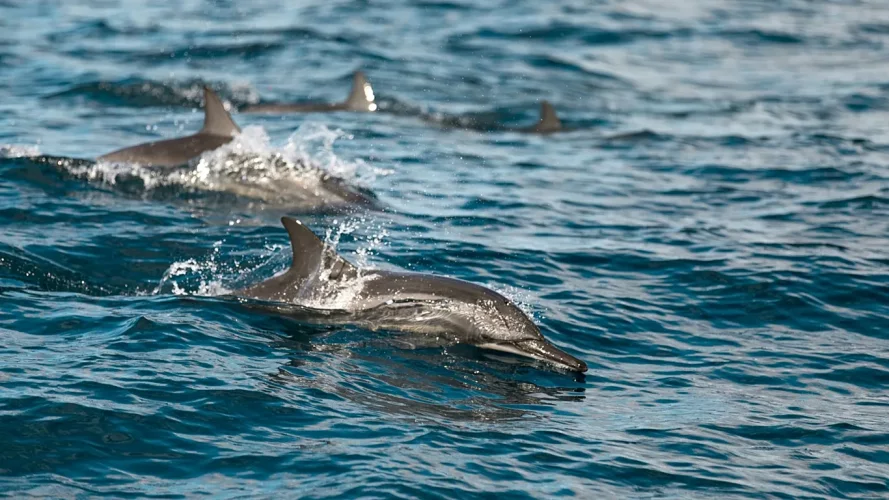
It will take the Black Sea cetaceans between 30 and 50 years to reach the population levels seen at the start of 2022. Overall, due to the full-scale war, the dolphin population in the Black Sea may be at risk of extinction.
This was reported by ‘Ukrinform’, citing a comment by Ivan Rusev, head of the research department at the ‘Tuzly Estuaries’ National Nature Park.
Multiple threats
Even before the war, in the 1980s, these dolphins were listed in the international Red List. This species is extremely vulnerable to imbalances in ecosystems and human exploitation. In particular, according to the researcher, during the Soviet era the animals were simply slaughtered en masse — for their meat, blubber and bone meal.
"Over the course of several decades, 6 million dolphins disappeared. Then another disaster befell the mammals — the emergence of Mnemiopsis, jellyfish-like creatures that feed on anchovy roe. Anchovy stocks were dwindling, and they are the dolphins’ main food source. The Russians also caught the dolphins and unsuccessfully trained them for military purposes, resulting in the animals’ deaths,” said Ivan Rusev.
Another deadly trap for dolphins is fishing nets. Between 10,000 and 20,000 animals die in them every year. According to estimates by staff at the nature reserve, in the Black Sea alone – in the north-western part of the basin – up to 3,000 km of nets were set each year, and one dolphin became entangled in them for every 10 km of netting.
Risk of extinction
At its peak, the total population of all three species of cetaceans living in the Black Sea was around 2 million individuals. Before the Russian invasion, there were around 500,000.
"If the dolphin population continues to decline, they will find themselves in a difficult situation. Our park has already prepared the documentation for the creation of a large marine reserve as part of the National Park off Zmiinyi Island, to ensure the safe reproduction of these mammals," said the scientist.
The creation of a safety zone has already been provisionally approved by the Ministry of Economy, but the regional administration has not yet granted the necessary consent.
This stretch of water is particularly valuable — from March to October, mammals migrate here from Crimea, as well as from Turkey and Georgia.
"They breed and feed here, so it is very important to provide them with suitable conditions. They reach sexual maturity at 6–10 years of age. A pair gives birth to a single calf every 2–3 years, and the parents then raise the calf for a further 3 years. Consequently, it will take a very long time for the population to recover. According to our estimates, it will take 30–50 years to restore the pre-war numbers of these dolphins,” Rusev emphasised.
EcoPolitics previously reported that, as of early August 2026, around 100,000 dolphins had died as a result of the full-scale invasion.