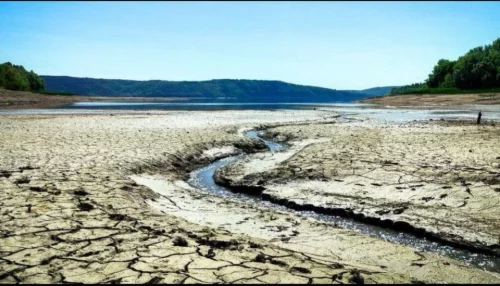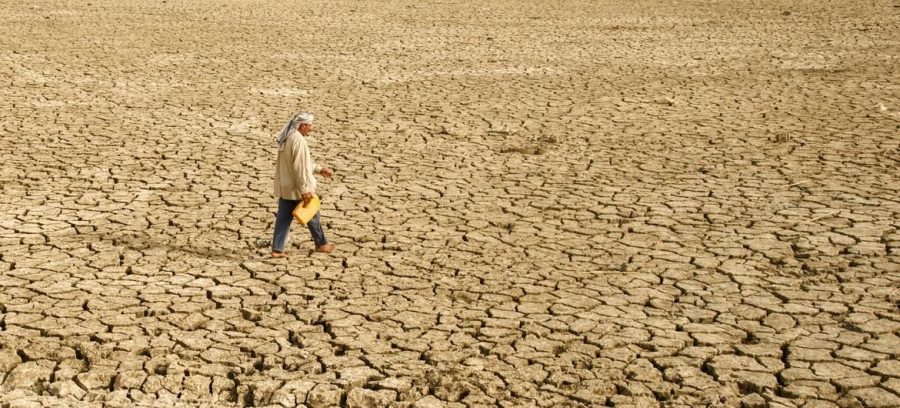
As global temperatures rise, the Earth’s arid regions may become even drier. Their boundaries will expand, encroaching on ever more territory. All of this will lead to land degradation and the destruction of vegetation. Over the next 70 years, the area covered by such regions will increase by an area equivalent to the whole of Algeria or a third of Australia.
As reported by Science Alert, this is supported by data from a new study published in the journal *Environmental Research Letters*.
Differences in methodology
Scientists worldwide agree that arid lands are those that face a severe water shortage. In such areas, water loss through evaporation and plant transpiration exceeds the amount of rainfall.
There is also a general consensus regarding the location of the world’s driest regions. However, global estimates of the area covered by such regions may vary. This is primarily due to differences in climate data and measurement methods.
However, the scientific community must find common ground in the face of this threat. This is necessary for accurate monitoring, which should inform the development of countermeasures.
"Given the high environmental vulnerability of arid lands, updated assessments of the area of arid lands and their future redistribution are needed to support adaptation to climate change and sustainable development," the research team explains.
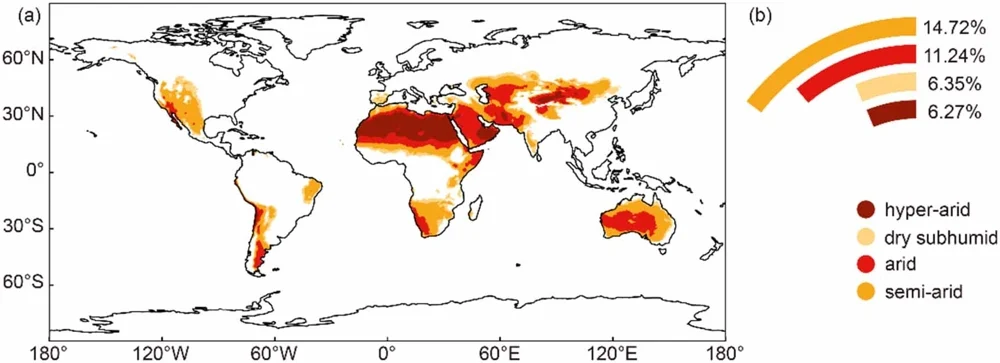
Джерело: Environmental Research Letters
Updated forecasts
Scientists have used an updated climate model to map arid areas and predict how they might expand in the future.
To this end, the aridity index (AI) was used – the ratio of precipitation to potential evapotranspiration (PET; the total evaporation of moisture from the soil and vegetation). Areas with an AI below 0.65 were classified as arid.
The unexpected effects of CO2
High levels of carbon dioxide in the atmosphere can reduce water loss from vegetation. Special ‘stomata’ on plants close when there is an excess of this gas, which affects transpiration.
In turn, changes in transpiration affect the overall calculations, a factor that was not taken into account in many previous studies.
"Conventional projections often overlook the impact of CO2 on potential evapotranspiration, which may lead to higher estimates of aridity and alter models of aridity hotspots," the authors write.
The impact of CO₂ was therefore incorporated into the forecast alongside an updated PET model, which took into account meteorological data for the period 1960–2023.
The spread of drought
Excluding Antarctica, data from 1994–2023 show that arid lands covered around 38.58 per cent of the land surface. However, their composition is also heterogeneous. Around 14.7 per cent are semi-arid, 11.2 per cent are arid, 6.4 per cent are dry sub-hyperarid (transitional), and 6.3 per cent are hyperarid, i.e. the driest on the planet.
According to the study, between 2071 and 2100, arid zones will cover up to 40.3 per cent of the land surface. The greatest increase will occur in the hyper-arid segment. Just under 2 per cent may seem insignificant in statistical terms, but in reality this is an area the size of the whole of Algeria or 30 per cent of the Australian continent. It is Australia that will face the most significant changes, along with Brazil and parts of Africa.
This trend is worrying, but in a sense it is encouraging, given the impact of CO2 on transpiration. After all, some researchers had put forward far worse forecasts – up to 56 per cent.
EcoPolitic reported that the south of Ukraine is at risk of desertification. The causes are not only climate change, but also the unsustainable use of water resources and the felling of forest belts.
This year, Ukraine, like the rest of the world, has faced an unprecedented drought. In a number of western regions, a critical danger level has been declared, and the authorities have restricted water abstraction for 300 enterprises, including the water supply companies in Chernivtsi, Uzhhorod, Svalyava and Kalush.