A Spanish research team from the CSIC has developed an interactive platform that predicts potential yield losses on agricultural land across the globe. The countries that will be hardest hit are those least responsible for greenhouse gas emissions. However, the map makes it possible to take adaptive measures in advance or relocate production.
This was reported by Euronews.
Net climate impact
The interactive tool has been named CADI – an acronym for the Climate-Induced Agricultural Decline Index.
Its key function is to compare how much yield a specific plot of land can produce under different climatic conditions. The 2020 yield has been chosen as the baseline.
Analysts compared historical crop yield data from the FAO with climate records from the European Copernicus programme. The period covered is from 1981 to 2020. Based on these trends, it is already possible to predict what will happen next.
The model does not take into account adaptation measures, but demonstrates the net impact of climate change.
Who Loses the Most
It is already known that one in six areas of agricultural land has lost 10% of its potential productivity over the past 20 years compared to the previous similar period.
The greatest losses occur in tropical regions. Meanwhile, any productivity gains in more northern latitudes do not compensate for the global losses, as they begin from lower yield baselines.
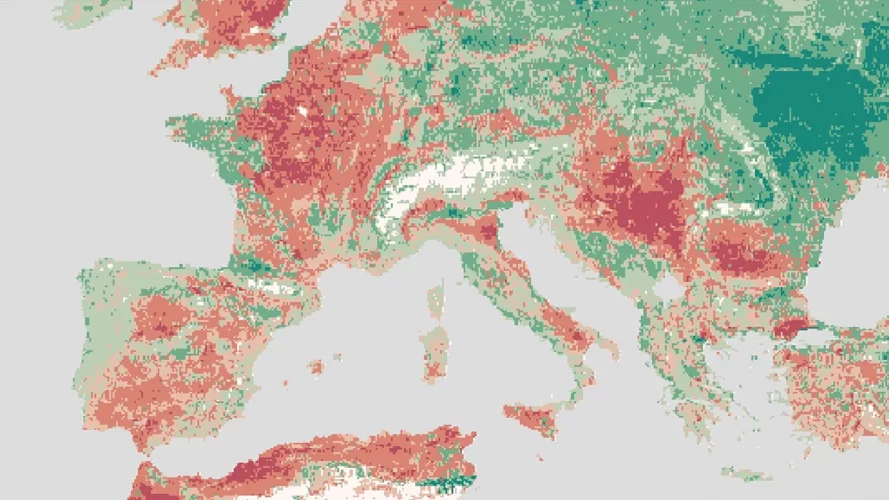
A north–south pattern is observed across Europe. Scandinavia, Scotland, and the Alps are improving their agricultural potential, while the south of the continent is losing it.
Impact on the Future
It is reported that about 15% of the world’s population lives in areas where agricultural potential has already dropped by at least 5%. If the planet’s temperature rises by 2.1°C compared to 1990, between 2041 and 2060, half of the Earth’s population will be living under such conditions.
Losses among countries will be uneven. It is expected that just 25% of countries will bear 90% of the losses, primarily in tropical regions.
This highlights global injustice. Countries that emitted the least greenhouse gases will suffer the most from the global warming caused by those emissions.
EcoPolitic previously reported that because of global warming, the south of Ukraine will also lose its agricultural potential. Many crops are already “migrating” north and west, where conditions for cultivation are more favorable.