At the end of May, the Ministry of Economy announced that the first application had already been submitted via the Unified State Register of Integrated Environmental Permits (IEP) platform. Almost two months have passed – and there are still no new applicants seeking to obtain a permit under the updated procedure, even though the platform has been operational since September 2025.
EcoPolitic decided to check on the progress of IEP applications and found that there has been virtually none.
On the national online platform ‘EcoSystem’, the IEP state register still contains only one application: that from the ‘Torgtekhnika’ cardboard and paper factory in Vinnytsia.
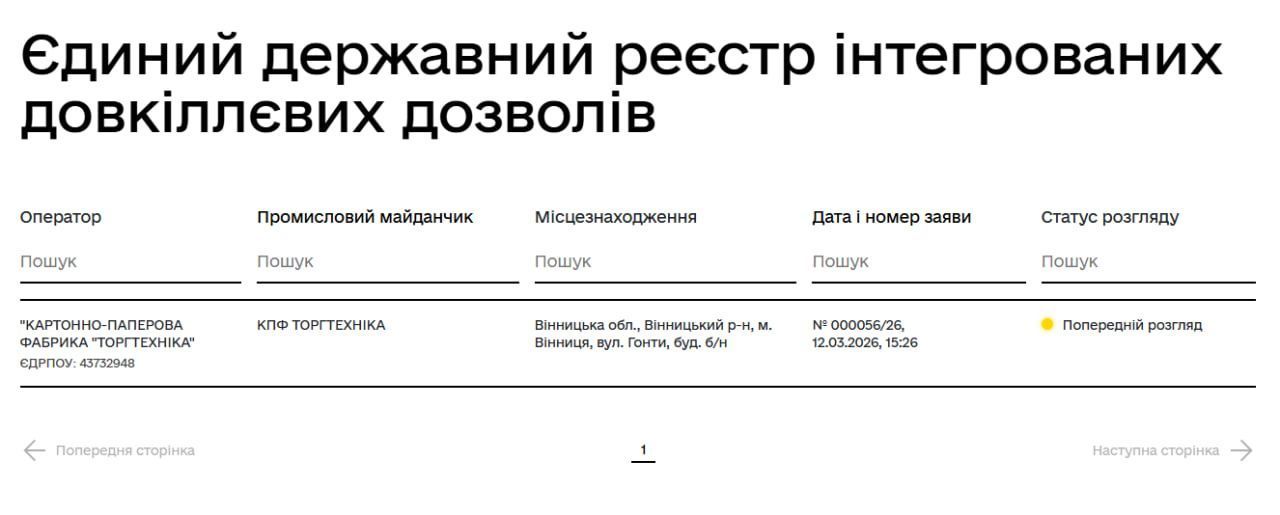
Screenshot from the "EcoSystem" platform
The application itself is dated March 12 and is still under preliminary review. It includes a package of accompanying documents, ranging from information about the installations themselves to a production diagram and situational plan.
The text of the application amounts to 142 pages and was uploaded to the platform only on July 10. It appears this is due to changes, as the application has already been returned for revision three times.
Chaotic Chronology
The first attempt at obtaining an IEP is essentially an example and a learning opportunity for other companies to avoid similar mistakes. However, this will not be easy.
It is immediately noticeable that the chronology of the application review is chaotically mixed. For example, after the status “Pending pre-moderation” dated April 16, there is a notification about a preliminary review on July 14, followed by a return for revision dated March 13.
It appears the website sorts statuses by number rather than by date.
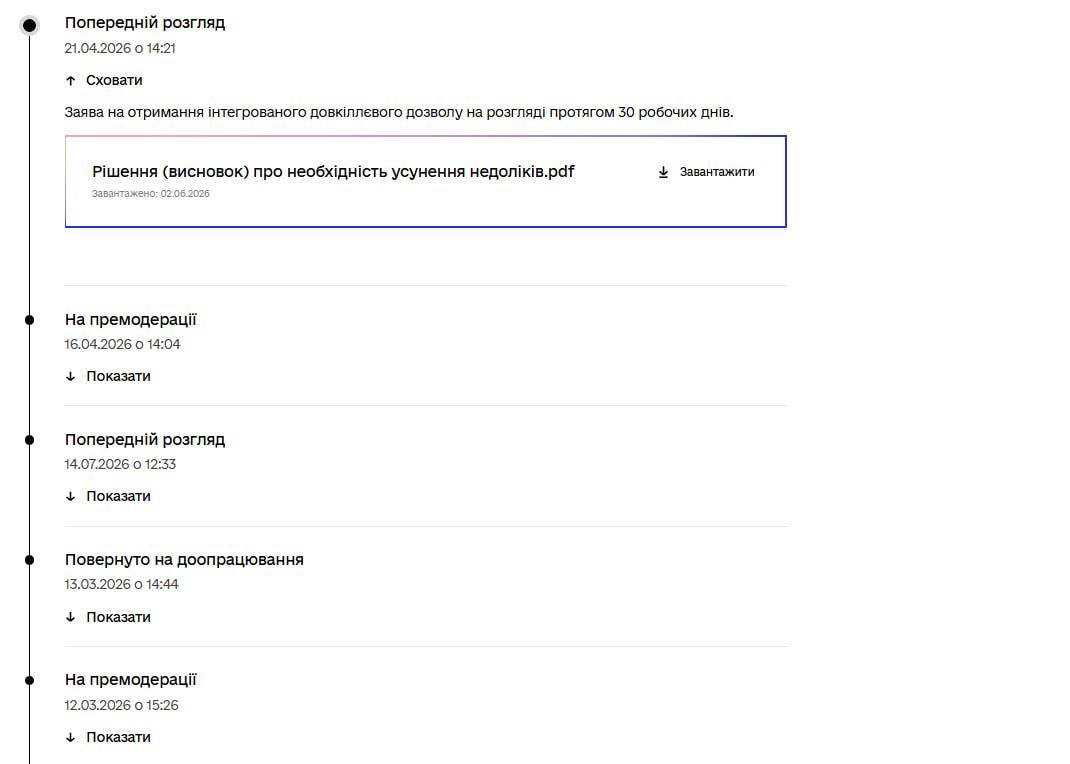
Screenshot from the "EcoSystem" platform
However, after the updated application and documents were uploaded on July 10, from July 14 this IEP is again under preliminary review.
What is an IEP and what are the timeframes for its issuance?
The need to obtain an IEP is stipulated by Law No. 3855-IX “On Integrated Prevention and Control of Industrial Pollution.” It entered into force on August 8, 2025. The IEP register was already launched on the "EcoSystem" platform in September of the same year.
Businesses have a transitional period of four years to obtain an integrated environmental permit. Three years are allocated for submitting the application, and another year for obtaining the IEP itself.
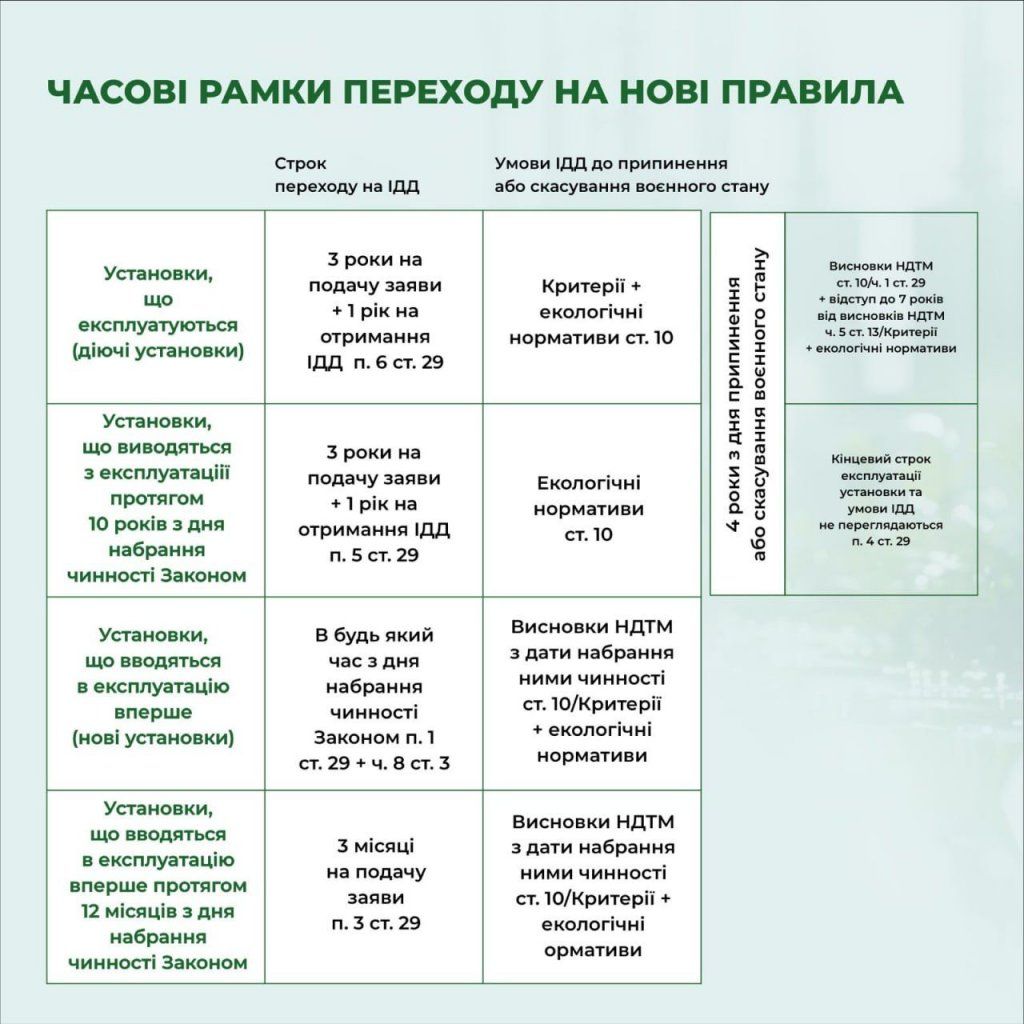
Source: t.me/mindovkillia
An IEP is a new type of permit that consolidates several different environmental permits, such as permits for emissions, waste management, and special water use. However, it must be obtained for each individual installation.
Read more about IEP in EcoPolitic’s detailed material.
The Ministry of Economy urged not to delay the submission of applications. If everyone waits until the end of the prescribed period to submit, the permitting authority will be overwhelmed, and there is a greater risk of missing the deadline.