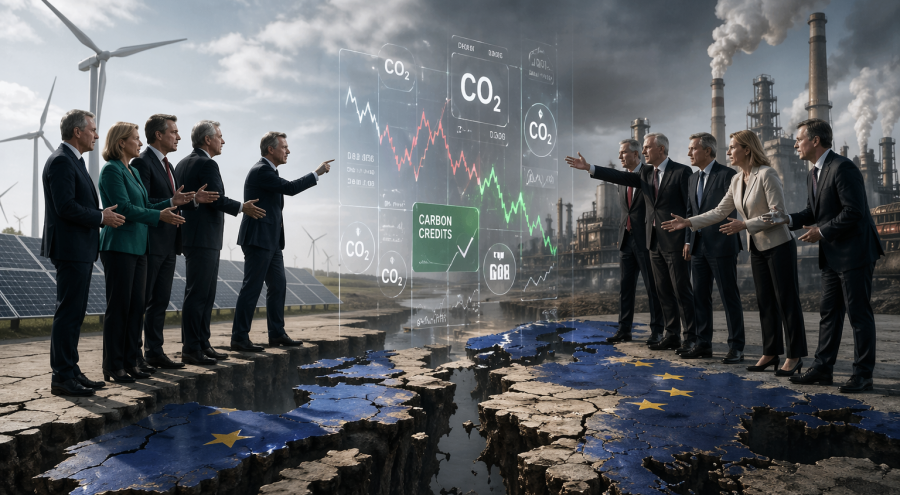
In late February, a heated debate rocked the European Union: the EU Emissions Trading System (EU ETS)—a tool long considered the flagship of climate policy—had become a source of political conflict among member states. As Brussels prepares for a major overhaul of the system in July, voices calling for “carbon fatigue” are growing louder within the bloc. Countries have divided into three camps: active opponents, defenders, and cautious observers.
EcoPolitic examined what caused this dramatic escalation and how the EU ETS became a bone of contention among member states after 20 years of operation.
Why the disputes surrounding the European ETS have flared up right now
The main tension arose from a combination of several factors:
- High energy prices in the EU, which have risen even further due to Iran's blockade of the Strait of Hormuz.
- Global instability resulting from numerous military conflicts and the unpredictable policy of one of the key players on the world stage – the United States – following Donald Trump's re-election as president.
- The scheduled review of the European ETS this July. Interested countries are trying to submit their amendments to the upcoming reform package in time.
- Full-scale implementation of the Carbon Border Adjustment Mechanism (CBAM) this year.
- In the second half of Phase IV of the EU ETS, which began this year, the principle of "efficient ones earn, inefficient ones pay" in the EU is being replaced by "all polluters pay," and the gradual termination of free allocation of allowances by 2034 will also start. As companies approach the point where they must fully pay for carbon emissions, the “don't hurt us” lobby is getting louder.
- Sharp swings in carbon prices. Very high price volatility makes the emissions market unpredictable and leads to rising costs in the steel, cement, aluminum, and chemical industries.
Who is attacking the European Emissions Trading System and why
The so-called “opponents” of the EU ETS do not form a single monolithic camp, as two distinct approaches can be heard within it.
The first is a radical one, whose main idea is “let's put a pause on it now, and deal with it later.” Italy represents this approach. The country's Prime Minister, Giorgia Meloni, has repeatedly called the current format of the system harmful for competitiveness.
“We cannot allow environmental fanaticism to destroy our industry. The EU ETS in its current form is a counterproductive tax that drains working capital from manufacturers and forces us to buy dirty products from abroad,” she declared at the latest EU summit.
On February 26 this year, Italy's Minister of Economic Development Adolfo Urso publicly called for suspending the ETS "until a comprehensive review is done." He justified this by citing pressure on industry and competitiveness. In his rhetoric, the politician called the ETS an "additional tax" imposed on companies.
The second group of countries insists on the following approach: “let’s soften and stabilize, because industry cannot cope.” This group includes states that do not directly ask for the system to be cancelled but want a significant change in the rules to reduce the risks of high prices and volatility, particularly through the Market Stability Reserve (MSR) and slower phase-out of free allowances.
The most illustrative coalitions and statements:
-
In February, during his speech at the European Industrial Summit in Antwerp, German Chancellor Friedrich Merz stated that the ETS should be reviewed or postponed. In his view, its main objective is not generating new revenues but reducing CO₂ emissions and supporting the “green” transition of industry. As a result of such statements, the flagship European carbon price dropped to a five-month low. Later, Merz softened his messaging and called the ETS “successful,” but the earthquake effect on the market had already occurred.
-
The Czech Republic has also taken an extremely tough stance in this discussion. On February 12, the country’s Prime Minister Andrej Babiš said that European Union Allowances (EUA) are destroying Czech industry and called for a substantial review of the ETS.
-
A little later, a coalition of 14 EU member states, which became known as the “Friends of Industry,” issued a joint statement demanding that competitiveness should be the top priority in the upcoming ETS review. The statement was signed by Austria, Bulgaria, Croatia, Czech Republic, France, Germany, Italy, Luxembourg, Poland, Portugal, Romania, Slovakia, Slovenia, and Spain. The key words of the statement were: “predictability,” “market stability,” “protection against excessive volatility,” and a “pragmatic approach” to free allocation.
-
On March 18, a letter from 10 leaders to EU authorities appeared, demanding a comprehensive ETS review, the extension of free allowances beyond 2034, and a gradual phase-out of these allowances starting in 2028. The appeal was signed by Italy, Austria, Bulgaria, Croatia, Czech Republic, Greece, Hungary, Poland, Romania, and Slovakia. These countries are also urging the European Commission to accelerate the timetable for the review, stating that it should be conducted not in July, but already by the end of May.
Who sided with von der Leyen
After the sharp attack from Italy, statements were voiced in defense of the EU ETS. A viewpoint diametrically opposed to Giorgia Meloni’s government was expressed by Sweden’s Deputy Prime Minister and Minister for Energy and Industry Ebba Busch.
“The ETS is one of the most successful instruments of the European Union, as it has delivered both emission reductions and greater economic growth,” she stated.
Busch also warned: if the “foundations” of the ETS are undermined, it could threaten the industrial transition achieved over the past 10–20 years and undermine trust in EU decisions.
Eight countries – Denmark, Finland, Luxembourg, Portugal, Slovenia, Spain, Sweden, and the Netherlands – publicly opposed the idea of suspending the emissions trading scheme and voiced their support for maintaining the carbon market. In a joint informal document drafted in March, they referred to the EU ETS as “the cornerstone of the European Union's climate policy” and explicitly stated that suspending it would be “an extremely worrying step backwards”.
Another form of support came from a letter signed by the energy ministers of seven EU countries – Denmark, Finland, Latvia, Luxembourg, the Netherlands, Portugal, and Sweden – with a request not to dismantle the existing energy market structure. Instead of a market overhaul, officials recommended investing in renewable energy sources, improving cross-border flows, and increasing both flexibility and storage capacity to lower prices and enhance energy security.
An important detail: most ETS supporters are willing to discuss targeted adjustments to the system such as the MSR, benchmarks, or safeguards against volatility, but they draw a red line at suspending or dismantling the system itself.
Observer countries
There is a third group – countries that have not expressed their position publicly or have sent mixed signals.
France is a typical example of such caution. The country does not appear to favor suspension, but regularly returns to the idea of stabilizing the carbon price by setting a certain price corridor. France also proposes to review the functioning of the MSR.
The “non-public centre” also includes states with less ETS-intensive industry or which rely on other instruments (Effort Sharing, national taxes, subsidies), and thus do not take an active stance. During 2026, for instance, this group includes Cyprus and Malta.
Overall, the distribution of countries by these conditional “camps” currently looks as follows:
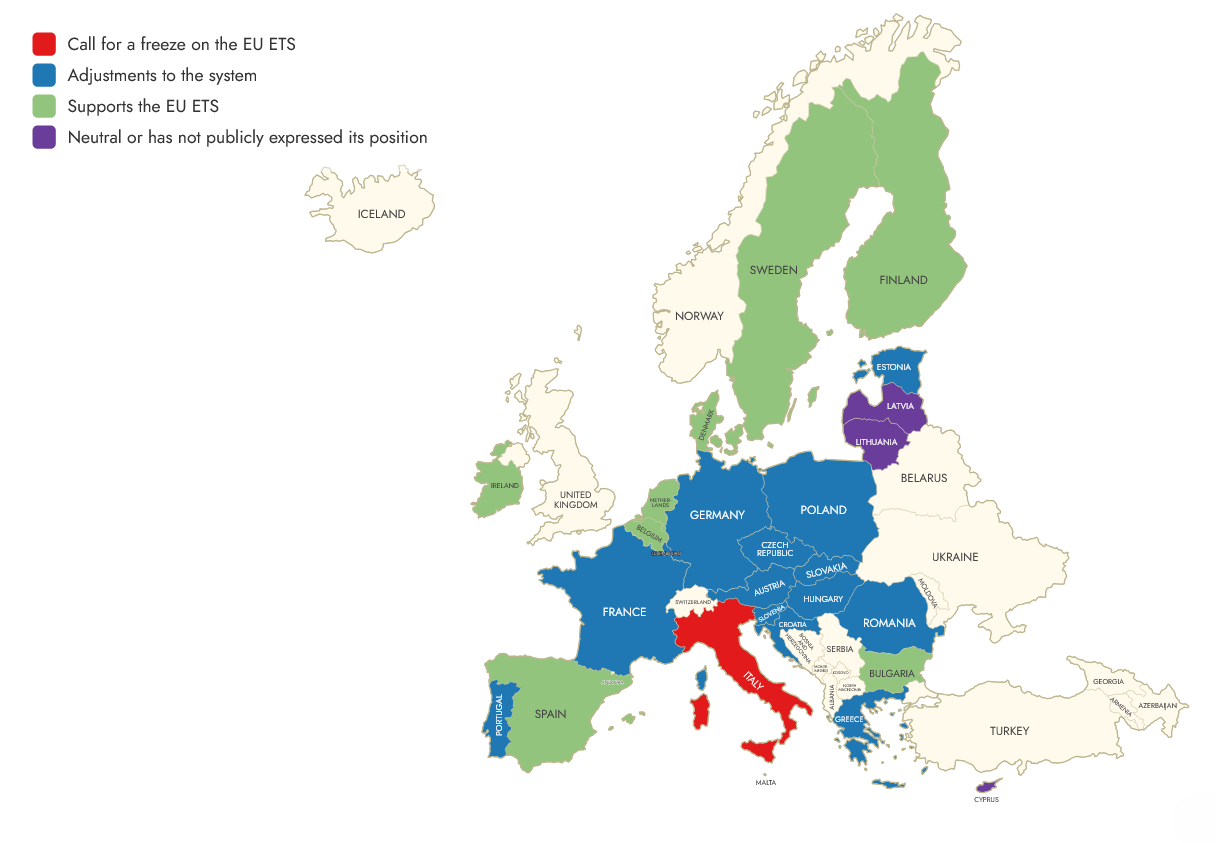
It is worth noting, however, that there have been instances where countries have changed their rhetoric over time. For example, Spain signed the “Friends of Industry” letter demanding competitiveness as a top priority, then later decisively came out in defense of the EU ETS, calling the suspension of the system a major mistake.
How the EU authorities are responding
The European Commission finds itself in a tight spot: on one hand, it must safeguard the EU industry’s competitiveness and protect producers amid high electricity prices, while on the other, it must not abandon its climate ambitions or undermine one of the pillars of the European Green Deal. Despite mounting pressure from member state governments and industry representatives, the key messages from the Commission and top officials have remained consistent – the EU executive is not planning to abandon the system.
-
At the aforementioned summit in Antwerp, President of the European Commission Ursula von der Leyen assumed a position diametrically opposed to that of Friedrich Merz and defended the EU ETS.
-
Commissioner for Climate Action Wopke Hoekstra in March emphasized that “it is extremely important to continue the ETS,” as it is “a key instrument of climate policy,” and even beyond climate policy, it is needed for strategic autonomy thanks to energy independence.
-
European Commission Vice-President for a Clean, Fair and Competitive Transition Teresa Ribera, after rumors in March about a suspension of the EU Emissions Trading System (EU ETS), expressed her stance as directly as possible:
“I do not believe that abolishing the carbon price would send a positive signal to anyone. This could undermine our decarbonization efforts, leave those who acted ahead of time behind, and harm our competitiveness.”
The European Commission is also moving towards “reassuring industry without destroying the market”; in the public sphere, there were plans announced to work on benchmarks and potentially strengthen the ability of the Market Stability Reserve (MSR) to mitigate short-term volatility.
Why the EU is divided: economy, electricity, and “carbon” math
An almost geographical dividing line has formed within the EU:
-
Western and Northern Europe support the ETS as the foundation of climate policy;
-
Central and Eastern Europe seek mitigation due to its impact on the energy sector;
-
Italy is advancing the idea of suspending the system.
But the real reason lies not in the geographical location of countries, but in each state’s energy structure, economic orientation, and starting conditions.
Energy structure
Enterprises in this sector are among the main sources of carbon emissions and, accordingly, incur some of the largest carbon payments. In countries where solid fuels make up a larger share of the energy balance, the ETS has a much stronger impact. Indeed, the share of this type of fuel in available energy is high in Estonia, Poland, and the Czech Republic.
In France, which has invested in nuclear generation for decades, nuclear energy dominates. Therefore, today the country has one of the lowest carbon intensities in Europe. For France, the EU ETS is more of a bonus than a burden: electricity is already relatively “clean”, so the costs for allowances are minimal. A similar situation exists in Sweden, where hydro and nuclear power prevail. There, the ETS virtually does not create additional price pressure.
Gas is significant for Italy and Hungary.
And the reality is entirely different in countries that have historically built their energy sectors on coal and are slowly increasing the share of renewables. For example, Poland has found itself in a trap: its generation is carbon-intensive, so every tonne of CO₂ automatically leads to higher electricity costs. For such economies, the ETS has become a significant financial burden that is difficult to offset quickly. That is why resistance to the system here is not just political, but structural.
Dominant energy sources in European countries
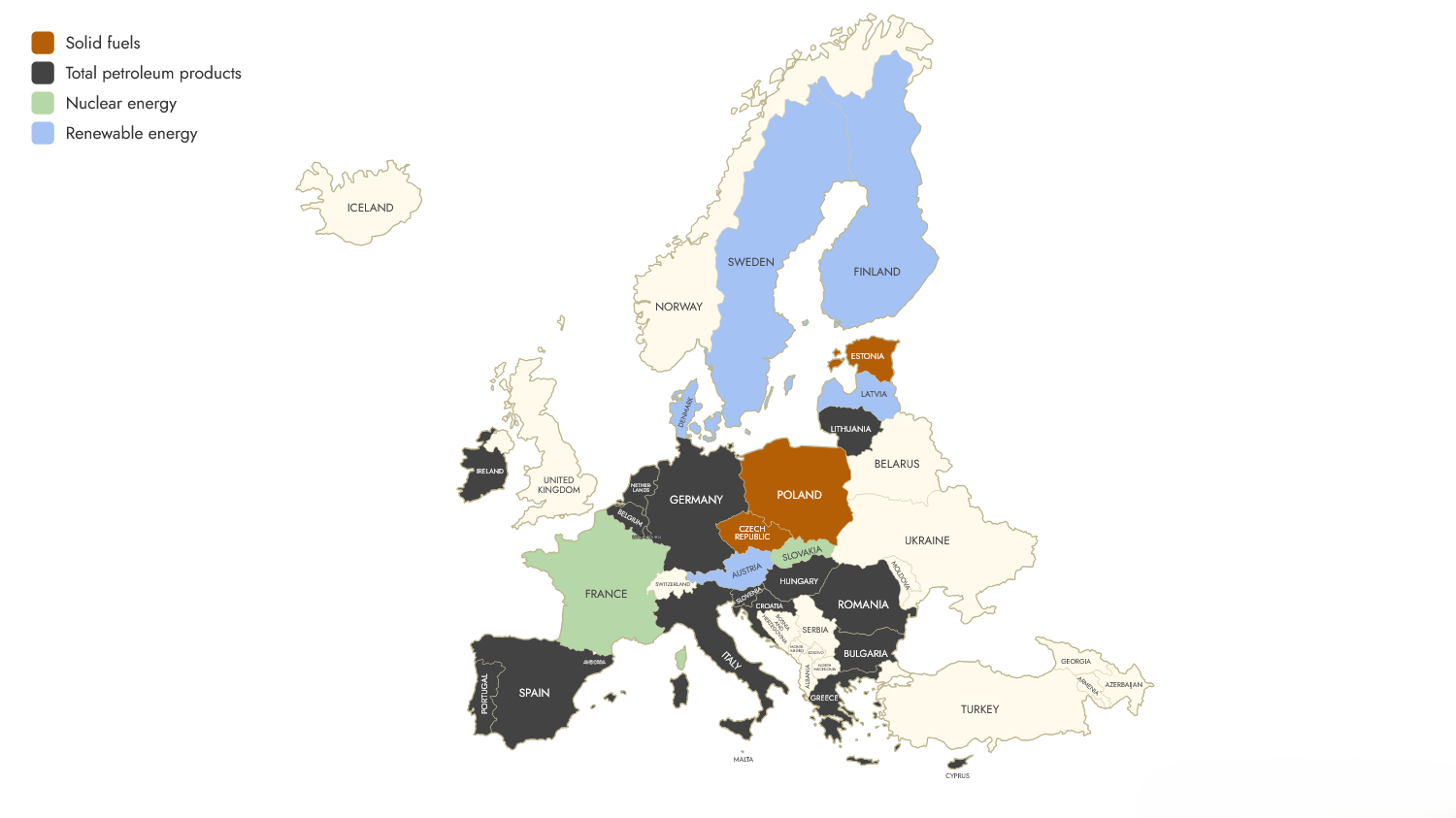
Data source: Eurostat. Latest available data for 2024.
We provide detailed figures in the table below:
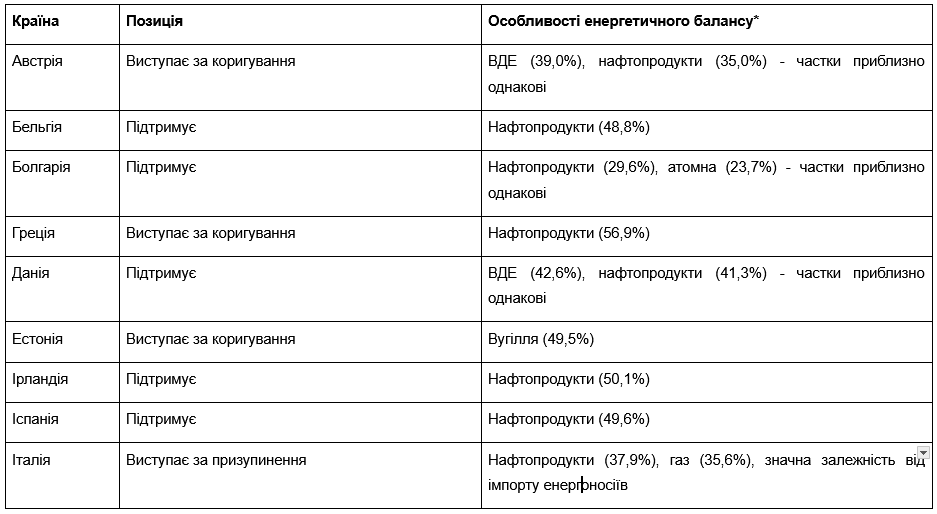
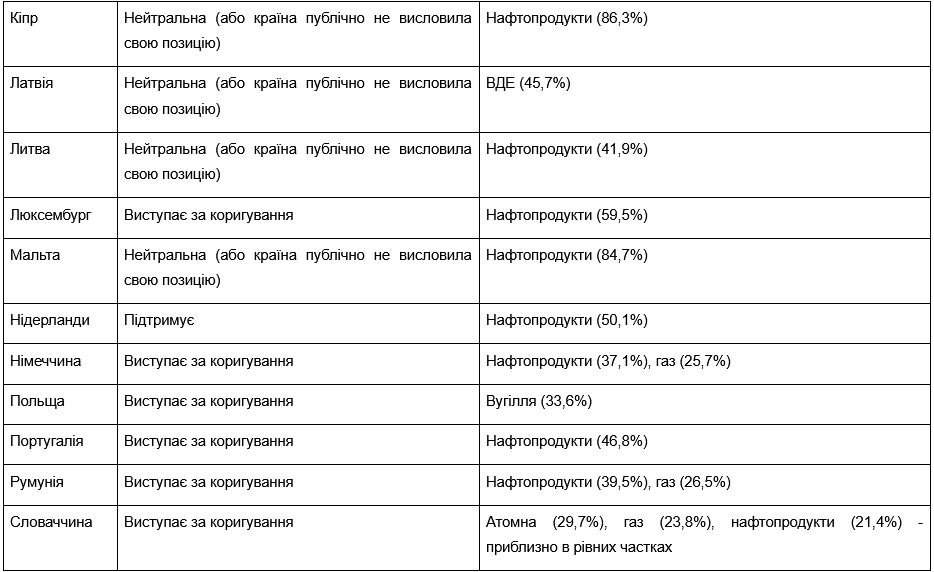
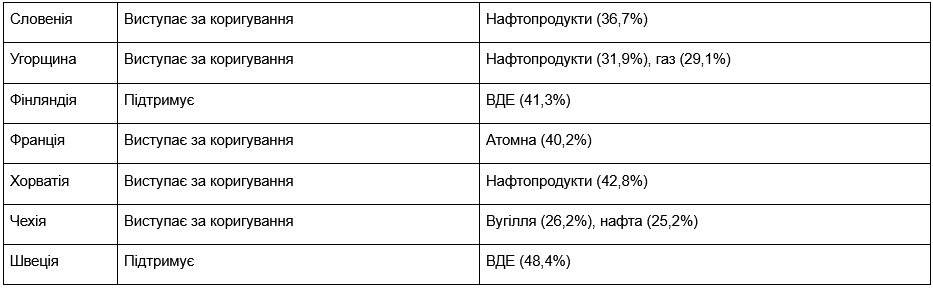
*according to the latest Eurostat data for 2024.
Despite the general move towards phasing out fossil fuels, which gained momentum after the start of Russia’s full-scale war against Ukraine, EU countries' dependence on these energy sources still remains rather high. Accordingly, the impact of prices for imported energy resources is directly reflected in the political statements of European leaders.
Type of economy
Western European countries like Germany or the Netherlands have long been moving toward innovative, high-tech sectors. Their economies are less dependent on energy-intensive production and therefore adapt more easily to carbon pricing. In addition, they have greater resources to invest in decarbonization.
Meanwhile, in many Central and Eastern European countries, energy-intensive industries-metallurgy, cement, and chemical sectors-still play a significant role. These are fields where it is technically difficult and costly to reduce carbon emissions.
As a result, the EU ETS works asymmetrically: for some, it is a manageable transformation tool, for others, it is a factor in losing competitiveness.
Energy dependence
A significant number of European countries, due to the lack of sufficient domestic reserves of energy resources, are forced to purchase them abroad. A vivid example is the gas “needle” on which Russia hooked German industry.
Italy is also largely dependent on imported gas, making it vulnerable to price fluctuations. Under such circumstances, any additional burden related to the ETS is seen as an aggravating factor. This explains why the country’s Prime Minister Giorgia Meloni has become the system’s loudest critic.
Uneven playing field
As a result, a rather tough logic emerges, which underpins the division. The EU ETS effectively entrenches inequality: countries that previously invested in low-carbon energy now enjoy a competitive advantage. Those who lagged behind for various reasons are forced to pay-and to pay now.
However, this difference is not just about “who was better prepared.” It is also about starting conditions that countries did not choose. States that have historically had access to their own energy sources-hydro or nuclear generation-or have been less dependent on gas and oil imports, are now advancing strict climate regulations because they can afford to do so. For them, the EU ETS is a tool to strengthen an existing advantage rather than a risk factor.
In contrast, countries with carbon-intensive industries or a high dependence on energy imports find themselves in a much worse position: for them, the system acts as a financial burden that is difficult to offset quickly.
This inequality is further exacerbated by the economic divide. Wealthy EU countries such as Germany or the Netherlands have the resources to invest in decarbonization, subsidize businesses, and cushion them against high carbon and energy prices. Less affluent economies do not have such resilience-they are forced either to lose competitiveness or to openly oppose the current rules of the game.
It is precisely this asymmetry that creates tension. The debate is not so much about climate policy as it is about the redistribution of economic gains and losses both within the EU and on external markets. Until this imbalance is addressed, discussions around the EU ETS are unlikely to become any less contentious.
Increasing political turbulence and instability in the global energy market-driven by the unpredictable decisions of Donald Trump and the war in the Middle East-also do not contribute to reaching a consensus. As a result, European leaders will have to seek a common carbon denominator under very challenging circumstances.