In a previous article, EcoPolitic examined a number of issues with the environmental impact assessment (EIA) procedure in Ukraine, which have turned it into a tool for pressuring businesses and hindering investment. At the same time, the procedure still fails to fulfill its primary objective: preventing new projects from having a negative impact on the environment.
We asked experts what solution they see to the current situation. In their opinion, should we listen to those calling for the elimination of the EIA?
The need is undeniable
In their responses, the experts were unanimous: this procedure must remain, but it requires significant revision.
“I fundamentally do not support the approach where this issue is proposed to be solved by simplifying or abolishing the EIA. A weak tool should not be removed, it should be fixed,” asserted Lyudmyla Tsyhanok, President of the Professional Association of Environmentalists (PAEW).
Andriy Glushchenko, an analyst at GMK Center, also agreed in a comment to EcoPolitics that an environmental impact assessment is a necessary procedure for maintaining a balance between economic activity and nature conservation.
Viktoria Karpets, Manager of the Industrial Ecology and Sustainable Development Committee at the European Business Association (EBA), noted that EIA reform is part of the European integration process.
“But can we really call it successful, given that it has not yet been completed?” she asks.
The expert emphasized that the Association supports the path toward European integration, particularly regarding environmental protection, but stresses the need to reduce the burden on businesses and to pursue deregulation.
Members of the Ukrainian Environmental Group (UEG) consider the EIA a good European mechanism for preventing harm to nature, but caution that it is not a panacea. Activists note that in most cases, the procedure is conducted only after a decision regarding a particular activity has already been made by government or local authorities.
“As a result, political pressure is exerted on officials who issue EIA conclusions, since budget funds have already been allocated or businesses have invested their money in land or urban planning documentation. And management demands a ‘green light’ to implement these projects,” the UEG explains.
How to turn the EIA into an effective tool: expert proposals
- Minimize the influence of officials on decisions regarding the issuance of EIA conclusions and shift from a formal to a practical approach.

To achieve this, experts recommend adopting clear criteria for environmental inadmissibility and a definitive list of critical violations that would make a project ineligible for approval.
“Fixing the EIA means restoring the procedure to its basic function. Clear entry criteria. Predictable decisions. Proportional requirements based on impact level. And most importantly – focusing on real environmental results, not simply completing the procedure,” explains Lyudmyla Tsyhanok.
Фахівці наполягають, що необхідно відмовитися від чинної бюрократичної практики, коли підставою для відмови у наданні висновків з ОВД стають другорядні, формальні або технічні недоліки.
“It should be noted that the Ministry of Economy regularly holds public meetings with business representatives to address problematic issues that arise for business entities during the EIA procedure. At the same time, business representatives believe that the approach to reviewing conclusions should be changed from a formal to a business-oriented one, given the importance of accelerating the implementation of investment projects and supporting business entities,” said Viktoriya Karpets.
- Bring the scope of the Law in line with Directive 2011/92/EU.
Experts call for narrowing the Ukrainian list of types of activities subject to the EIA to match the European list and for removing from Ukrainian regulation those positions that do not follow from the Directive.
- Eliminate the mechanism for refusal to issue an EIA conclusion.
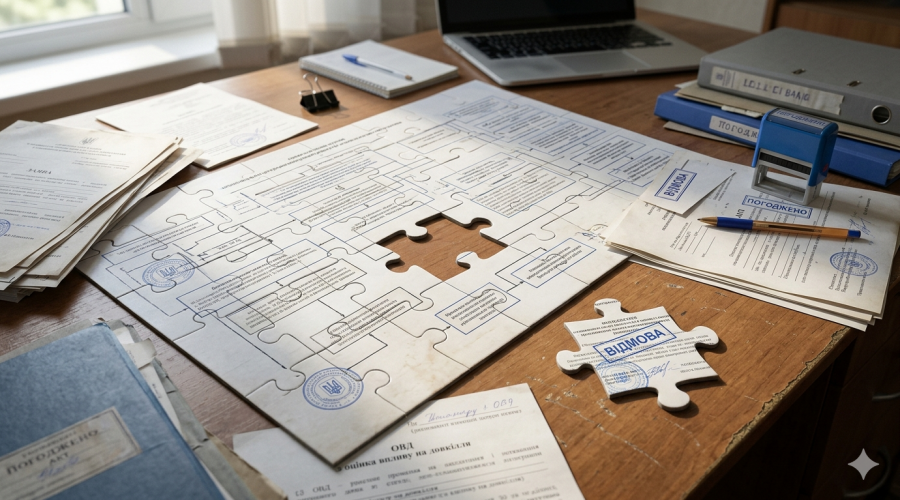
“Ukraine has a separate mechanism for refusal to issue an EIA conclusion, which in itself is a source of corruption risk. According to the logic of the Directive, the result of the procedure should be an environmental conclusion, which is further taken into account when making a permitting decision. Instead, Ukrainian regulation, through Article 9¹, allows for refusal to issue the conclusion itself on formal or subjective grounds. This turns the EIA from an assessment procedure into a separate permitting and blocking barrier,” explains Vladyslav Antypov, CEO of LLC 'Center for Ecology and New Technologies Development' (CERNT).
That is why the expert proposes either excluding Article 9¹ from the Law “On Environmental Impact Assessment” or radically limiting its application. He believes the result of the procedure should not be a “refusal of conclusion,” but a properly prepared summary of the environmental assessment.
If lawmakers decide to retain the mechanism for refusal to issue an EIA conclusion, experts insist there must be an exhaustive list of clear grounds for such refusal to prevent arbitrary interpretation.

- Harmonise the regulatory acts underpinning the EIA with other environmental and related legislation. This will help avoid legal conflicts that are currently used as grounds for refusing to issue conclusions.
- Allow companies to correct report deficiencies during the review process without restarting the procedure.
To that end, experts recommend amending Article 9 of the Law to allow a business entity to:
- revise the report,
- address comments,
- eliminate deficiencies and minor technical errors,
- continue the procedure not from the beginning but at least from the report publication stage,
- avoid repeating the notification stage if the problem occurred at a later stage.
To avoid unnecessary repetition of the EIA process in the case of purely formal project adjustments, it is also advisable to allow amendments to already issued EIA conclusions, according to Vladyslav Antypov.
- Legally enshrine the following rule: if the authorized body has accepted the notification of the planned activity and published it, its formal deficiencies may not subsequently serve as grounds for a final refusal.
All claims regarding the notification must be received by the company immediately after its submission and before it is taken into consideration.
- Improve the handling of comments from the public and government authorities. They should be submitted at a stage when the company is still able to respond to them and make corrections to avoid rejection.
UPG also proposes applying European practices – to complete the EIA procedure before holding auctions and issuing special permits for the use of resources, including subsoil.
- Establish a permanent working group to review refusals to issue EIA opinions.
“It is necessary for such a group to review specific refusals twice a month in an open format,” says Vladyslav Antypov.
The expert notes that the following points should be considered at such meetings:
- typical grounds for refusals;
- ambiguous wording;
- the real reasons for negative decisions;
- recurring practice errors.
“This will enable a shift from an abstract 'do not make mistakes' approach to a substantive explanation of what is considered a violation and why,” explains the CEO of CERN.
The situation surrounding the EIA procedure is turning into a systemic crisis, one that is now being openly discussed by the media, the business community, and experts. Against this backdrop, the Ministry of Economy’s initiative to hold yet another discussion instead of implementing real changes looks more like a game of “openness and transparency” than an attempt to address the root of the problem.
The demand for changes has long been established and is quite specific: to eliminate corruption risks and bureaucratic formalities and bring legislation into line with European standards. And most importantly—this is not about dismantling the EIA, but about restoring its true role: as a tool for environmental impact assessment, not for blocking activities.
Further delays in implementing these changes will only deepen mistrust in the procedure, hinder investment, and distance Ukraine from fulfilling its European integration commitments. Therefore, the key question today is not whether EIA is needed, but whether officials are ready to move from endless discussions to the real, systemic changes proposed by stakeholders.