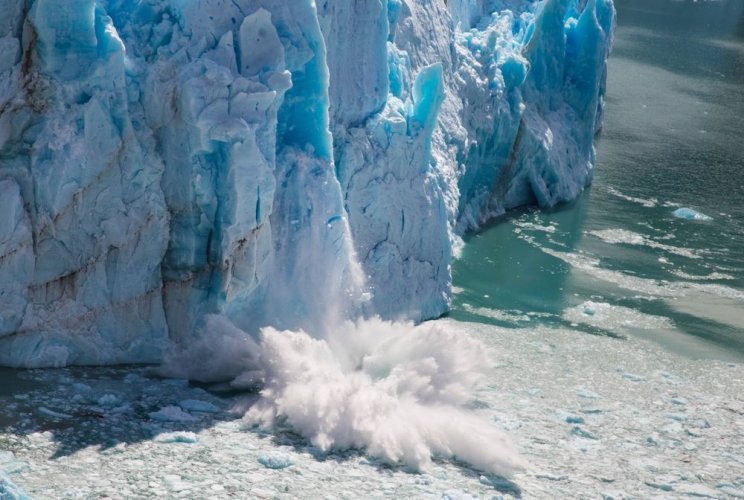
Global warming is rapidly melting Antarctic snow and glaciers. Despite the remoteness of this continent, the consequences of its warming will affect the entire planet. How devastating they will be depends on how quickly humans reduce greenhouse gas emissions.
Research by scientists at Newcastle University, reported by Euronews, models various scenarios for Antarctica — the worst and the best-case scenario.
"Although Antarctica is far away, changes here will affect the rest of the world through changes in sea level, ocean and atmospheric connections, and circulation changes. Changes in Antarctica do not stay in Antarctica," said Professor Bethan Davies of Newcastle University, lead author of the study.
In their modeling, the scientists used three scenarios for temperature increases by 2100, depending on emission levels:
- an increase of 1.8 °C above pre-industrial levels with low future emissions;
- an increase of 3.6 °C with medium-high emissions;
- an increase of 4.4 °C with very high emissions.
The researchers took into account eight environmental aspects of the continent that depend on temperature increases. Among them are the marine and terrestrial ecosystems, ice shelves, ice, the Southern Ocean, the atmosphere, and extreme weather events.
Worst-case scenario projections
With high greenhouse gas emissions, the ocean will warm more intensely and its waters will erode glaciers faster. This will cause sea levels to rise, which in turn will lead to coastal erosion and flooding around the world. The report emphasizes that every centimeter of sea level rise poses an additional flood risk to 6 million people.
The worst-case scenario shows that sea ice volumes will decrease by 20%. This will affect species that depend on it, such as krill. Krill, in turn, is a food source for penguins and whales.
Scientists suggest that many species will move closer to the pole to avoid excessive heat. In theory, warm-blooded predators will cope with warming, but their prey will not. This could lead to starvation.
Research in Antarctica itself will also be called into question. Rising sea levels and extreme weather conditions will damage the infrastructure and equipment needed for weather forecasting.
The best-case scenario is still not ideal
Even if the world manages to reduce emissions, extreme weather events and glacier melt will still be unavoidable. However, the pace will be much slower, with sea levels rising by only a few millimeters. It would also be possible to preserve the ice shelves.
“It would be very difficult to restore glaciers and bring back the wildlife that makes Antarctica special. If we do not make changes now, our great-grandchildren will have to live with the consequences,” the scientist pointed out.
EcoPolitics previously reported on the impact of warming on Antarctic penguins. These birds have changed their breeding period, and now the food supply is insufficient for everyone.
Scientists are implementing a grand project to protect the Doomsday Glacier from melting. To achieve this, they plan to separate it from warm waters with a 150-meter wall.