Despite hundreds of appeals from experts, the public, and parliamentarians, the Ministry of Economy, Environment, and Agriculture issued an environmental impact assessment (EIA) for the construction of a wind farm on the Runa plateau in Zakarpattia. Environmental activists see this as an extremely outrageous precedent, where a developer can ignore the law and then still receive carte blanche from the authorities to destroy unique ecosystems.
EcoPolitic reports on the position of the Ministry of Economy, the reaction of the environmental community, and the possible impact of this EIA on the future of the Carpathians.
The Ministry's justification
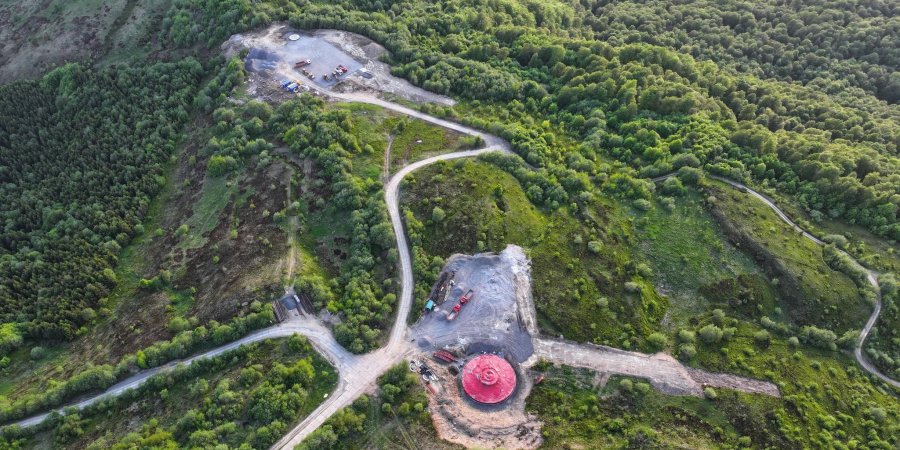
The Ministry of Economy announced the issuance of EIA conclusion No. 8343 on Friday, February 13. It concerns the construction of a wind farm on the territory of the Tur'ye-Remetivska community. There are plans to build 30 wind turbines with a total capacity of 156 MW.
The Ministry of Economy's arguments in favor of building wind turbines on the mountain pasture:
- the site of the WPP and its infrastructure is not located within a protected area and does not overlap with primeval forests or wetlands;
- the protected zones of nature conservation sites will not be affected.
- Runa is not a primary wilderness area;
- the project does not provide for deforestation;
- the project implementation complies with EIA regulations.
Additionally, the Ministry assures that the case of Runa will not set a precedent.
"The EIA decision for Runa mountain meadow does not mean automatic analogous EIA decisions for other locations–each case is examined individually. Other EIAs for wind turbines are underway throughout the country, in various regions, and each case is reviewed separately and within the law," the statement says.
The Ministry also addressed the issues of economic viability and energy resilience. Among the factors influencing the decision, it cites the devastating Russian strikes and the need for the development of the renewable energy sector in Ukraine.
It should be separately noted that the Ministry effectively relinquished responsibility for the fact that the developer constructed the turbine foundations by exploiting gaps in the current regulatory policy.
"The investor began building the foundations for the future wind turbines even while permit documentation was being contested in court, prior to obtaining the EIA conclusion. However, the current Law of Ukraine on Environmental Impact Assessment does not contain an explicit prohibition of this approach, so it's not possible to deem the activity inadmissible solely on this basis," the Ministry writes.
Even recognizing the developer's arbitrary actions, the institution granted permission for further work.
Justified distrust of society
The environmental community is outraged not only by the decision itself but also by attempts to “calm” the public – as if the conclusion concerns only the Runa meadow. The Ukrainian Nature Conservation Group (UNCG) provides several facts confirming that preparations for the construction of wind power plants are already underway on other meadows, while, at the same time, destructive legislative amendments regarding forest protection are being drafted.
- According to UNCG, on the Svidovets, Hostra, and Krasna meadows, land plots have already been delineated and measurement boundaries set.
- The Ministry of Economy is not allowing the State Environmental Inspectorate to conduct inspections on the meadows. In four months, SEI received only one approval. For example, in Negrebivka, residents have been waiting for the Ministry-promised inspection for two months now.
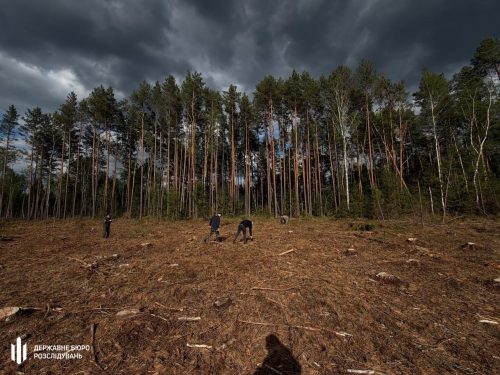
- Primeval forests are being logged right now. According to conservationists, the destruction of ancient beech trees is underway to lay power lines to the Runa and Hostra meadows.
- Widespread clear-cutting in the Carpathians could be legalized again. The State Forest Agency has drafted a resolution that would remove the last safeguards against the destruction of rare flora and fauna from the Red Book.
“In effect, with its decision, the ministry has allowed businesses to destroy nature first – build roads and foundations – and only then, after the fact, obtain the necessary permits,” the community summarizes.
Support from experts in the field of renewable energy sources
From professional communities working on the development of renewable energy in Ukraine, the Ministry of Economy’s decision received support.
“Under current conditions, when the country’s energy infrastructure is undergoing systematic attacks, timely and legal decisions regarding new generating capacities are not only a matter of investment attractiveness but also of national security,” writes the Ukrainian Wind Energy Association (UWEA).
At the same time, the community emphasizes the importance of adhering to principles of transparency and the rule of law. UWEA underscores that maintaining a balance between the development of renewable energy and compliance with environmental standards is crucial for building investor and international partner trust.
Public response
Both the post by the Ministry and the post by Minister Oleksii Sobolev received hundreds of negative comments from eco-activists and the public.
A separate issue is the evident blindness of the Ministry of Economy, which chose to ignore a number of violations in this case.
“The foundation doesn’t count, logging of forests for roads doesn’t count, designating this area as an Emerald Network site doesn’t count. What else is there to say,” writes Mariia Hnatyshyn.
“We support renewable energy, but not at the expense of the Carpathians. A road has already been cut through the primeval forest – there is a criminal case and the FSC certificate has been suspended. The Supreme Court ruling regarding the Emerald Network has been ignored. This is not a green transition – this is Black Friday for the green Carpathians,” comments the account of the Ukrainian Climate Network.
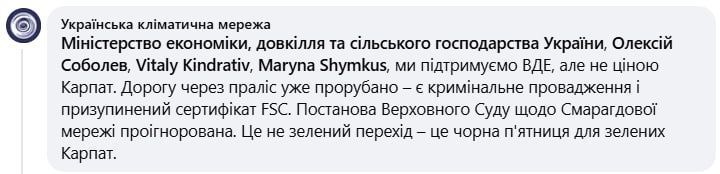
Screenshot of comments on the Ministry of Economy's Facebook post

Screenshot of comments on the Ministry of Economy's Facebook post
The reality seen by Ukrainians contrasts sharply with the perceptions of the world and legality conveyed by the Ministry.
“In all Environmental Impact Assessments (EIA), the Ministry of Economy ensures the observance of 'red lines' regarding environmental protection. The development of renewable energy is only possible with ecological safeguards and compliance with legal requirements,” wrote Minister Sobolev in his Facebook post.
However, the development on Polonyna Runa involves a series of legal violations systematically ignored by government institutions. Here are just a few examples – the State Environmental Inspection of Zakarpattia did not find any violations, and previously refused to provide the inspection report confirming the legality of the construction. Zakarpattia Regional Administrative Court also refused to protect Polonyna Runa from illegal development.
EcoPolitic regularly covers this situation. Only recently did we report that 17 Members of Parliament appealed to Minister Oleksiy Sobolev with a request to grant protected status to the high-mountain territories of the Carpathians. They stated that those areas suffered irreparable damage even before the EIA conclusion. As we can see, the Ministry of Economy disregards even the opinion of lawmakers.