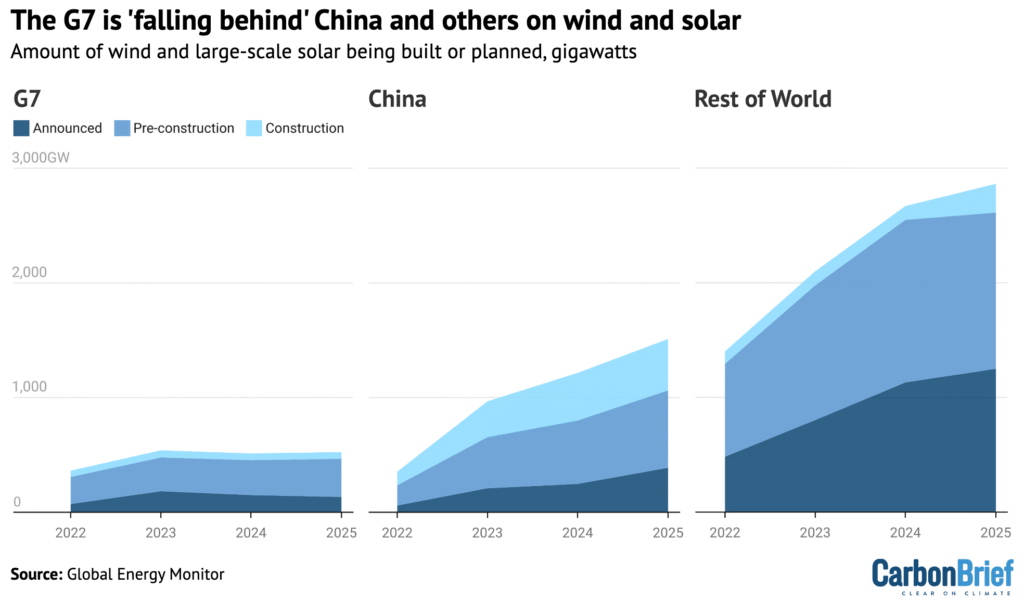
A green energy gap is growing between the G7 countries and the rest of the less affluent world. The combined capacity of new G7 projects in wind and solar energy is three times less than that of China alone. Other developing countries are also overtaking the economic leaders.
This is according to CarbonBrief, citing data from Global Energy Monitor (GEM).
A colossal energy gap
The volume of new solar and wind energy projects worldwide has grown by 11% since 2024, reaching 500 GW. The total capacity of planned projects and those under construction in 2025 reached a record 4,900 GW.
China is building more than 30% of new renewable energy capacity. Its 1,500 GW of new generation is almost three times higher than that of all G7 countries combined. The United States, the United Kingdom, Germany, France, Italy, Japan, and Canada are adding only 520 GW of wind and solar generation.
Among the leaders in clean energy growth are Brazil (401 GW), Australia (368 GW), India (234 GW), the United States (226 GW), Spain (165 GW), and the Philippines (146 GW).
“The center of development for new clean energy has clearly shifted towards developing countries. In 2025, despite their wealth, G7 countries lagged significantly behind China and other nations in terms of annual capacity growth,” emphasized Diren Kojakushak, a GEM analyst.
Source: carbonbrief.org
Global trends in wind and solar power development
In the structure of new generation during 2025, wind power dominated at 2,700 GW, while the remaining 2,200 GW was from large solar power plants.
However, the global pace of clean generation capacity additions has slowed noticeably. According to GEM, in 2024 these rates were 24% higher than they were in the previous year, 2023. The decline has affected wind power projects most of all.
Experts attribute the drop to political obstacles and unsuccessful auctions. For example, in 2025, no bids were submitted for offshore energy auctions in the Netherlands and Germany. In Denmark, bidding was canceled entirely, as there were no participants in the previous year, 2024.
By as early as 2030, renewables and nuclear energy will cover half of the world’s energy demand. EcoPolicy reported that already now clean generation has surpassed coal.
A number of European countries have agreed to build a grand offshore wind farm of 100 GW. Wind turbines along the North Sea coast will directly supply energy to these countries via an interconnector network.