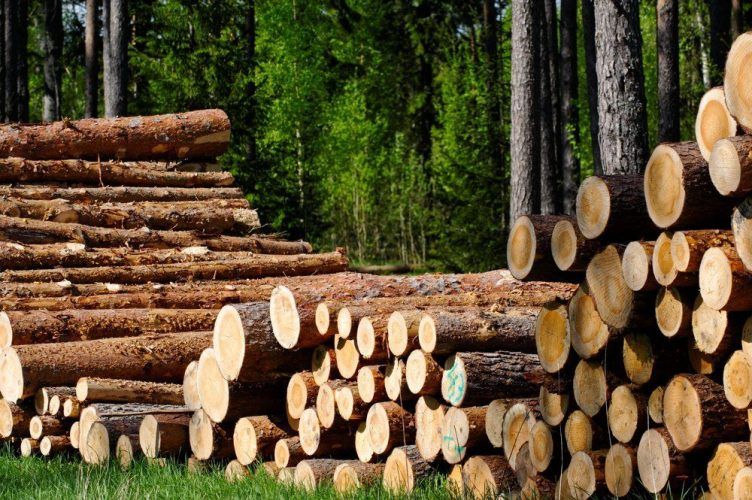
Illegal logging is one of the most common crimes against the environment. Almost every second criminal proceeding related to ecology is connected with the destruction of forest plantations. However, according to environmental experts, Article 246 of the Criminal Code of Ukraine contains a number of gaps and loopholes, making it difficult to fully bring those responsible to justice.
Specialists from the NGO Forest Initiatives and Society analyzed the provisions of the Criminal Code and pointed out loopholes that should be removed in order for the law to work.
"This complicates the classification of illegal logging and proving the guilt of violators, causes conflicts with special legislation, and creates grounds for different interpretations in judicial practice. Such shortcomings lead to low effectiveness in the application of criminal law provisions and reduce the preventive effect of punishment," the community writes.
Outdated penalties
The amount of fines for criminal tree felling is no longer a significant deterrent for violators. In 2019, the average salary was about UAH 9,200, and in 2025, it will be almost UAH 26,500. At the same time, however, the amount of penalties has not changed and ranges from 17,000 to 25,000 hryvnia. In today's economic reality, it carries less weight and is less of a deterrent to criminals.
At the same time, inflation makes illegal logging more profitable in economic terms. The LIiS community is concerned that the high profits from the sale of illegal timber easily outweigh the modest fines. This may motivate offenders to take risks. And even if they are punished for their crimes, the punishment will be incomparably milder than the profits they have made.
“It is advisable to consider raising the minimum penalty to at least UAH 51,000 (three thousand tax-free minimum incomes of citizens) and the maximum – to UAH 102,000 (six thousand tax-free minimum incomes of citizens), which would better correspond to current economic conditions and the level of public danger posed by this crime,” suggest the NGO 'Forest Initiatives and Society'.
Uncertainty of concepts
The provisions of the Criminal Code are guilty of excessive terminology that does not correspond to other sectoral laws.
Part 1 of Article 246 of the Criminal Code begins with the phrase "Illegal felling of trees or shrubs in forests, protective and other forest plantations...". With this wording, the Code seems to separate the concepts of "forest" and "protective forest plantations," adding the abstract "and other." While the Forest Code clearly defines the concepts of "forest" and "protective forests," the Criminal Code invents a new gradation without providing a legal definition for it.
At the same time, the Criminal Code separates nature reserves from other nature conservation areas and introduces the term "specially protected forests," which simply does not exist in legislation. This creates room for free interpretation of the norm.
Narrowing the list of criminal acts
Article 246 of the Criminal Code only refers to the felling of trees. This term usually means separating the trunk from the root system using appropriate tools. Sometimes this includes uprooting. However, the provisions of the Code generally ignore such a method of destroying trees as damaging them to the extent that they cease to grow.
It is noteworthy that a broader classification is provided by the "Rates for calculating the amount of damage caused to forests by enterprises, institutions, organizations, and citizens through illegal felling and damage to trees and shrubs to the point of stopping their growth," approved by Cabinet of Ministers Resolution No. 665 of July 23, 2008.
“It is advisable to amend Article 246 of the Criminal Code of Ukraine to make it possible to consider intentional damage to trees and shrubs to the extent that their growth ceases as an independent (alternative) form of socially dangerous act, alongside actual forest felling. This should also apply to such actions as digging up trees and shrubs, uprooting, including by means of explosives, and burning of roots,” the organisation noted.
Criminal offense for two trees
The threshold for "significant damage" for a criminal offense starts at just over UAH 30,000 according to data for 2025.
The financial consequences of illegal logging are calculated in accordance with Appendix 1 of the above-mentioned government resolution. The amount of damage depends on the diameter of the destroyed tree and the height of the stump. For example, if the offender cut down a tree with a diameter of 34-38 cm at a height of 26-30 cm from the ground, the damage amounts to UAH 11,677.02, and with a diameter of 46-50 cm, it amounts to UAH 19,676.86. The motives for cutting and the value of the tree species are not taken into account here.
Therefore, taking into account the current fines for illegal logging, a person can be held liable for cutting down just two trees with a diameter of 47 and 35 cm, or three trees with a trunk diameter of 35 cm.
Activists consider this irrational, as it leads to excessive criminalization of minor logging. In their opinion, the amount of significant damage for logging should be increased, for example, to 25 non-taxable minimums, and for serious damage – to 70 and above.
The environmental community is trying to block the adoption by the government of a resolution that would abolish EIA during clear sanitary fellings. EcoPolitic has reported that the National Agency on Corruption Prevention (NACP) recognized that this document poses corruption risks.