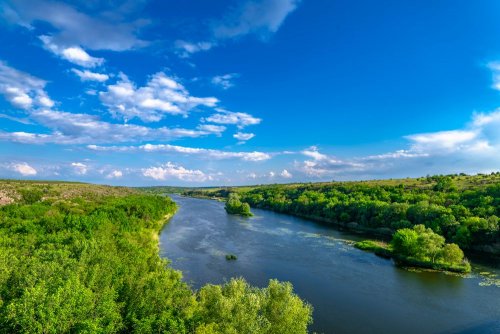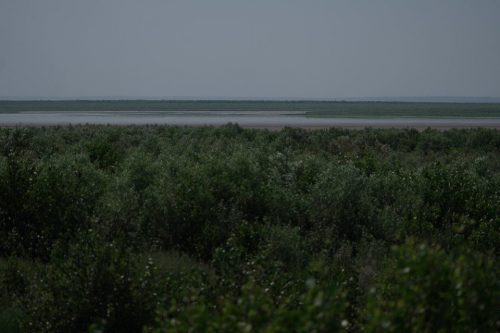
A large part of the Kakhovka Reservoir has been filled with water again, leading to the flooding of many areas. Nevertheless, this situation will have a positive impact on local ecosystems.
This was stated by ecologist Vadym Manyuk, according to Suspilne.
"All the ecosystems that are now being reproduced on the site of the reservoir, on the site where the Velykyi Luh used to be, are water-related ecosystems. If these are lake systems, it goes without saying that there should be enough water in the lake for fish spawning and for the formation of some zones of aquatic vegetation," explains Vadym Maniuk.
According to him, terrestrial ecosystems, such as floodplain forests, need to be flooded with water. The land should be saturated with moisture as much as possible to ensure better survival and development of young willow and poplar seedlings, to enable them to adapt and grow better.
The ecologist emphasizes that each of these systems needs an additional volume of water in the spring, which will be gradually used during the season.
"If there was not enough water now, then by the end of the summer there would be a drying out, and then these young forests could simply dry out. This is very dangerous. If there is no new arrival of water in such volumes as now, then this will be enough to in a month, maybe even less, for all the water to go down into the sea and reach the level it was in the fall," says the ecologist.
He assumes that for the time being there will be water supply, because there is still a lot of resource in reservoirs in the upper reaches of the Dnipro. Until the beginning of summer, the water level will still be relatively higher. And already in the summer, all the water will go away, if the enrichment of the reservoir from the upper reaches of the Dnipro is not continued.
"It is good when the water pulsates in the floodplains of the Dnieper: that is, it comes, fills the floodplains, and then leaves the floodplains. Level fluctuations are necessary for such systems: that is, first the flow from the Dnieper to the floodplains, and then from the floodplains to the Dnipro. This constant movement enlivens the system : it is better saturated with oxygen. The ecosystem is more stable, lives a fuller life, and that's why it should be," Vadim Manyuk notes.
Earlier EcoPolitic analyzed what is currently happening at the shallow-watered Kakhovsky Reservoir and what its future might be.
On the territory of the shallowed Kakhovsky Reservoir, recorded water return, which may be a manifestation of water logging in the lower reaches of the Dnipro River.