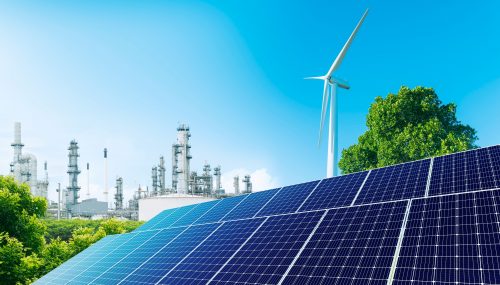
Denmark has accelerated the construction of two energy islands off the coast to help wean the country off Russian fossil fuels in response to the war in Ukraine.
Minister of Climate, Energy and Utilities Dan Jorgensen spoke about green energy plans, reports Eurones
"Denmark and Europe must get rid of Russian fossil fuels as soon as possible," he said.
To this end, Denmark is significantly accelerating its green transition by deploying renewable energy sources both on land and at sea. Jorgensen said that only the North Sea has the potential for wind energy to cover the energy needs of millions of European homes.
"This great potential of offshore wind needs to be harnessed, so the Danish government is starting preparations for additional energy islands along with those already planned," he said.
Hundreds of wind turbines will be connected to the artificial islands, which will allow Denmark to produce much more energy than other offshore wind projects.
One of the islands will be based in the North Sea and produce 3 GW of energy. The second will be built on the island of Bornholm in the Baltic Sea, it will generate 2 GW of offshore wind. The islands will serve as hubs for connecting wind turbines to electricity grids in the region surrounding the two seas. Together, they will be able to provide electricity to at least 5 million European homes with the potential to increase to 10 million.
The islands are small will work by 2030, but Denmark seeks to reduce its dependence on fossil fuels in the wake of the war in Ukraine. Currently, 48.6% of the country's total energy comes from wind energy.
According to the International Energy Agency, almost 16% of energy production in Denmark depends on Russia, and in 2016 this figure was 34%. At present, the country hopes to achieve full independence from this source.
Jorgensen also hopes that the meeting with energy representatives from Germany, Belgium, the Netherlands and the European Commission in Esbjerg will facilitate the energy transition. They will present concrete plans on how offshore winds from the North Sea can help the EU achieve climate neutrality and energy independence.
"The EU must become independent of Russian fossil fuels as soon as possible, and the best way forward is for European countries to work together to expand and accelerate renewable energy production in the North Sea," he said.
We will remind, Denmark plans to create "energy" island in the North the sea.
As EcoPoliticа reported earlier, Denmark will increase generation solar and wind energy fourfold until 2030.