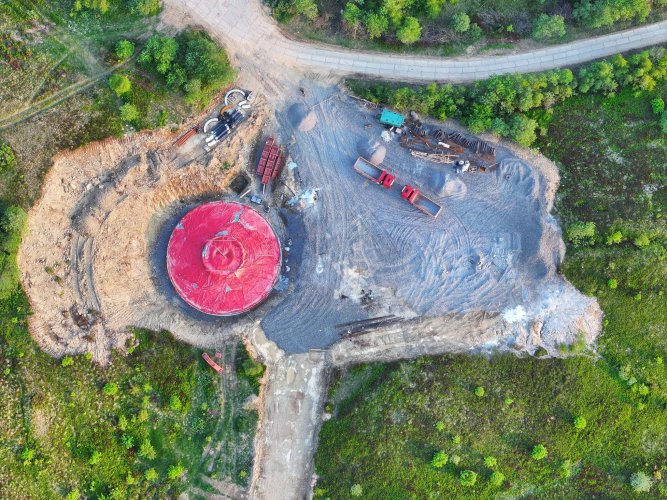
At the end of January, the Ministry of Economy resumed the EIA procedure for the construction of a wind farm by the company "Wind Park Turiansky" on the Runa mountain pasture in Transcarpathia. At the same time, the environmental community called on all concerned citizens to send appeals to Minister Oleksiy Sobolev to reject the construction approval. However, activists have recently begun to receive formal replies.
This was reported by the Ukrainian Nature Conservation Group (UNCG).
The content of the reply eloquently demonstrates the indifference of the Ministry of Economy, Environment, and Agriculture. According to the UNCG, they simply replied that the deadline for public discussion on the development of the mountain pasture had passed. However, experts emphasize that even before this, scientists and public organizations had submitted numerous reasoned comments on the feasibility of the wind farm construction.
A separate issue is the preservation of the territory. The response reveals a desire to shift responsibility to the Transcarpathian Regional State Administration and local authorities. Allegedly, the creation of nature reserves is purely within their competence. However, the UNCG insists that this is an underestimation of the institution's powers.
"As for the nature reserves – the Ministry of Economy has the legal authority to create them without the involvement of local authorities, particularly on lands transferred to communal ownership during the 2021 land reform. The law expressly allows this," the environmental organization writes.
What should be done next?
The Ministry is expected to make the final decision regarding the construction of wind turbines in the Carpathians on February 13. Until then, environmental activists urge people to send appeals to the Ministry of Economy to demonstrate public opposition to the destruction of this unique natural area. They have prepared a detailed guide on how to reach the institution.
What will happen to the high-mountain areas?
If Oleksii Sobolev supports the positive conclusion of the EIA, it will give the “green light” to the destruction not just of Runa alone. As noted by UNCG, other meadows will also be affected-Svydivets, Borzhava, Apetska, Hostra, and Krasna.
The community emphasizes that the situation with Runa highlights systemic violations-both of Ukraine’s international obligations to protect natural complexes and of Ukrainian legislation, which also requires the preservation of unique ecosystems.
"This case is a test of Ukrainian legislation. After all, the situation with Mount Runa clearly shows that it is possible to do whatever one wants, contrary to the law, and then demand its legalization," emphasized UNCG biologist Andrii Tupikov.
The construction of the wind farm on Mount Runa has led to intense confrontation. On one side are businesses and state institutions, while on the other are scientists, eco-activists, and the local community.
EcoPolitics has been consistently covering this story, which risks becoming a negative precedent and a threat to the Ukrainian Carpathians. Back in 2024, activists reported the disruption of public hearings regarding the construction of a wind farm. However, this did not prevent the company from starting to install foundations for the generators.
Particular “attention” should be paid to the inaction of the authorities and state institutions. The Zakarpattia State Environmental Inspectorate failed to detect any violations, and previously refused to provide the report on the legality of the construction. The Zakarpattia Regional Administrative Court also refused to protect the meadow from development.