In 2025, local budgets in the Vinnytsia region received one and a half times more environmental tax revenue than in the previous year.
EcoPolitic decided to investigate whether this increase in resources will benefit the region's environment. This is another article in a series where we analyze regional environmental programs.
The amount of environmental tax in the region
Complete information on the payment of environmental tax by enterprises in Vinnytsia region in 2025 is not yet available. However, we have data for the first three quarters of last year. During this period, polluting enterprises in the region paid UAH 253.3 million in environmental tax.
These funds were transferred to the general and special funds of the consolidated budget and then distributed as follows:
- general fund of the state budget – about UAH 71.4 million;
- special fund of the state budget for CO2 emissions – over UAH 94.6 million;
- special fund of local budgets – about UAH 87.3 million.
In total, based on the results of 2025, local budgets received UAH 119.5 million from the environmental tax. This indicator was 57.7% higher than in 2024.
The management of the regional tax office, of course, thanked businesses for their diligence. However, does their contribution really improve the environmental situation in the region?
Regional center eco-program
Environmental protection programs are financed from a special environmental tax fund. It should be added that local authorities usually supplement this funding with other sources.
Vinnytsia's program for 2021-2025 began with environmental education. An entire section is devoted to organizing scientific and informational events, a congress of ecologists, and school eco-competitions.
However, in the next section, we see the traditional desire to use eco-tax funds to develop sewerage networks. Thus, the section "Protection and rational use of water resources" includes river cleaning and restoration, laboratory research, and water quality monitoring. However, alongside these, we see measures such as the construction, reconstruction, and major repair of sewerage networks, as well as the installation of storm drains.
It is surprising that items that would be more logically classified as housing and communal services development are again included in the environmental program. However, the city council is aware of this, as the implementing agencies are the departments of municipal services, restoration, and development.
Measures that seem out of place
Some measures seem completely out of place in the program. For example, the organization of a sustainable centralized heat supply system with heat recovery. The only thing that vaguely resembles "environmental friendliness" here is the use of treated wastewater.
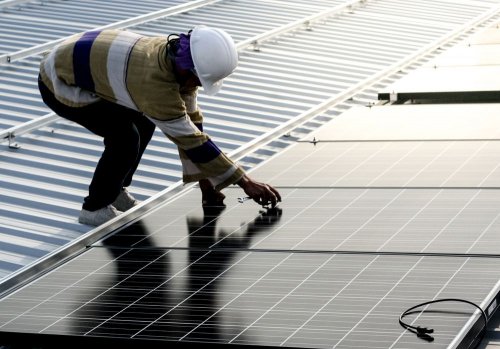
In addition to thermal energy, elements of solar energy have also been added to the environmental protection program. Thus, the section "Waste Management" provides for the construction of a landfill degassing system with the installation of a solar power plant. In general, in this section, the city solves its waste management problems and even develops a corresponding program at the expense of the eco-tax. Everything here is classic – from the construction of waste processing plants to the repair of containers and the installation of litter bins.
According to the Vinnytsia City Council, the renewal of municipal transport is also an environmental measure. Here, the purchase of new vehicles, allegedly due to the reduction of emissions, is also part of the environmental protection program.
What is considered "environmental measures" in smaller settlements?
Let us consider the Program on ecological safety and environmental protection in the city of Koziatyn. It is scheduled for the period from 2021 to 2026. Here we see measures such as “planting floral arrangements”, cleaning and landscaping cemeteries, as well as, of course, a lengthy list of items relating to waste, sewage, and even the construction of wells and water supply networks. While sewage can be “linked” to ecology due to the harm from discharges, when it comes to water supply, this looks even more inappropriate.
The Environmental Program of the Teplytsia Settlement Council of the Haisyn District, for 2025–2027, due to a limited local budget, has far fewer items. Still, among them are the reconstruction of sewerage, improvement of water bodies-whatever that may mean-and measures for greening the settlement.
The hands of the local authorities are untied
Every area of human activity affects the environment in some way, especially if you look hard enough-construction, transport, energy, engineering infrastructure, waste, and even walking dogs in the park. But is this a rational reason to include measures to address issues in these fields in environmental programs? This remains an open question, and each council at the local level answers it at its own discretion.
It should be noted that when planning program activities, local councils rely on an outdated, albeit updated several times, Cabinet of Ministers decree from 1996. It is precisely this decree that allows municipalities to address landscaping and housing and communal services through environmental funding.
So, we see that at the local level there is no clear guidance or fundamental restrictions to ensure that funds from polluting enterprises genuinely work to reduce the consequences of pollution or prevent them.
Earlier, EcoPolitic analyzed how environmental funds were spent in Cherkasy, Zhytomyr, Ivano-Frankivsk Regions and other regions.