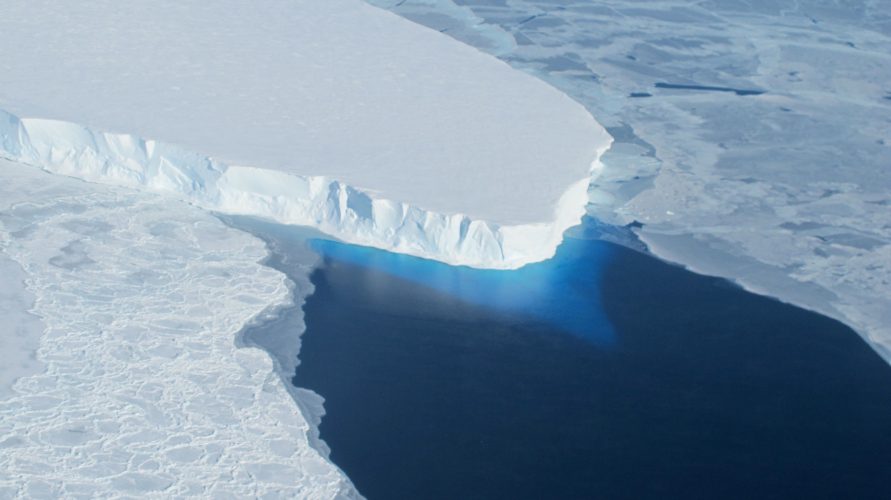
An international scientific mission is working on a project to build a huge wall along the Doomsday Glacier. Due to global warming, the ice mass is melting at an extremely rapid rate—it is already responsible for a 4% rise in water levels.
This was reported by Euronews.
The impact of one glacier
The Thwaites Glacier in the West Antarctic Ice Sheet got its telling name for a reason. The glacier covers an incredible 192,000 km2, which is close to the size of the entire United Kingdom. It holds such a huge mass of ice that if it melts, sea levels will rise by 65 cm. And every centimeter is a threat of flooding and inundation for about 6 million people.
The goal of this ambitious project
The wall around the Thwaites Glacier will create a physical barrier around the ice. It is designed to block warm ocean waters from reaching the ice sheets. Scientists say this additional measure is extremely important, as limiting greenhouse gas emissions alone is not enough.
The ocean wall development team includes researchers and engineers from the universities of Cambridge, Chicago, New York, and the Arctic Center at the University of Lapland. Together, the scientists will develop a project to build a glacier "shield" that will be 152 meters high and 80 km long.
The project roadmap includes a three-year research period. During this time, scientists will design the shield and mooring structures, determine the optimal materials for construction, and test the technology's ability to block warm currents.
“During the current three-year program, we will focus on developing the technologies, engineering, and scientific testing of prototypes deployed in a Norwegian fjord,” the project statement says.
The research has begun
Data is already being collected from the Thwaites Glacier to develop mooring systems. At the same time, scientists from the UK and South Korea have reached the least studied part of the ice mass. There, they drilled a kilometer-long borehole to observe the effect of ocean water on the melting of the lower layers of the glacier.
"This is one of the most important and unstable glaciers on the planet, and we can finally see what is happening where it matters most. We will be able to observe in near real time how warm ocean water affects the ice at a depth of 1,000 meters. This has only recently become possible, and it is critical to understanding how quickly sea levels could rise," said Dr. Peter Davies, a physical oceanographer with the British Antarctic Survey.
This weekend, the researchers suffered a setback when their equipment got stuck in a borehole. However, they managed to collect unprecedented data. According to The New York Times, they found that the water under the ice sheet is warm and fast-flowing.
EcoPolitic previously reported that the first ice core repository was created in Antarctica. This refers to cores from Alpine glaciers that are rapidly losing volume due to climate change. The ice “reserve” is intended to preserve valuable samples for future research.