Just five countries account for about 75% of global coffee production. However, the annual number of hot days there has already increased by an average of 57, so it is unclear how much longer the plants will be able to withstand it.
According to The Guardian, global warming is making coffee cultivation increasingly difficult.
Temperatures unbearable for plants
Ethiopia is traditionally considered the birthplace of coffee. This plant provides the main income for more than 4 million households and a third of the country's export earnings.
The "coffee belt" in Ethiopia is located between the Tropic of Cancer and the Tropic of Capricorn. For plants to bear fruit effectively, they need a certain temperature regime and watering. The slightest deviations affect the yield. Coffee trees, especially Arabica varieties, cannot withstand temperatures above 30 °C.
"Coffee farmers in Ethiopia are already feeling the effects of extreme heat. Ethiopian Arabica is particularly sensitive to direct sunlight. Without sufficient shade, coffee trees produce fewer beans and become more susceptible to disease," said Degen Dadi, general manager of the Oromia Coffee Farmers Cooperative Union (OCFCU).
The impact of global warming
However, climate change only increases the number of hot days. Analysts at Climate Central have calculated how many days with temperatures above 30 °C were recorded in the main coffee-producing countries between 2021 and 2025. The findings are alarming.
El Salvador was the most affected, with 99 additional hot days. Brazil, which accounts for 37% of global coffee production, saw an increase of 70 days of high temperatures per year. Ethiopia had 34 such days.
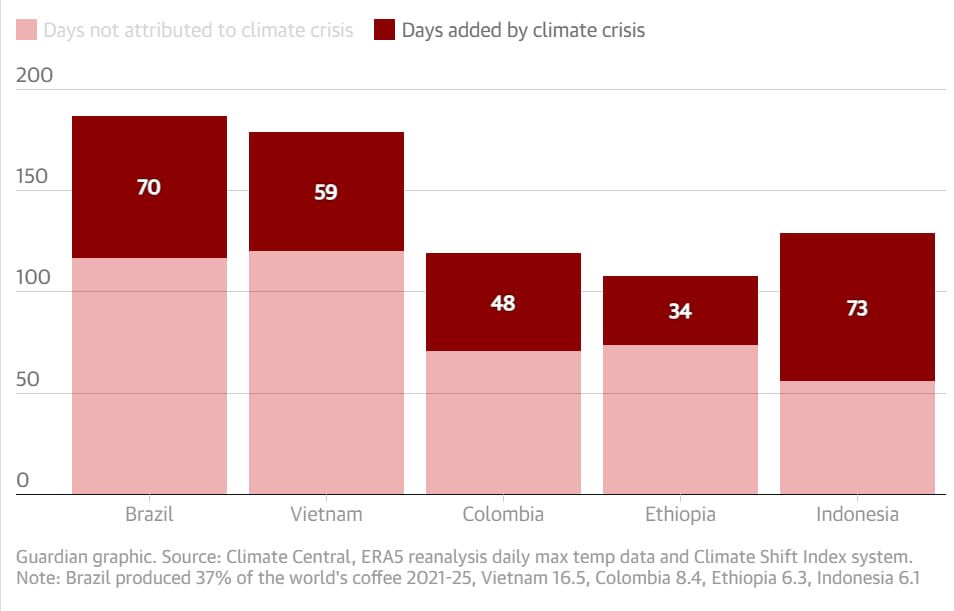
Source: The Guardian
The heat has also had a significant impact on the cost of coffee. According to the World Bank, the cost of Robusta and Arabica beans will almost double between 2023 and 2025. And in February last year, the price of coffee beans reached an all-time high.
The importance of adaptation
The industry needs to adapt to climate change urgently, but small farmers receive only a fraction of the total funding for climate measures. According to activists, small producers grow 60-80% of coffee, but according to research, they received only 0.36% of the amount needed for adaptation.