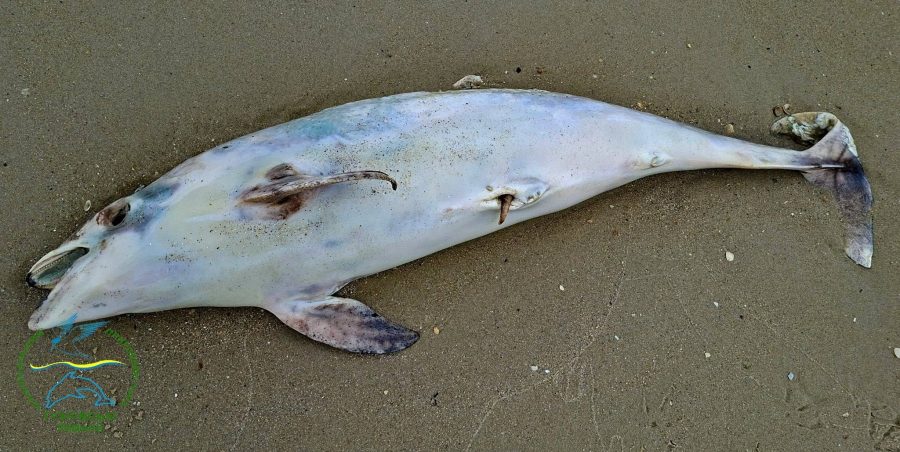
Between 6 and 8 July, the bodies of a further seven dead Azov dolphins were found on the coast of the Tuzly Estuaries National Nature Park. These are rare creatures that are at risk of extinction. In total, over the past month and a half, the bodies of 74 dead animals have been recorded within this nature reserve alone. Scientists blame the war unleashed by Russia for the genocide of the dolphins.
This was reported by Ivan Rusev, head of the scientific department at the Tuzly Estuaries National Nature Park, on Facebook.
A wider problem
The scientist noted that the bodies of dead cetaceans are being found all along the Black Sea coast. This applies not only to the Odesa and Mykolaiv regions of Ukraine, but also to neighbouring countries – Romania and Bulgaria, as well as Turkey and Georgia. And, of course, the consequences of Russia’s crimes against nature are also being seen on Russian territory and in occupied Crimea.
“In addition to the corpses, the war also throws out dolphins shell-shocked by the conflict. However, the actual total number of animals killed is much higher and, according to our estimates, already exceeds twenty thousand just in the first half of wartime 2026, while during the period of the full-scale invasion, the number has surpassed 100,000,” Ivan Rusev shared these shocking figures.
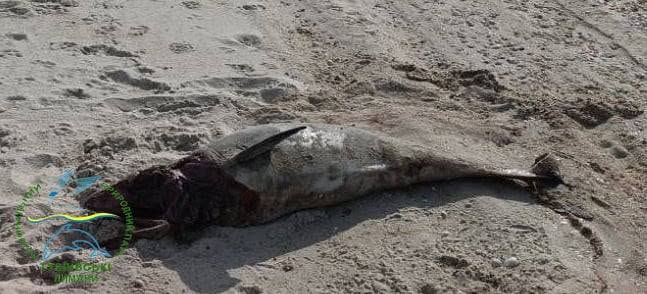
Source: Ivan Rusev on Facebook
Statistical сhallenges
It is extremely difficult to count 100% of all animals killed by the war with complete accuracy. The scientist explains that this is a race against time. If park employees do not manage to record a body within a day, it is considered lost. There are several reasons for this. First, waves can once again carry the animals out into the open sea. The second reason is predators. Jackals, for instance, may snatch the carrion and carry it further away from the shore into dense thickets, where scientists will not be able to see it. These facts are confirmed by images from camera traps.
“Additionally, it is known that 95% of the bodies of dead dolphins sink into the depths of the sea and only 5% are washed ashore. And of those 5% of carcasses, people manage to find only a small portion,” explained the national park representative.
EcoPolitic previously reported that there are two key causes of animal deaths – toxic and acoustic pollution. The first is associated, among other things, with oil product spills that cause damage to internal organs, while the second is related to the effects of explosions and sonars, which disorient the animals.