With the start of Russia's full-scale invasion, the Ukrainian authorities closed access to a lot of data and registries for security reasons. The public and activists lost the few tools they had to keep an eye on what officials were doing in the environmental sphere.
Public councils (PCs) attached to ministries, other central executive bodies, and local military administrations should remain one of the tools for citizens to influence officials' decisions and a platform for dialogue between the authorities and society.
EcoPolitic investigated how these "bridges" between officials and citizens work during a full-scale invasion and whether they work at all.
Public councils – what is their purpose?
Such councils bring together representatives of public organizations, trade unions, the media, and local self-government bodies so that they can express the position of society and influence the preparation of decisions by state authorities. Public councils collect the opinions, suggestions, and comments of citizens, process them, and pass on these recommendations to officials.
The original idea was that public councils would help the government listen to the people and help the people participate in shaping public policy, but that's just in theory. In practice, we often see something completely different.
How it used to be
During the period of the separate Ministry of Environmental Protection and Natural Resources, at least the appearance of openness to public opinion was maintained. The nominative list of the 35 members of the public council was available in open access. On its official website, the agency published the PC’s work plans and reports, as well as minutes of its meetings (the last published one dates from April 2025).
For the Ministry of the Environment, the full-scale war did not prevent continued dialogue with society.
No place for the public here
So, what do we see now? On the website of the merged Ministry of Economy, Environment, and Agriculture in the "For the Public" section, there is a "Public Council" item. There is not only no up-to-date membership list for this council, but also the last materials related to its activities date back to 2019.
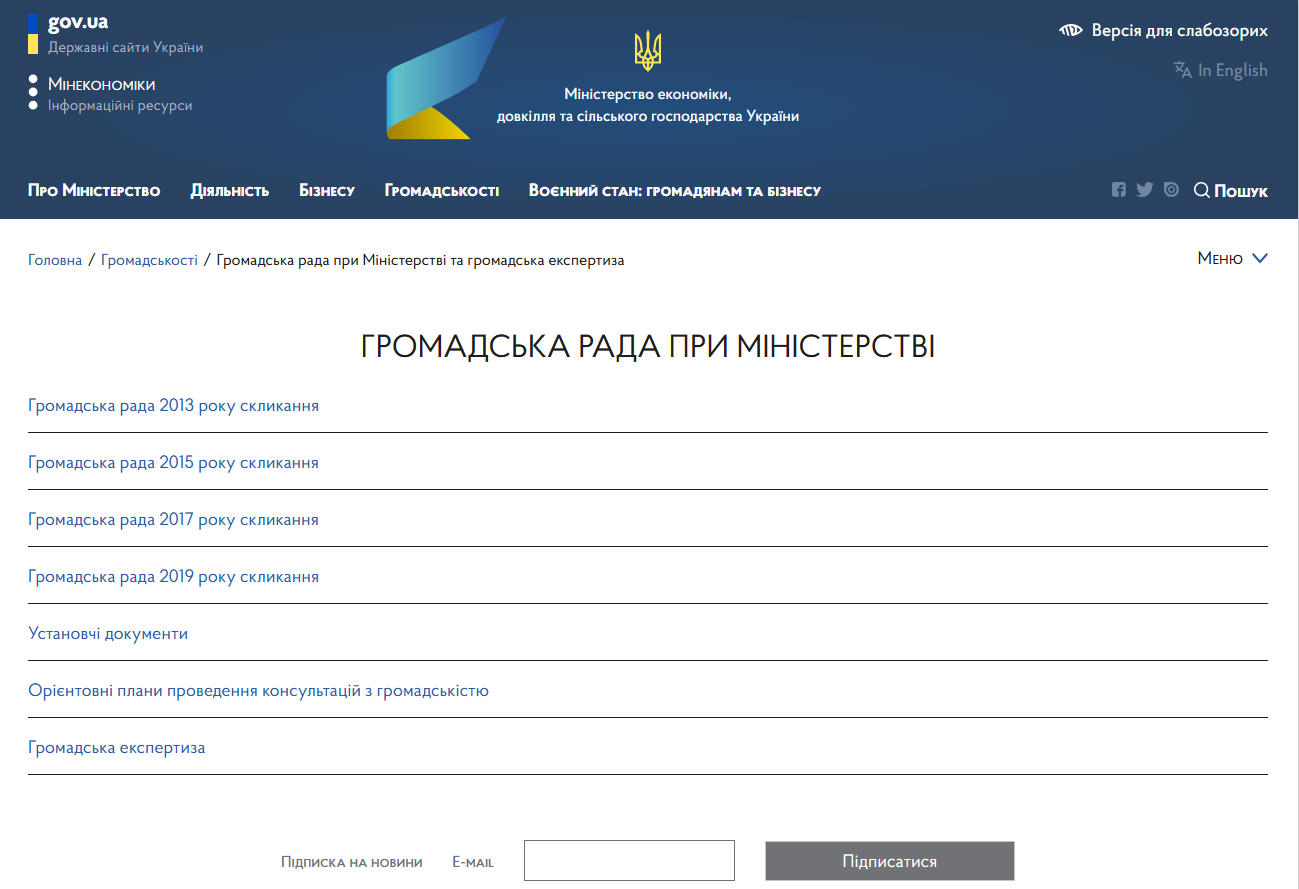
Screenshot from me.gov.ua website
Why is this the case? In November 2019, during the term of Minister Tymofiy Mylovanov, the activities of the public council at the Ministry of Economy were prematurely terminated. There are several interesting points to note here:
-
This advisory body operated for only three months.
-
As grounds for the early termination of its work, the Ministry of Economy referred to a nonexistent item 24 of the Model Regulation on the public council under a ministry, another central executive body, the Council of Ministers of the Autonomous Republic of Crimea, regional, Kyiv and Sevastopol city, district, and district in Kyiv and Sevastopol state administrations.
After this liquidation, the public council at the Ministry of Economy was never created again. The question is: why? In this case, even the full-scale invasion cannot be used as an excuse.
Therefore, the transparency of the ministry is in question. In the six months since the merged Ministry of Economy came under the leadership of Oleksii Sobolev, the situation has not improved. Experts and eco-activists have repeatedly stated that the agency deliberately withholds the publication of drafted regulatory legal acts which could provoke strong public criticism.
Carpathian forests – let's go!
The latest high-profile case relates to an attempt by the ministry to covertly side with foresters and cancel the environmental impact assessment (EIA) for clear sanitary logging. Let us recall, the EIA is currently the last safeguard preventing the destruction of healthy forests in the Carpathians under the pretext that they are allegedly diseased.
At the beginning of the year, Petro Tiestov, an ecologist with the Ukrainian Nature Conservation Group, reported that the Ministry of Economy had developed and sent for approval to other central executive authorities a draft resolution proposing to cancel the EIA for clear sanitary logging. For some reason, the agency “forgot” to publish it on its official website.
Bohdan Kuchenko, an ecologist from the NGO “Ecoaction,” confirmed the complete disregard for public opinion.
“It is important to understand that the ministry created a working group. Within it, we were supposed to consider everything related to changes in the legislative framework surrounding logging. We found out about the draft resolution completely by accident. For almost an entire day in the working group's chat, which includes one of the minister's profile deputies, Vysotskyi, public organizations have been inquiring about what is happening. The draft will be up for government consideration any day now. There has been no response from Mr. Vysotskyi or from any other high-ranking officials in the working group chat,” – he reported at the beginning of January.
That is, the Ministry is ignoring even those public activists who work in the task forces it created. Each time, officials try to justify the introduction of environmentally harmful initiatives by citing the ongoing war.
Public opinion? Not this time
Let's take a look at the Ministry of Economy's "Provisional Plan for Public Consultations in 2026." It contains only eight questions. Consider the scale: the largest ministry in the country wants to discuss only eight questions and draft regulations with the conscious public for the entire year.
Do officials really believe that the public has no say on other issues? Let us remind you that, in accordance with the Resolution of the Cabinet of Ministers of Ukraine "On Ensuring Public Participation in the Formation and Implementation of State Policy," consultations are mandatory on issues that affect the vital interests of citizens, in particular those that affect the state of the natural environment.
The ministry planned to discuss several items related to the environment:
-
protection, use, and reproduction of water resources and biological resources;
-
use of land under peatlands;
-
management of invasive alien species of plants and animals,
as well as hold public hearings regarding planned activities subject to EIA.
That's all. It appears the ministry prefers to develop and approve other documents without unnecessary witnesses.
What's going on with the inspection?
The situation at the State Environmental Inspectorate looks a bit better: the composition of the Public Council, approved in August 2020, is available on the official website. It includes 34 representatives from public organizations and associations of both environmental and other orientations.
If one relies on the documents on the website, the Public Council existed for only a short time; the last published meeting minutes are dated November 2020.
Apparently, even in this government agency, well before the full-scale war, it was decided that the Public Council only hinders their work.
Impressive slides for Brussels and total disregard for Ukrainians
In June 2025, Ukrainian officials, during an official screening, assured European partners that Ukraine is successfully implementing EU environmental legislation. They also mentioned the Aarhus Convention-a document guaranteeing citizens the right to participate in decision-making that affects the environment.
The slides looked more than convincing; however, in reality, public councils are disappearing, consultations are being reduced to a minimum, and officials try to make important decisions without unnecessary publicity.
Ukrainian officials have become experts at preparing presentations for Brussels, but when it comes to transparency within the country, things are much more complicated.
At every public collective meeting, top officials from the Ministry of Economy assure professionals and activists of their openness, willingness to engage in dialogue, and readiness to cooperate. In practice, as it turns out, these statements are lies. Decisions on environmental issues are increasingly being made without those directly affected by them.