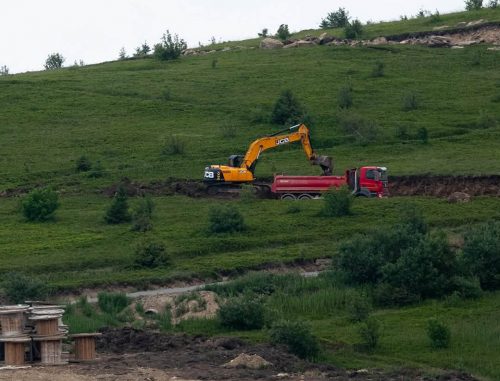
The autonomy of local councils in developing their own environmental strategies leads to irrational and pseudo-environmental spending. The Kirovohrad region is no exception. Measures that could actually lead to a reduction in emissions are left to the enterprises themselves. Meanwhile, the region, cities, and towns are planning to renovate sewer systems, plant trees, and purchase garbage trucks.
EcoPolitic continues its series of articles on how regions use environmental tax funds.
As a reminder, polluters are required to pay this tax for the emissions they cause. Subsequently, these funds go partly to the state budget and partly to local budgets. There, they can only be used for environmental measures. And once again, we see that everywhere, the essence of these measures is interpreted at the discretion of those in charge.
Regional environmental program
It should be noted at once that we cannot provide a detailed account of the program of Kirovohrad region for 2026–2030. This is the first such document reviewed by EcoPolitic where the measures are not specified. All that is known is that, with state budget funds, sewage treatment facilities in Znamianka, Oleksandriia, and the town of Smoline will be reconstructed.
Otherwise, the document is purely indicative. Even the expenditure on the measures is given as average for each group. There are seven groups in total, and the list of measures only includes generalized actions and processes, as well as references to items of Cabinet of Ministers Resolution No. 1147 dated 17 September 1996, to which these measures correspond.
EcoPolitic refers to this resolution every time it analyses environmental programs. It is this resolution that allows councils to include, in a document that was supposed to outline environmental restoration strategies, activities relating to landscaping, maintenance of utility networks, and other questionable actions.
There is nothing new in Kirovohrad region: alongside the installation of air purification equipment, development and expansion of the nature reserve fund, air quality monitoring, and environmental research, we see the same sewage, greening, and waste management activities.
The measures are planned to be implemented using funds from the state and regional environmental protection funds. The region's budget for 2026 allocates 23.2 million UAH from the environmental tax.
Environmental protection measures in Kropyvnytskyi
In contrast to the regional program, the Kropyvnytskyi council has outlined its measures in more detail, though they are rather few. For 2024–2026, the ecological improvements include the following landscaping measures:
- planting and removal of greenery at schools and throughout the city in general;
- removal of fallen trees.
The city also plans to develop an Environmental Passport and to hold thematic environmental lessons.
The reduction of industrial emissions is entrusted to the enterprises themselves. Three local companies are required to carry out reconstruction and retrofitting of installations whose emissions pollute the air. In addition, the Kropyvnytskyi Oil Plant is expected to… replace fluorescent lights with LEDs.
Environmental programs in smaller cities and communities
In Oleksandria, the activities of the local environmental protection program cover the years 2026–2030. It is worth noting that some activities are formulated rather abstractly. For example, what is meant by “Measures for the protection of groundwater and elimination of their sources of pollution”? Isn’t this just the reconstruction of sewerage networks? In order to prevent the contamination of water resources in the city, they intend to establish water protection zones “with a set of sanitary and other measures.” What these are remains unknown.
In the section on air protection, the sole activity is also formulated quite generally. It refers to the eco-modernization of enterprises aimed at reducing and preventing pollution. Enterprises and organizations with emission permits are to carry out this work within their own budgets.
Oleksandria also plans to recultivate disturbed lands and solid household waste landfills, construct facilities to prevent flooding, and survey soils. Greening projects and the elimination of windfall impacts also form part of the environmental program, as does the procurement of waste collection vehicles.
In Kirovohrad region, there is also an exclusively “floristic” environmental program. In Subottsi rural territorial community, all 5 of the 5 initiatives planned for 2026 are connected in some way with plants. These include street landscaping, removal of deadwood, and the planting of flowerbeds with purchase of seedlings. Funding will come from the local village budget, but will also take into account charges for pollution and monetary penalties for environmental damage. We can only be pleased that apart from weeds and the need to replace flowers in flower beds, there are no environmental problems in the village.
Ustynivka settlement council has added some diversity to its 2026–2028 program. Besides landscaping the area, environmental measures here include the purchase of a garbage truck and the development of a waste management plan. There are genuinely environmental initiatives as well, such as the inventory of pollution sources and the development of a local ecological network scheme. The implementation will be funded through the local budget and non-budgetary sources, without specifying details.
Legally, including everything related to wastewater, garbage, and flowers in an environmental program is not a violation. However, from the standpoint of efficient use of funds, such an approach appears completely irrational. EcoPolicy cited the position of experts and business representatives who see such practices as diluting the environmental protection function of the environmental tax.
Вou can also explore other materials regarding the use of the environmental tax. EcoPolitic has already prepared articles about the Zaporizhzhia, Poltava, Odesa, Vinnytsia, Rivne, Zhytomyr, Ivano-Frankivsk, Cherkasy and other regions.