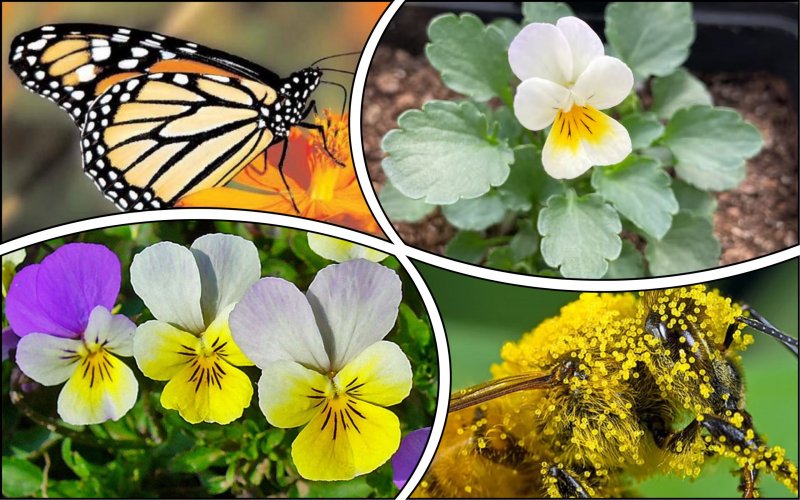
French scientists have found that the number of self-pollination in wild pansy violets has increased by 25% over the past 20-30 years due to a decrease in the number of pollinating insects.
Scientists are calling for urgent action to preserve pollinators to stop negative evolutionary trends, the Guardian reports.
"Our research shows that pansies are evolving to abandon their pollinators. They are evolving towards self-pollination, where each plant reproduces by itself, which works in the short term, but may well limit their ability to adapt to future environmental changes," said one of the authors of the study and researcher at the French National Center for Scientific Research Pierre-Olivier Cheptou.
It is noted that over the past 30 years, the size of the flower has decreased by 10%, and the amount of nectar by 20%.
As you know, during cross-pollination, plants exchange genetic material, which contributes to the stability of the population, while self-pollination leads to less genetic diversity.
A German study found that between 1989 and 2016, the total weight of insects caught in traps fell by 75%.
It is noted that insects and plants have built their mutually beneficial relationships over millions of years of co-evolution. But pansies and pollinators may now be stuck in a vicious circle: plants produce less nectar, and therefore insects will have less food, ultimately accelerating their decline.
Scientists were surprised by such a rapid evolution of plants. They found no other population changes in leaf size and shape or other plant parameters.
The article explained that some other plants, on the contrary, produce more pollen and nectar to compete for a small number of pollinators.
Earlier, EcoPolitic wrote, that in some parts of the world the number of insects has halved due to climate change and intensive farming.
Previously, EcoPolitic analyzed what is meant by the concept of "biological diversity", why it is important for our planet, what threatens it and how to preserve it