The central regions of Ukraine on the river coasts still preserve areas of virgin, untouched steppe. These areas are often unsuitable for plowing, which is why they have been preserved. However, there is another threat to such steppe lands—mineral extraction.
The Kyiv Ecological and Cultural Center (KECC) calls for careful accounting of the remaining stone steppes of Ukraine and their protection from destruction.
The value of unique natural monuments
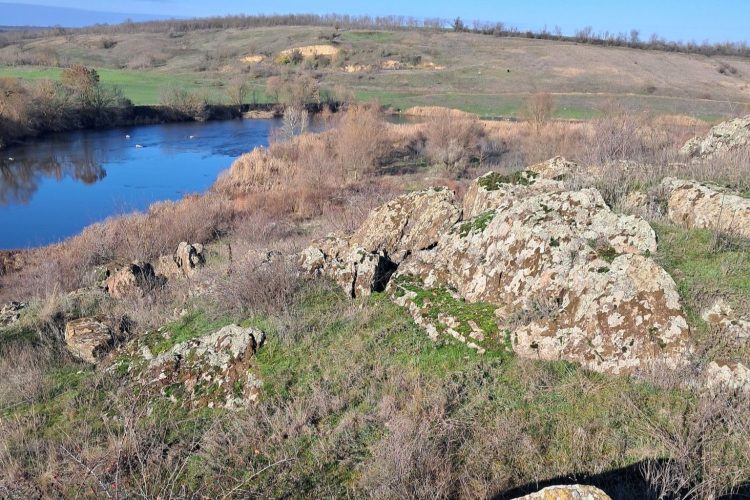
A number of central regions of Ukraine are located within the crystalline shield, an array of Precambrian rocks that form picturesque river rapids and cliffs on the surface and contain valuable mineral deposits. The shield has created picturesque landscapes, such as the Cascades on the Bug River. Rare plants are preserved in such places.
Ukrainian areas of virgin stone steppe are unusually large for Europe, ranging from 20 to 200 hectares. They are mainly represented by the coasts of steppe rivers – the Southern Bug, Ingul and Ingulets, Sinyukha, Sugoklei, Black Tashlyk, and Yatrans. In 2025 alone, the KECC discovered about 1,000 hectares of such areas.
“The thought that a boulder has lain here for thousands of years inspires awe. The most beautiful time here is, of course, in spring and early summer, when the steppe is abloom with all kinds of wildflowers. Then, the stones and grasses blend in a unique symbiosis, highlighting and complementing each other,” writes KECC director Volodymyr Boreiko.
The presence of stones makes agricultural activity inconvenient, thus preserving the plants from destruction. While in the steppe ravines of Cherkasy and Kyiv regions you will find only rare feather grass, in Kirovohrad region, where the steppe is stony, there are more than 10 species of Red Book plants. If you also count the insects, snakes, and fungi, the total exceeds 40 species.
These areas are also valuable for research – climatic, biological, and soil science – as they preserve original information on the ecosystem’s condition.
Threat from industry
However, the crystalline shield, whose surface outcrops protect flora and fauna, contains minerals that are important for industry in its depths. Therefore, according to the KECC, the stone steppes are threatened by mineral extraction.
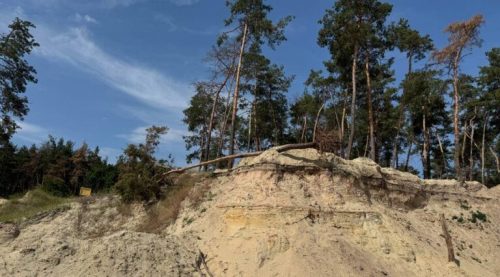
Mining will completely destroy unique landscapes and their inhabitants. Environmentalists consider the development of quarries along rivers to be particularly dangerous, as it also threatens to lead to water depletion and pollution.
The KECC cites examples of such developments that have permanently destroyed stone steppes—granite quarries in Haivoron (Kirovohrad region), in the village of Granitne (Vinnytsia region), and near the village of Synyukha (Kirovohrad region).
"In Kirovohrad (primarily), as well as in the adjacent parts of Mykolaiv, Dnipropetrovsk, Odesa, and Vinnytsia regions, an inventory of stone steppe areas should be carried out with their subsequent designation as natural monuments. Later, the most scientifically interesting areas of the stone steppe should be included in future nature reserves," emphasizes Volodymyr Boreyko.
Previously, EcoPolitic covered new botanical reserves that are to be established in Ukraine at the initiative of activists.
Аnd in Chernihiv region, in order to meet afforestation plans, a steppe area was destroyed.