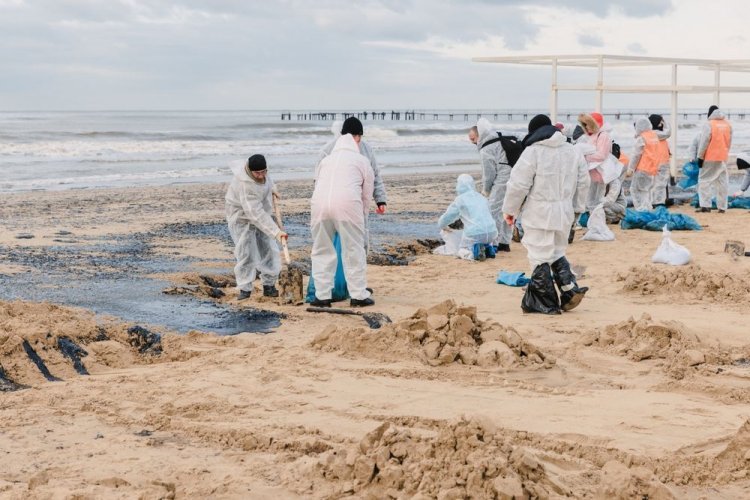
Ukrainian Navy spokesman Dmytro Pletenchuk reported an oil spill in the Black Sea. The incident occurred in Russian-occupied territory.
The Navy spokesman said this in a comment to RBC-Ukraine.
According to Dmytro Pletenchuk, the oil spill probably occurred in the eastern part of the Black Sea, near the eastern coast.
“Most likely (the spill occurred) from one of the ships that are directly navigating in this area under the control of the Russian Federation,” said the Ukrainian Navy spokesman, recommending that visitors to this area of the sea “not smoke directly in the water.”
The oil slick in the Black Sea, which is moving towards Crimea, formed on August 29 during cargo operations with a tanker in the port of Novorossiysk in Russia at the Caspian Pipeline Consortium's marine terminal. At that time, the fuel oil covered dozens of square kilometers.
Russian propagandists claimed that at least 10 tons of oil products had leaked into the Black Sea, and that the area of the black oil slick allegedly reached 350 square kilometers and was moving towards the occupied Crimea.
Experts say that as of now, the oil spill is located near the Russian city of Anapa, flowing south of the Kerch Strait. However, most of the pollution has reached the coast of Russia's Krasnodar Krai. The lion's share of the pollution stretches from Novorossiysk to the Taman Peninsula and covers an area of 211 square kilometers.
In addition, there is a patch moving in the direction of Crimea. According to the monitoring channel, its area is 14 square kilometers.
As EcoPolitics noted earlier, the Black Sea has become overgrown with algae: experts have taken water samples, and this is likely a seasonal phenomenon caused by rising air temperatures.