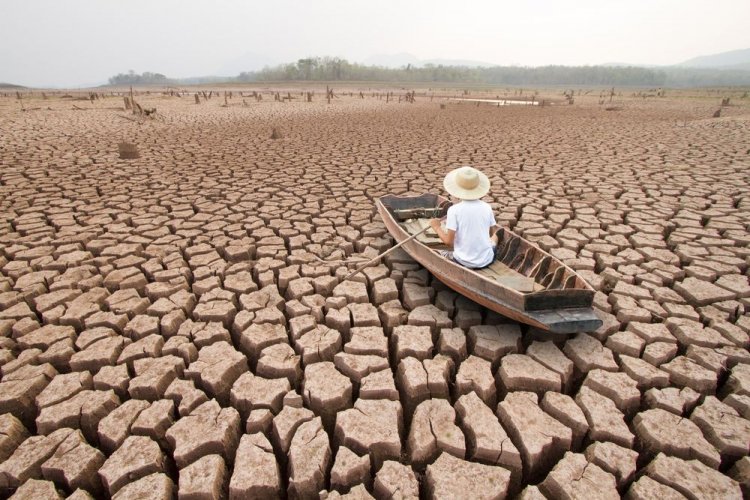
The Kakhovsky reservoir has turned into a solid desert

The Kakhovsky reservoir has turned into a solid desert shutterstock
Katerina Belousova

Deep cracks formed at the bottom

After the explosion of the hydroelectric power station, the water completely disappeared in the Kakhovsky Reservoir and it turned into a solid desert.

At the bottom of the former reservoir, stumps from the former collective farm garden, which were cut down in 1951 before flooding, are visible, NV reports in Telegram.

Kherson journalist Serhii Nikitenko filmed what the reservoir looks like now.

He said that the layer of sediment, the so-called silt, is not large, about 20 cm. Also, deep cracks formed at the bottom.

Nikitenko explained that the former reservoir was inspected to assess the possibility of supplying water to the town of Novovorontsovka in the Kherson region. After all, there are problems with water in the community.

"We are the first to walk here in the last 70 years, and you are the first to see the floodplain," he said.

Earlier, EcoPolitic wrote, that in the Kakhovsky Reservoir after the detonation of the hydroelectric power plant near the occupied Energodar the water has completely disappeared, and the territory turned into a desert. According to experts, there is currently no threat to Zaporizhzhya NPP.

Earlier, EcoPolitic spoke with the head of the ecomonitoring committee of the PAEW Association of Environmental Professionals, Maksym Soroka, regarding complex consequences for the environment from the Kakhovskaya HPP disaster.

Related
Fire at a landfill site in Kryvyi Rih: the city has been plagued by the stench for four days

Local air pollution levels were more than twice the limit

The Ukrainian government has approved 11 environmental documents: an overview of the key ones

This concerns the update of the National Pollutant Emission Control Plan (NPEC), the biodiversity conservation strategy, and European standards for monitoring new pollutants

Due to the collapse of the dam, the National Military Cemetery near Kyiv is turning into a swamp

Marshy terrain with natural watercourses is unsuitable for construction

Around a hundred organisations are calling for the Great Meadow to be recognised as a UNESCO World Heritage Site

In addition to gaining access to the historical site, the researchers also witnessed a remarkable restoration of a unique natural ecosystem