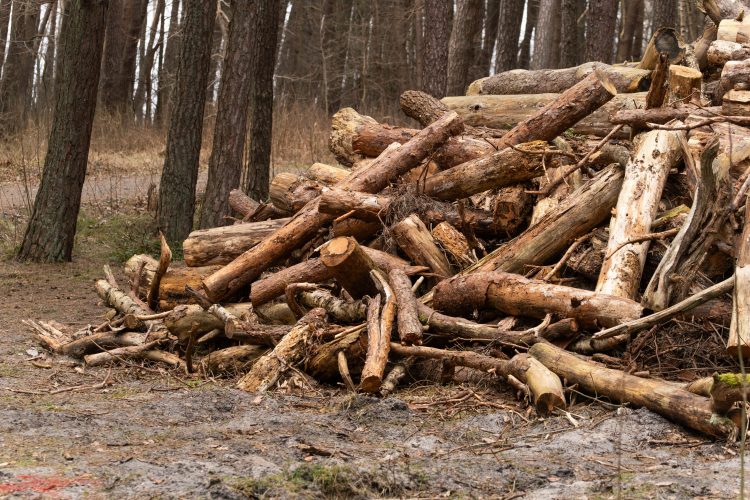
Recently, in the Kyiv region, people were fined for collecting dry firewood in the forest. There was an outcry online, with many arguing that this does not constitute an offence. However, the Administrative Offences Code states the opposite. Even dry trees are the property of the forest user, so in essence, one can be fined for stealing them.
EcoPolitics explains the regulations in force in Ukraine.
The infringement referred to above was detected by the State Environmental Inspectorate’s environmental control post in the Bila Tserkva district. Those responsible for harvesting the firewood were held accountable under Article 64 of the Code of Ukraine on Administrative Offences.
The Act sets out penalties for breaches of the established procedures governing the use of the timber reserve, the harvesting and removal of timber, and the harvesting of resin. Its provisions provide for the following fines:
- for citizens — between 6 and 14 non-taxable minimum incomes (102–238 UAH);
- for officials — between 10 and 16 minimum wages (170–272 UAH).
However, in such cases, offenders may also be punished under another section — Section 65. This section deals with the unlawful felling, damage to and destruction of forest plantations and young trees, as well as the transport or storage of unlawfully felled trees. The penalties under this section are different:
- for citizens — between 30 and 60 non-taxable minimum incomes (3,400–8,500 UAH);
- for officials — between 10 and 16 minimum wages (5,100–10,200 UAH).
Everything must be authorised
Technically, there is no law in Ukraine that allows citizens to collect firewood in the forest without restriction. Even dry firewood remains the property of the forest user.
Therefore, if members of the public wish to collect them, they must obtain special permission from the authority responsible for the forest.
Everything is part of the ecosystem
The Forest Code of Ukraine provides a different perspective on such actions. It classifies everything found in the forest as part of its ecosystem. This is set out in Article 6:
"Forest resources comprise timber, industrial, medicinal and other forest products that are used to meet the needs of the population and industry, and which are regenerated as part of the formation of natural forest ecosystems".
According to the interpretation of industry experts, these products also include dead, dry and fallen trees. They form part of the ecosystem and may provide a habitat for insects and reptiles.
What you can take from the forest
Article 66 of the same Forest Code sets out the rules governing the general use of forests. In other words, this refers to members of the public who do not hold a permit for special use.
The Code permits the gathering of wild plants, berries, mushrooms, nuts and flowers. However, there is a caveat — regional executive authorities may set maximum limits on the quantities that may be gathered free of charge.
This may be done in state-owned and municipally-owned forests, as well as in privately-owned forests, provided the owner has given their consent.
Previously, EcoPolitics reported on how much fish you can catch without incurring a fine.
Also, as the garden tidying season gets underway, we would like to remind you of the fines for setting fire to dry vegetation.