Against the backdrop of a decline in energy supply from coal and petroleum products, the supply of electricity generated from renewable sources continued to grow throughout 2025. At the same time, the share of gas in electricity supply also increased.
This is evidenced by new data from Eurostat.
Trends in the energy sectors
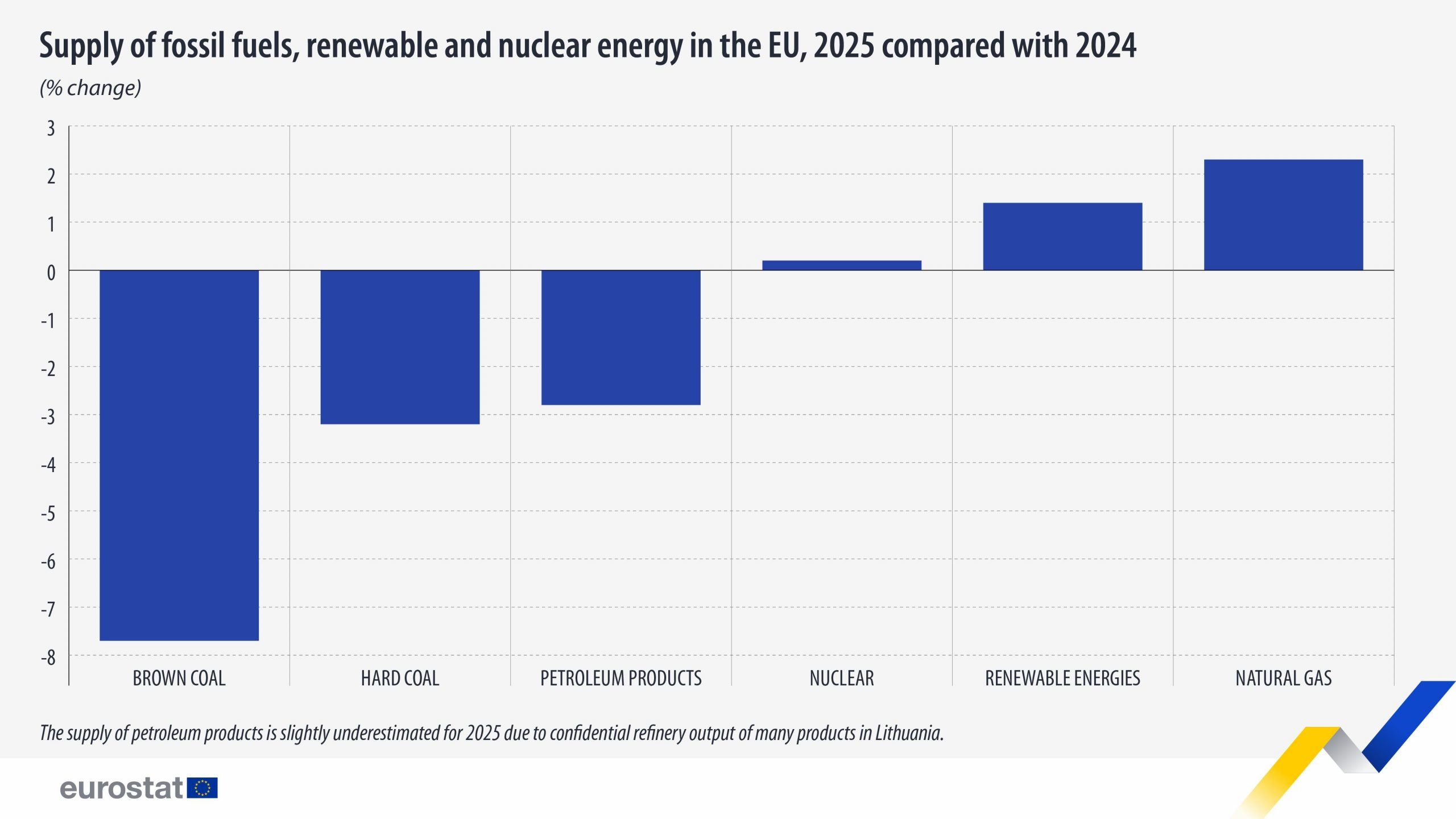
The annual increase in renewable energy supply stood at 1.4 per cent. Overall, in 2025, the volume of electricity from renewable energy sources reached 11.5 million TJ. These figures were achieved despite a significant drop in hydropower generation, which even slightly reduced the total volume of net generation.
Nuclear energy supply also increased — by 0.2% compared with 2024, amounting to 650.6 TWh.
Following a sharp decline in 2023, energy supply from natural gas continues to rise. Compared with 2024, it increased by 2.3% in 2025, reaching 13.1 million TJ.
Other types of fossil fuels, however, showed a significant decline. Energy supply from hard coal fell by 3.2% to 107.1 million tonnes, and from lignite by 7.7% to 181.7 million tonnes. These figures reached an all-time low since records began in 1990.
The total volume of petroleum product supplies fell by 2.8% compared with 2024, amounting to almost 448.7 million tonnes.
Source: Eurostat
Leadership of renewables
By the end of 2025, renewable energy sources remained the main source of electricity in the European Union. They accounted for 47.2% of all generation. Renewables produced 1.33 TWh of electricity for EU countries. However, this figure is 0.5% lower than in the previous year.
On the other hand, electricity generation from fossil fuels increased. Annual growth was 3.2%, and generation totaled 0.83 TWh or 29.6% of total electricity production.
Nuclear energy ensured another 23.2% of EU electricity output. Compared to 2024, production rose by 0.2% to 0.65 TWh.
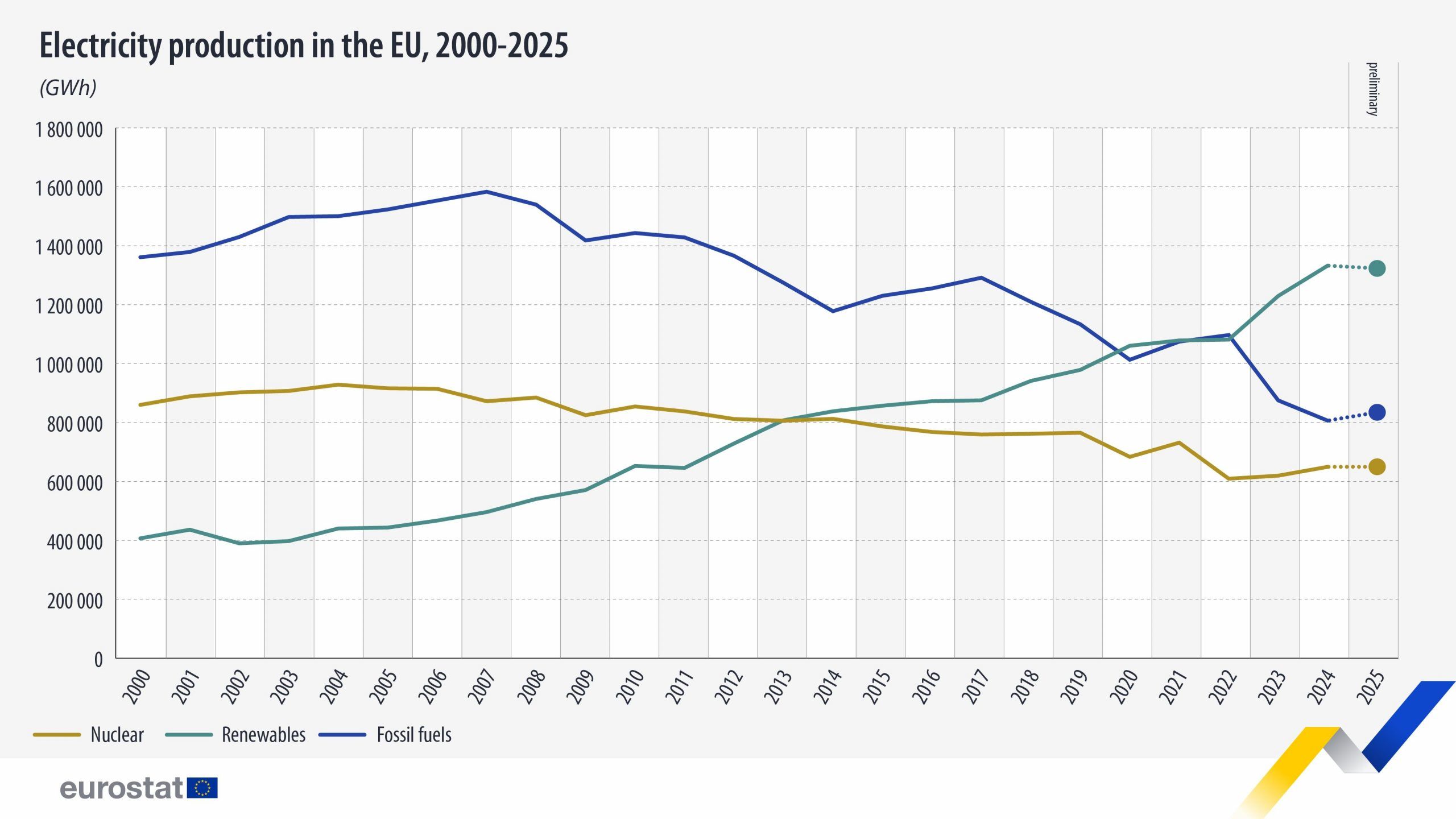
Source: Eurostat
Earlier, EcoPolitic reported that wind power plants generated the most clean energy for the EU (37.5%). Solar and hydropower ranked among the top three as well, with 27.5% and 25.9% respectively.
Meanwhile, in Ukraine, the share of “green” energy in total electricity generation stands at 11%.