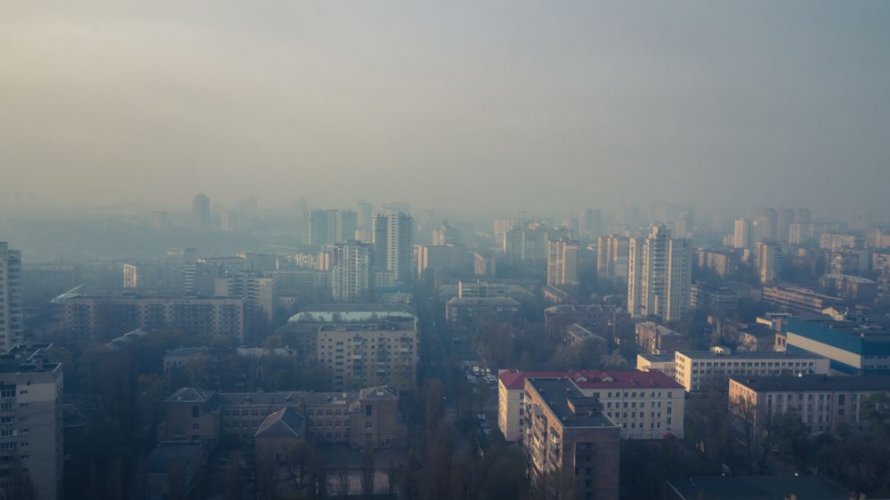
Across Ukraine as a whole, as of the morning of 25 September, there are no towns where the average pollution level poses a risk to the public. Only isolated instances of levels exceeding the limit have been recorded.
This is evidenced by data from the international monitoring platform IQAir.
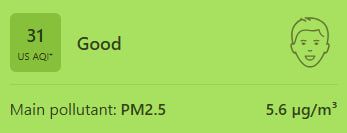
The average air quality in the capital falls within the ‘green’ range on the pollution scale. The concentration of particulate matter is 5.6 µg/m3. Meanwhile, the upper limit of the standard set by the World Health Organisation is 5.5 µg/m3.
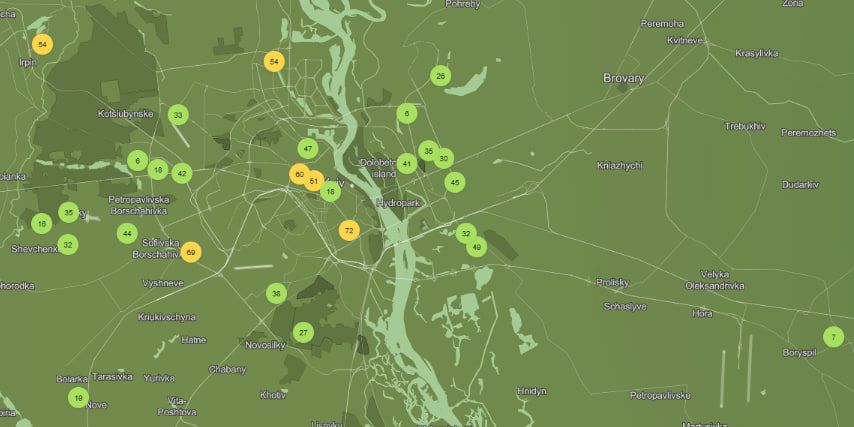
Monitoring stations at various locations are recording average pollution levels. For example, on Konovaltsia Street, the dust concentration is 20.6 µg/m3, and on Sichovykh Striltsiv Street — 13.9 µg/m3. The ‘yellow’ level is also recorded in some of the nearest settlements: in Sofiivska Borshchahivka — 18.6 µg/m3, in Vyshhorod — 10.7 µg/m3, and in Irpin — 22.2 µg/m3.
Air quality also remains average in a number of regional centres. The main pollutant there is fine particulate matter:
- Ivano-Frankivsk — 22.9 µg/m3;
- Odessa — 14.6 µg/m3. The average reading was influenced by dangerous levels of pollution on Pishonivska Street, where the highest exceedances were recorded for PM10 particulate matter;
- Dnipro — 10.2 µg/m3;
- Lutsk — 9.6 µg/m3;
- Cherkasy — 9.5 µg/m3.
In most major cities, however, air quality is good in the morning:
- Poltava — 8.8 µg/m3;
- Lviv — 8.3 µg/m3;
- Rivne — 7.1 µg/m3;
- Chernivtsi — 6.3 µg/m3;
- Khmelnytskyi — 6.2 µg/m3;
- Mykolaiv — 6.1 µg/m3;
- Ternopil — 5.3 µg/m3;
- Vinnytsia — 5.1 µg/m3;
- Kharkiv — 5.1 µg/m3;
- Zhytomyr — 5 µg/m3;
- Zaporizhzhia — 4.8 µg/m3;
- Chernihiv — 3.9 µg/m3;
- Uzhhorod — 3.1 µg/m3.
As a reminder, enemy attacks may temporarily deteriorate air quality. Levels may exceed the norm by up to ten times.