Clean energy remains the most competitive in terms of generation costs, and some of its segments have become even cheaper in 2025. So much so that the price of energy produced by 90 per cent of industrial renewable energy projects was lower than that generated by new gas-fired power stations. This economic advantage is driving the wider roll-out of ‘green’ energy projects and delivering tangible benefits for the economy and the environment.
According to the latest report from the International Renewable Energy Agency (IRENA), last year alone the use of renewable energy saved $377 billion in fossil fuel costs. As a result, 8.4 gigatonnes of CO₂ were not released into the atmosphere.
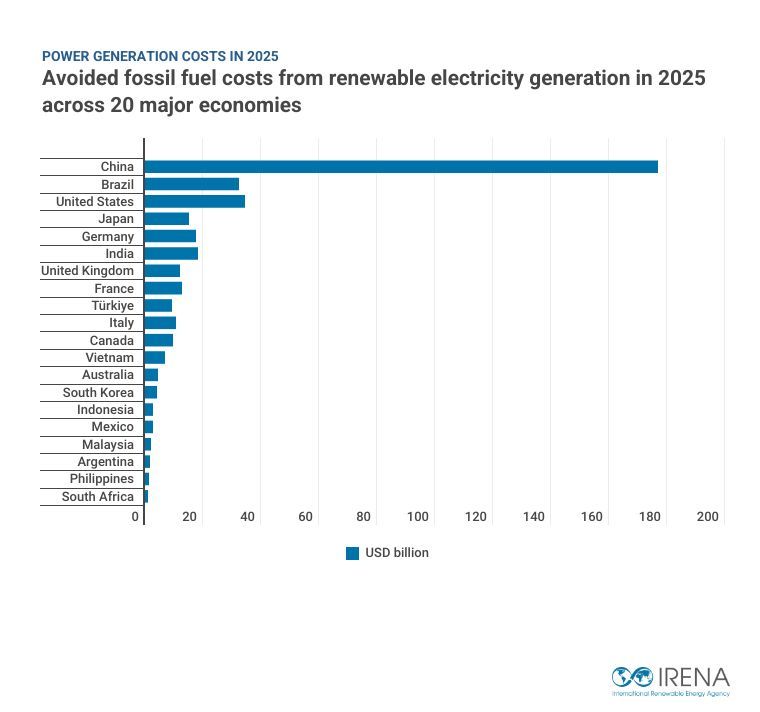
Source: IRENA
Prices in individual sectors
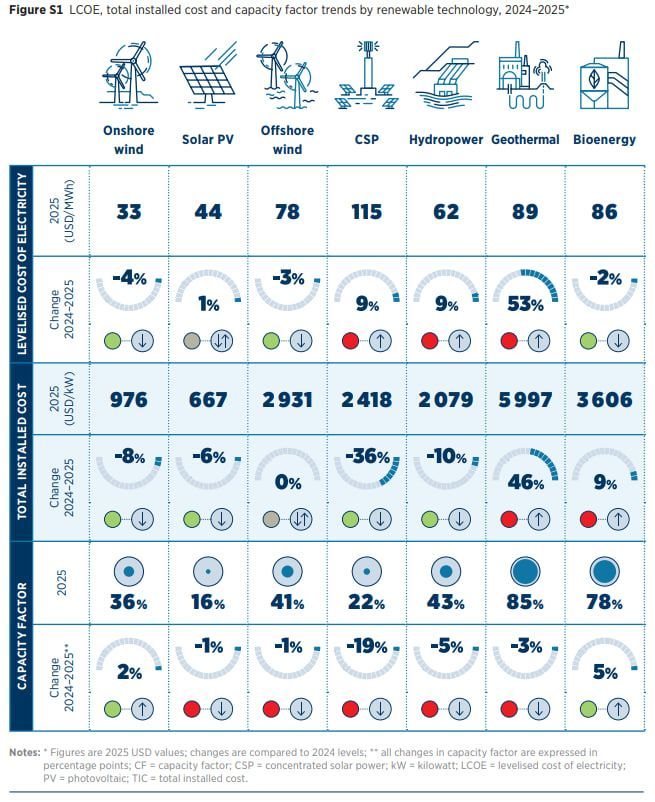
One of the cheapest forms of generation is energy from solar panels. In 2025, its cost matched the 2024 level and stabilized at around $44 per 1 MWh.
At the same time, wind power became even cheaper last year. The cost of generating 1 MWh in the onshore segment dropped to $33, while in the offshore segment, it reached $78.
However, dispatchable "green" generation saw an increase in costs. This refers to power facilities where electricity production from renewables can be adjusted to match demand. Thus, the cost per 1 MWh for hydropower rose to $62, for geothermal to $89, and for concentrated solar power to $115. The only decline came in bioenergy, where the average cost of generation per 1 MWh was $86.
Source: IRENA
Long-term price decline
An analysis of the 15-year period reveals that every segment of "green" energy is cheaper now compared to 2010. For solar power plants, the cost has decreased by 89%, for onshore wind by 71%, and for offshore wind by 63%.
In 2025, over 90% of new industrial-scale renewable energy facilities produced electricity at a lower cost than even the cheapest new fossil fuel power plants.
This is partly due to the fact that construction costs for new gas-fired power plants rose between 2024 and 2025. For example, capital expenditures for such construction in the USA almost doubled to $2,400 per 1 kW. As a result, in markets with expensive gas, generation in this segment cost up to $100 per 1 MWh, while in markets with cheaper gas, the cost was around $50–60.
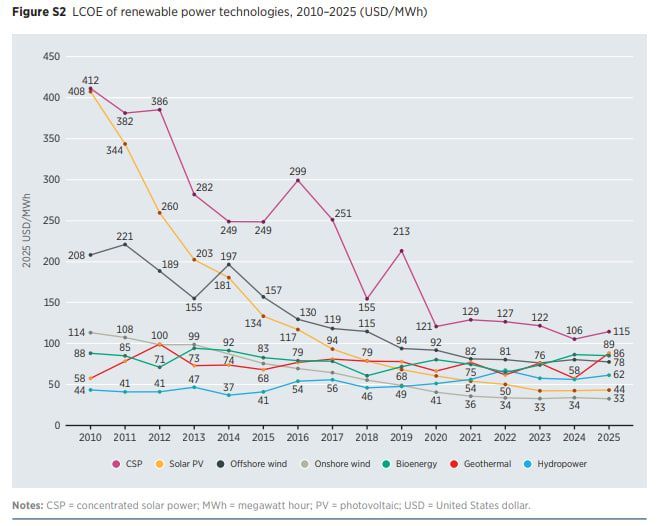
Source: IRENA
Regional differences
All previous prices are global market averages, but in certain countries, they differ significantly. For instance, wind generation is cheapest in China, where the cost per 1 MWh is $27 for onshore and $49 for offshore. In the USA, the figure for offshore wind was $141.
For solar generation, 1 MWh in China cost $36, in India $35, and in Brazil $37.
Energy storage
The average cost of energy from solar power plants with storage systems has fallen to $85 per 1 MWh since 2020. This refers to regions with high insolation. By 2030, it is expected to decrease by another 30%, and by 2035 – by almost 40%.
The cost of installing energy storage systems with four-hour storage duration dropped almost 30% in 2025 – to around $140/kWh, which is nearly 95% less than in 2010.
This is driven by the decline in battery costs. Thus, last year around 25% of all industrial solar power plants were commissioned already equipped with energy storage systems. Under the most optimal conditions, generation of 1 MWh of energy at such sites fell below $85.
However, experts suggest taking into account that fluctuations in the cost of raw materials for batteries may partially slow down the rate at which electricity storage systems become cheaper.
EcoPolitic reported that last year, it was renewable energy sources that became the main source of generation for the EU, providing 47.2% of demand.
At the same time, in Ukraine, the share of renewable energy in total generation amounted to 11%.