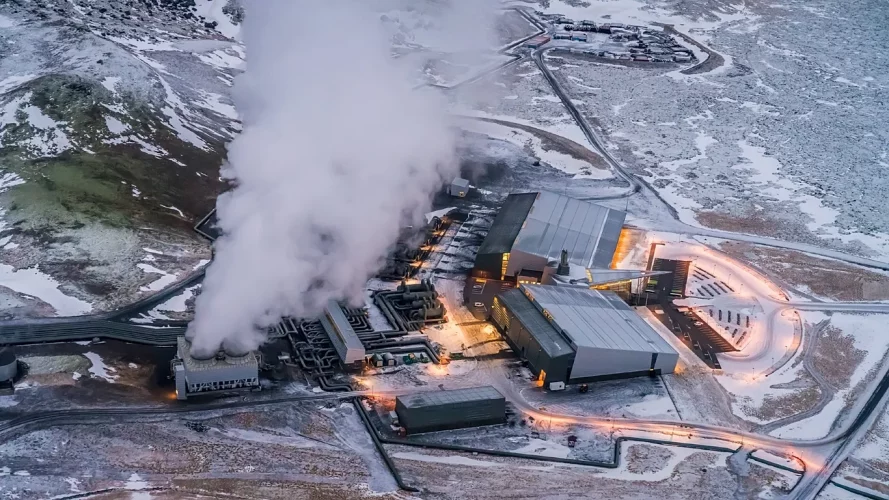
Geothermal energy could free the European Union from its dependence on fossil fuels. And you don't need to have volcanoes in your country to do so. The EU already has the potential to develop 43 GW of enhanced geothermal capacity, which would be cheaper than using gas and coal.
This is according to a report by the energy analytics center Ember, the results of which were reported by Euronews.
The figures quoted are only a small fraction of Europe's potential. If a geothermal network were to be deployed across the entire European Union, it could generate more than 300 TWh of energy annually. Based on 2025 figures, this is 42% of the total energy produced from gas and coal.
Overall, geothermal energy could cover up to 15% of the growth in energy demand worldwide by 2050.
Countries with the greatest geothermal potential
Traditionally, it was believed that this type of energy could only be produced in areas with high volcanic activity. However, the world is now gradually improving the technology of enhanced geothermal systems (EGS).
EGS involves drilling wells up to eight kilometers deep and creating reservoirs that are not linked to volcanic regions. Then, a fluid is pumped into the heated underground rocks, where it is heated at depth and then rises to the surface, ensuring constant and uninterrupted circulation.
According to Ember's analysis, continental Europe already has a techno-economic potential for the development of 50 GW of geothermal energy. This amount of energy would be sufficient to fully supply 30 million households.
Hungary has the greatest prospects – within its borders it is possible to generate 28 GW of geothermal energy. In Turkey, deep heat could provide 6 GW, and in France, Germany, and Poland – 4 GW each.
“Geothermal capacities can be developed at a low cost, and as a technology without fuel costs, they have an additional advantage – protection from fuel price volatility and rising carbon costs, which strengthens their role as a stable source of guaranteed low-carbon electricity in the long term,” the report states.
The EU is losing the geothermal race
At the beginning of the 21st century, Switzerland, Germany, and France attempted to launch their own EGS projects. However, bureaucracy and inconsistent support from governments hindered the commercial deployment of this type of energy.
In contrast, the United States and Canada have adopted technologies tested in Europe and are implementing them at home. Their combined geothermal portfolio now significantly outperforms Europe's.
In their report, Ember analysts emphasize that delays in the EU could have long-term consequences. In particular, due to technology leakage, its implementation, even with the potential, could become extremely costly.
EcoPolitic previously reported that geothermal energy is more cost-effective than solar and wind generation. At the same time, these installations require significantly less space than wind or solar power plants.