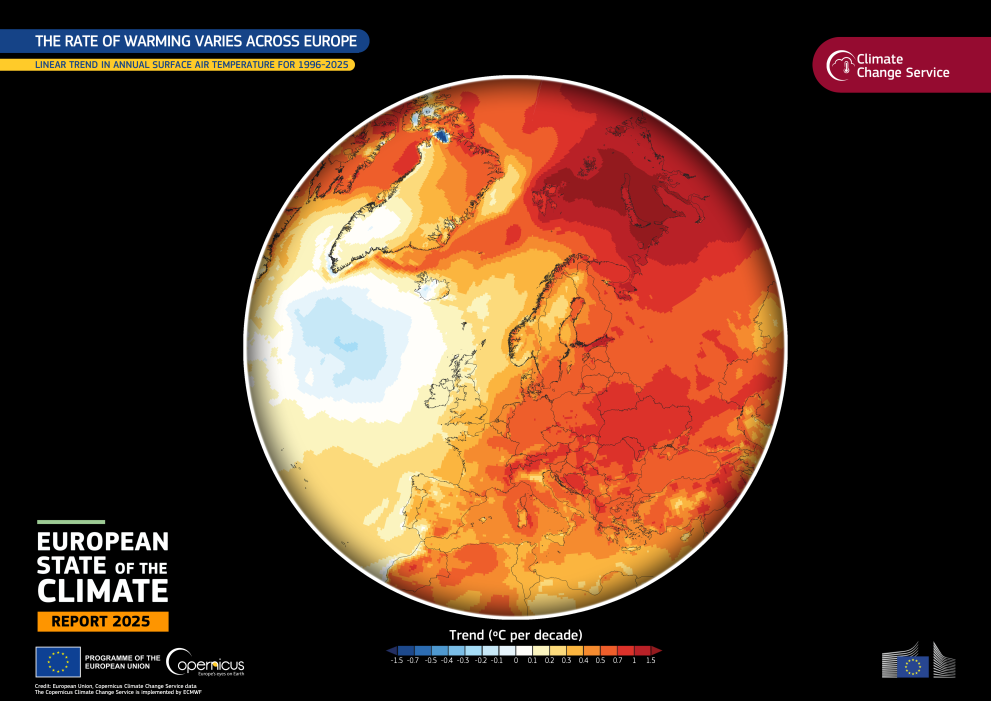
Throughout 2025, temperatures in 95% of the European Union’s territory exceeded the average. This confirms that Europe is warming faster than any other continent on Earth.
The European Commission reported this, citing a recent report from the Copernicus Climate Change Service.
The new analysis confirmed the previous findings of the European Climate Risk Assessment (EUCRA), which warned as early as 2024 that Europe was warming at twice the rate of the global average.
Time for urgent action
The acceleration of global warming requires more decisive action. In particular, the report emphasizes the need to:
- reduce greenhouse gas emissions to net zero;
- strengthen resilience to climate change;
- accelerate the transition to clean energy.
Intensification of extreme events
Across Europe in 2025, a series of large-scale heat waves swept through, one of which became the second largest in the history of observations. Even in subarctic regions, July saw prolonged periods when the temperature exceeded 30°C.
The heat exacerbated forest fires, which in 2025 set a new record for affected area, covering more than 1 million hectares of forests. Additionally, for four consecutive years, new records have been set for sea surface temperatures.
“Copernicus data is an alarming report and again confirms that Europe is the continent warming fastest. Today’s report on the state of the climate in Europe demonstrates the devastating and far-reaching impact of climate change on our societies, economy, and environment. The cost is constantly rising, and this is another reminder that clean energy is the best and only path forward for Europe,” emphasized European Commissioner for Climate Action Wopke Hoekstra.
It should be recalled that in its global temperature change report, the U.S. National Aeronautics and Space Administration (NASA) censored such words as “global warming”, “climate change”, “fossil fuel”, and “emissions”.
EcoPolitic also reported that the Council of Europe has finally adopted the bloc’s main climate goal. The EU is set to reduce emissions by 90% compared to 1990 levels by 2040.