Ukrainian agricultural production is gradually migrating to the western part of the country. And it is not only about the full-scale war-the primary reason is climate change, which is forcing farmers to seek territories with less scorching heat and a higher amount of precipitation. Climatologists give Ukrainian farmers a maximum of 10 years to adapt to the new conditions.
This was reported by Latifundist.com media in their article.
“Agroholdings will migrate west-now it is much warmer there than it was 20–30 years ago. In the past, it was nearly impossible to grow corn in Volyn or Prykarpattia. But now, not only corn is grown there, but also sunflower and grain,” previously noted Tetiana Adamenko, head of the agrometeorology department at the Hydrometeorological Center of Ukraine.
Natural zones have shifted
Over the past 20–25 years, the average temperature in Ukraine has increased by 1–1.2°C. At the same time, the difference in precipitation has become more pronounced-on the right bank, there is 10 cm more compared to the left. This difference is felt most acutely during the vegetation period, when plants require the most moisture. For instance, over the past four years, the Lviv region has averaged 683 mm of precipitation, while Zaporizhzhia has received only 455 mm.
These changes have already caused natural zones to “slip” westward and northward. The area of forest zone has decreased, while the arid steppe has expanded to almost 60% of the country’s territory.
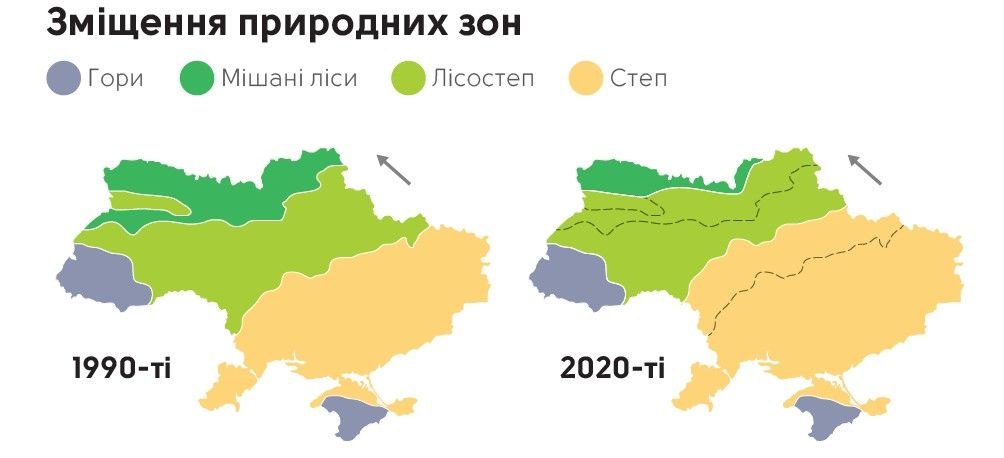
Source: latifundist.com
Usually, even summer droughts are offset by precipitation at the beginning of the year. However, this pattern has also begun to break down. The historical low for precipitation accumulation was reached in 2024.
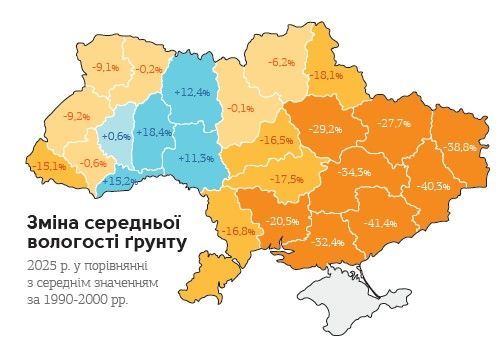
Source: latifundist.com
“Migration” of crops
If in 2019–2021 only 22% of grain and industrial crops were grown in the northwest of the country, by 2024 this figure had already reached 29%. This difference is not due to a reduction in area in one region and an increase in another; it is about the physical growth of production on the existing territories.
Which crops will be grown in different regions of Ukraine in the future
Gradually, due to the climate, a new structure for the distribution of crops is being formed. The south is becoming hotter and drier, humidity in the center is unstable, while in the west and north the situation is becoming increasingly favorable for agribusiness.
The forecast is as follows:
- South will lose its role as the vegetable and grain core. The reasons are moisture deficit, extreme heat, and the destruction of irrigation systems. This part of Ukraine will have to transition to a differentiated model. The transition will likely include more drought-resistant oilseed and grain crops with a short growing season. Vegetables will be grown only in local clusters.
- Center will enter a phase of climate turbulence. Among traditional crops, it will be necessary to find room for plants from the South. The priorities will be maintaining a balance between wheat, corn, and sunflower. It is expected that melons and vegetable crops may migrate here. However, investment in climate-technological adaptation will still need to increase.
- The North may forget about its limited potential. Production of various crops will increase here. Currently, Sumy and Chernihiv regions produce 21% of the country’s corn, and the area under wheat is gradually expanding. Growth in the fruit and vegetable segment is also projected.
- The West will become the new center of agriculture. In addition to higher humidity and lower temperatures, the regions here are less threatened by war, and the EU is closer. However, the main limitation remains the smaller area of agricultural land.
“As in the North, there is a rise in production across the main crop segments. The western regions are already among the top five in barley, soybean, rapeseed, and sugar beet production. Corn output is gradually increasing. The western region will continue to draw in the production of cereals, industrial crops, and vegetables,” writes Latifundist.com.
EcoPolitic previously reported that, according to forecasts, in 2026, may become the second warmest year on record.