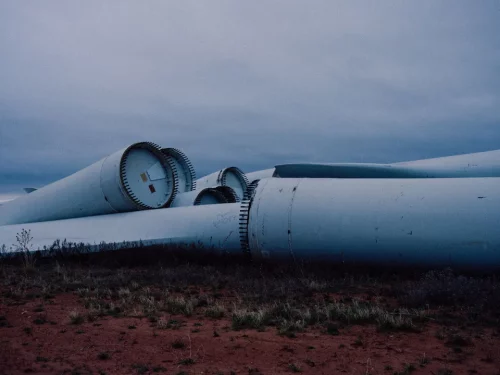
Chinese researchers have invented a way to reuse spent wind turbine blades, namely to curb desertification.
This was reported by the online publication Gizmodo.
The authors of the study emphasize that this approach not only solves the problem of recycling decommissioned wind turbine blades, but also reduces the shortage of materials for wind protection. It also helps stabilize the situation with sand spread in the Gobi Desert.
The results of the study showed that the erosion rate of wind turbines as a barrier against sand spread can be 56% lower than that of wood-based materials, and their bending strength is 14 times higher. The researchers also found that a blade porosity of 20% is optimal for reducing sand deposition.
According to the scientists, measures to create sand barriers are being taken to minimize economic losses and protect the environment. Although classic barriers against sand spread made of branches and reeds are inexpensive and environmentally friendly, they are short-lived and cannot withstand extreme conditions.
The authors of the study added that artificial materials are more effective in counteracting sandstorms, but they are also not ideal because they face difficulties in areas with strong winds. Materials must be strong, durable, resistant to wind erosion, heat-resistant, affordable, and have optimal porosity.
According to experts, new porous sand barriers made from decommissioned wind turbine blades have excellent resistance to ultraviolet radiation and erosion, high strength, and thermal stability. In particular, they are suitable for recycling and can be used for a long time.
It should be noted that in 2024, China became the leader in terms of investment in wind energy.
Germany, India, the US, and Brazil also attracted large investments in wind energy. These five countries together accounted for 81% of all new capacity added, which is 1% more than in the previous year.