At a time when fierce debates are raging over the European Union’s Emissions Trading System (EU ETS), Ukraine is preparing to launch its own system in less than two years. By April 1, the Ministry of Economy, Environment, and Agriculture of Ukraine was required to report to the government on the progress of the plan to establish the system, which was approved a year ago.
There is currently no up-to-date information available in the public domain regarding progress on this issue. Therefore, EcoPolitic decided to analyze Ukraine’s readiness to implement carbon pricing. In this article, we will examine:
- what an emissions trading system (ETS) is;
- how widespread the implementation of national ETSs is among countries around the world and why such a system is needed for Ukraine;
- what stage the development of our carbon market is currently at;
- whether it is realistic to launch the first operational stage of the domestic ETS in 2028.
What is an ETS?
The emissions trading system is a market-based mechanism for reducing emissions that contribute to global warming. It is one of the key instruments of carbon pricing.
The essence of the mechanism is that the state sets an overall cap on greenhouse gas (GHG) emissions for enterprises. Each company receives or purchases a certain number of allowances free of charge. These can be used for its own needs, saved for future use, or sold as a surplus on the quota market to other enterprises. The price of such allowances is determined by the market.
Emissions trading systems: which countries use them
The world’s first carbon market was the European Union Emissions Trading System (EU ETS), which was launched over 20 years ago, in 2005. Today, it is one of the largest such markets in the world.
Video: climate.ec.europa.eu
According to the latest report by the International Carbon Action Partnership (ICAP), as of April 2025 there were 38 emissions trading systems in operation worldwide and another 20 under development or consideration. Operating ETSs already cover more than 12 Gt CO2-eq., or 23% of global GHG emissions.
The countries that have implemented an ETS account for a total of one third of the world’s population and 58% of global GDP.
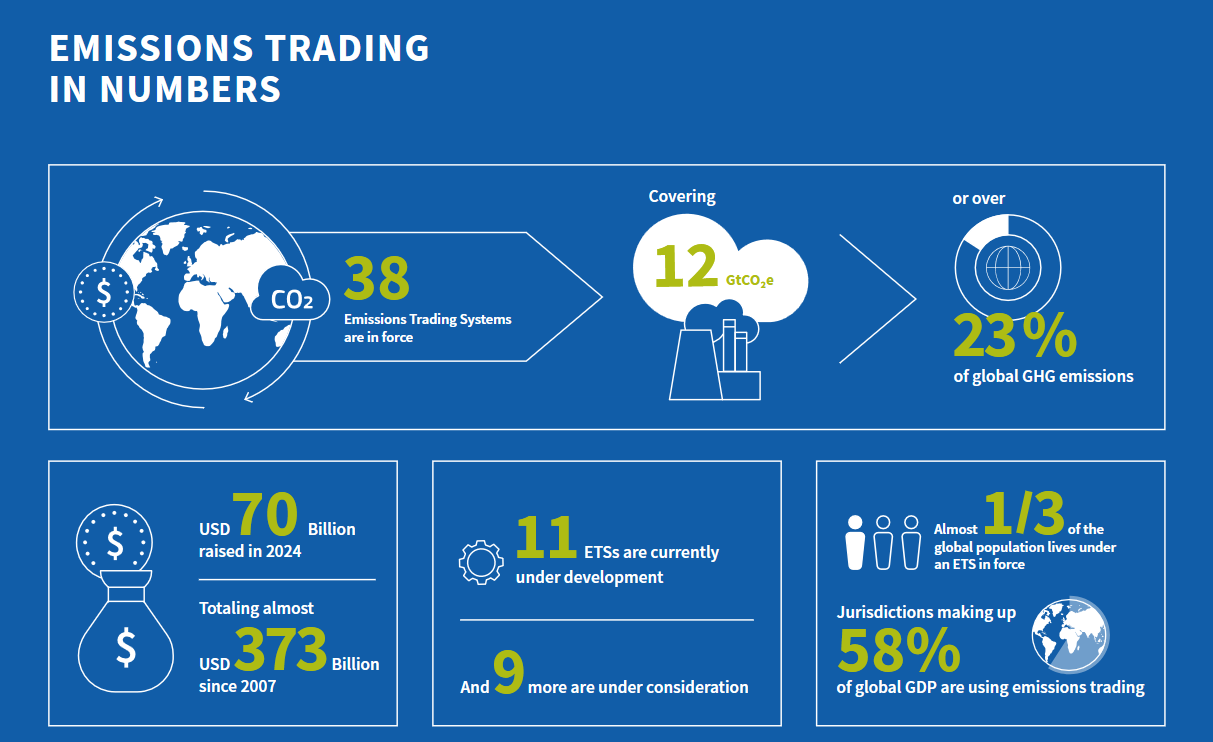
Source: icapcarbonaction.com
Seventeen G20 countries already have, or plan to introduce, an ETS at the national or regional level. This enhances the role of carbon pricing in leading economies.
Why does Ukraine need an ETS?
It is clear that the global trend toward implementing national emissions trading systems (NETS) is only gaining momentum. Moreover, the introduction of an ETS is one of the key instruments for achieving climate neutrality and remains a fundamental requirement for Ukraine’s accession to the EU.
The Ministry of Economy explains that carbon pricing is being implemented due to requirements from the International Monetary Fund (IMF) and the European Union, as well as in accordance with national financial and climate strategies. The agency placed particular emphasis on the inevitability of introducing a carbon price during the online event “Introduction of the ETS in Ukraine: Feasibility and Recommended Configuration” in December 2025. However, how actively are officials working on its practical implementation, and will they be able to complete all the necessary tasks by the planned launch date of the first operational phase of the ETS in 2028?
What stage is the preparation for the launch of the domestic system at?
The Ukraine Facility Plan notes that the emissions trading system is a complex instrument requiring the development of a significant regulatory framework, the establishment of the necessary infrastructure, and strengthening the capacity of various participants. It is important to understand that the ETS is a multi-component system. Its successful implementation depends on many factors. GMK Center analyst Andriy Hlushchenko lists the following mandatory elements of preparation:
-
adoption of a framework law;
-
approval of subordinate regulatory acts;
-
creation of technical infrastructure for emissions accounting, quotas, and trading;
-
designation of the government body to administer the ETS and the training of specialists to work in it.
The complexity of setting up the ETS is also confirmed by the European experience: the EU ETS has been implemented for more than 20 years, yet its rules are constantly being reviewed and amended.
Legal framework
Back in 2014, our country undertook commitments under the Association Agreement between Ukraine and the EU to develop national legislation and introduce an emissions trading system.
According to Stanislav Zinchenko, Head of the Industrial Ecology and Sustainable Development Committee of the European Business Association (EBA), Ukraine has lost many years since signing this Agreement without initiating the procedure to implement the ETS.
“There were probably many objective reasons, but they do not justify the lack of results,” the expert believes.
In October 2024, the Verkhovna Rada adopted the Law of Ukraine “On the Basic Principles of Climate Policy,” which provides for the introduction of the ETS.
A little later, in November of the same year, the Ministry of Environmental Protection and Natural Resources published a draft Cabinet of Ministers order “On the Approval of the Action Plan for the Creation of a National Greenhouse Gas Emissions Trading System.” In February 2025, the government approved this Plan.
It is noteworthy that in the first version of the document, the ministry limited the timeframe for drafting and submitting the draft Law on the ETS to 2025–2026. Officials planned to draft and adopt other regulatory acts necessary for its implementation later—in 2027–2028.
In the approved version of the Plan, officials gave themselves more leeway: they scheduled the preparation of both the draft law and the accompanying subordinate legislation for 2025–2028. In other words, formally, they can prepare the first version of the Law on the ETS by the end of 2028. And this is despite the fact that the first operational phase of the ETS launch is already scheduled to begin in 2028.
It is very difficult to say right now how things will actually turn out. A year ago—in April 2025—the Ministry of Environment promised to present a draft law on the ETS to the business community as early as May. At the end of last year, during the event “Post COP30: Results, Achievements, and Next Steps in Ukraine’s Climate Policy,” then-Deputy Minister of Economy, Environment, and Agriculture Pavlo Kartashov identified the official submission of the final draft of the CSD bill to parliament as one of the ministry’s key tasks for 2026.
Now, Oleg Bondarenko, chairman of the Verkhovna Rada’s Committee on Environmental Policy and Nature Management, noted in a comment to EcoPolitic that the only information he currently has is that the bill is being drafted by the government.
Questionable progress in implementing the plan
By April 1, the Ministry of Economy was supposed to report to the Cabinet of Ministers on the implementation of the Action Plan for the creation of the National Science and Technology System, which was approved last February. The ministry has not issued any public statements on this matter, so let’s take a look for ourselves.
According to this document, by 2025, the Ministry of Environmental Protection and Natural Resources was supposed to, in particular:
-
collect stakeholder proposals regarding the parameters for ETS operation;
-
identify the authorized body that would manage and supervise its implementation;
-
define the scope of NETS application;
-
determine the requirements for creating and operating the Unified Registry of the Emissions Trading System for greenhouse gas (GHG) allowances;
-
select approaches for setting the overall cap on allowances and their allocation;
-
establish requirements for competitive selection of emissions trading market operators;
-
set the rules and procedures for the targeted use of proceeds from allowance sales;
-
introduce financial compensation and allocate free allowances for vulnerable sectors of the economy;
-
ensure ongoing stakeholder dialogue and establish working groups for the implementation of the NETS.
Before its liquidation in July last year, the Ministry of Environmental Protection and Natural Resources managed to:
-
identify the economic sectors proposed to be included in the emissions trading system;
-
establish procedures for calculating the overall emissions cap and allowances;
-
develop several approaches to allowance allocation.
The Ministry of Economy analyzed two options for developing carbon pricing instruments in Ukraine and, at the end of last year, presented a carbon pricing system configuration suitable for our country.
In general, these are all the results of the work reported by the relevant ministries. It is worth noting that Ukrainian government agencies are currently almost entirely excluded from the process of developing proposals regarding ETS parameters and the draft regulations necessary for its operation. The reason is a lack of funding and expertise. This work is primarily being carried out by foreign projects and companies that have funding, but their expertise is questionable. That is why we currently have very limited progress.
Analyst Andriy Glushchenko confirmed our findings.
“At this point, the Ukrainian government has only presented a proposal with ideas for launching the ETS; in other words, all other aspects of the work have not been completed—at best, they are in the initial stages,” he says.
Objectively speaking, the Ministry needs time to draft a high-quality bill. The ETS is an entirely new system for our country and has to be designed amid the many challenges and uncertainties caused by the war. We hope that the Ministry of Economy will fulfil one of its key tasks for 2026 by submitting the final draft of the ETS bill to Parliament on time.
Read the second part of this article coming soon to learn how Ukraine is fulfilling its commitment to the EU regarding the creation of market-based carbon pricing mechanisms, and whether it will be able to launch the NCTB in 2028, as officials have planned.