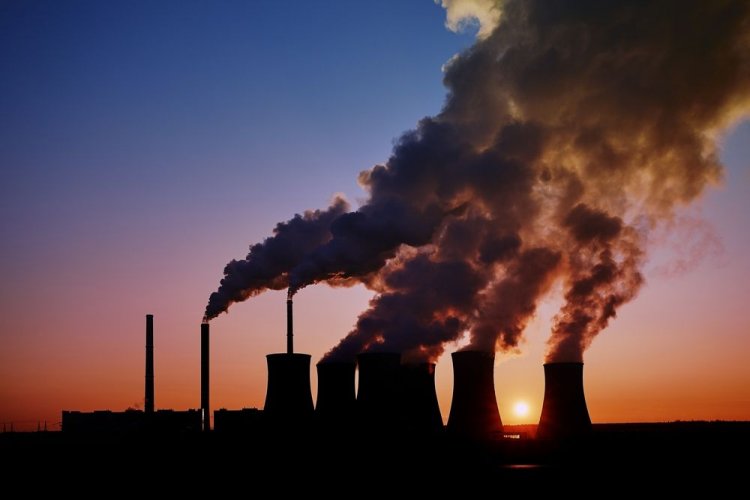
Chinese engineers have announced a breakthrough: a coal-fired power plant technology that does not burn coal and produces zero emissions. At the same time, this type of power generation could be twice as efficient as traditional methods.
This was reported by PiataAuto.
A Source of air pollution
Coal-fired power plants are among the dirtiest in electricity generation due to high emissions of CO₂, ash, and toxic impurities. Despite filters and the relative cheapness of coal, they have effectively become the outcasts of the energy sector today.
China still actively uses them, although it is simultaneously rapidly developing nuclear, hydro, and renewable energy, and has committed to reducing emissions.
A typical coal-fired power plant operates by directly burning the fuel. The heat warms a water circuit, the water turns into steam, and the steam drives a turbine. As recently as 2025, coal-fired power plants accounted for 60% of China’s electricity generation.
From “impractical” idea to reality
The Chinese did not invent anything fundamentally new: the idea of such clean coal generation had long existed in theory, but it was rejected due to the complexity of practical implementation.
However, Chinese scientists have step by step removed obstacles and developed a viable technology, which has now been tested and can truly generate energy without pollution.
Technology's distinctive feature
A typical coal-fired thermal power plant produces 2,010–2,580 kWh of electricity per 1 tonne of coal, although it could theoretically yield up to 6,700 kWh. The reason is the efficiency level, or thermal efficiency, of 30–40%.
The new technology achieves station-level efficiency of about 60%. Thus, compared to classical thermal power plants, coal will be used 50–100% more efficiently.
The essence of these innovative power stations is the abandonment of fuel combustion in favor of fuel heating. The fuel passes through an electrochemical cell, or fuel cell, acting precisely as electricity is generated from hydrogen. The process yields energy through a chemical reaction. There is no need to heat water, generate steam, or drive turbines.
“This eliminates much of the undesirable side effects of coal combustion, such as massive emissions that are difficult to filter or capture, and also prevents a significant portion of the heat losses that occur during coal burning,” the media notes.
It is worth mentioning that a carbon oxidation process still occurs. However, it is localized in the electrochemical cell, from which the gas is much easier to capture. This CO₂ can be used for various industrial purposes, including the production of synthetic fuels.
The only challenge is that the coal must be ground into powder with particles no larger than 10 microns and must be moisture-free. Additionally, to initiate the reaction, external energy is required to heat the chamber to 600–900 degrees Celsius, but after that, the internal reaction no longer needs external support.
EcoPolitic previously reported that China plans to double the capacity of its "green" energy by 2035.
Thanks to renewables, China managed to reduce greenhouse gas emissions for the first time since 2022.