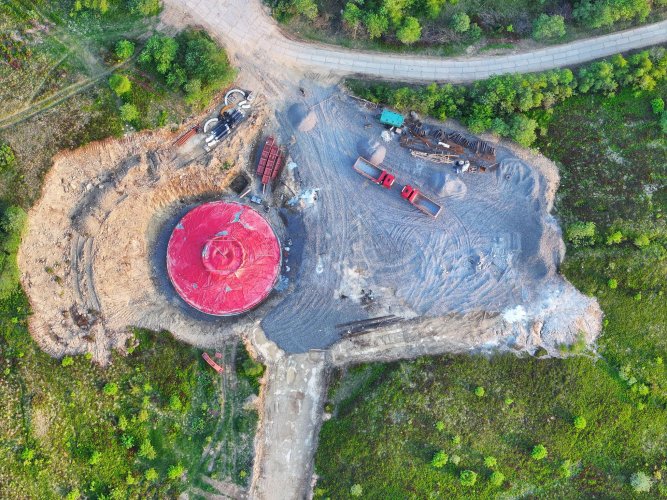
The Kyiv District Administrative Court has not allowed activists to sue the Ministry of Economy, Environment and Agriculture over a controversial environmental impact assessment (EIA) conclusion it issued for the construction of a wind farm on the Runa mountain pasture in Zakarpattia. Environmental campaigners consider this conclusion unlawful and are seeking its annulment. However, the judges considered the case without summoning the parties, without even allowing the plaintiffs to explain the full body of arguments set out in 5,000 pages of annexes.
As reported by the "Environment-People-Law" (EPL) organisation, they have already filed an appeal against the court's decision.
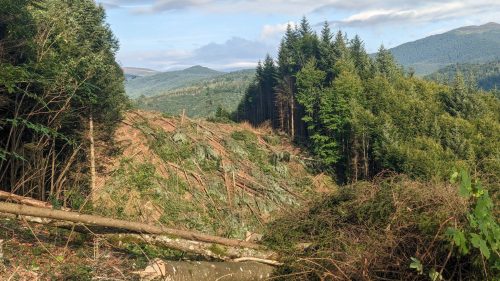
"The court decided to allow the destruction of the Runa mountain pasture, despite violations of international conventions, the destruction of habitats and serious risks to species that live or feed on the Runa mountain pasture or use it as a migration route," the organisation stressed.
Not allowed to present their position
The Kyiv District Administrative Court considered the case under simplified proceedings, without summoning the parties to court. The court refused to consider the case under the general rules on the same day it decided the case on the merits.
"The court was not prepared to hear all the plaintiffs' arguments at an in-person hearing and examined the more than 5,000 pages of annexes to the statement of claim very superficially, yet it studied the objections of "Turianskyi Wind Park" LLC in great detail and readily accepted their arguments and the evidence they submitted," EPL said.
A combination of violations of Ukrainian and international norms
EPL believes that, in considering the case, the court did not examine the materials sufficiently and failed to properly assess the key arguments of the environmentalists. In particular, this concerns a possible breach of Ukraine's international environmental obligations, an incomplete environmental impact assessment and restrictions on the public's right to participate in environmentally significant decision-making.
Transboundary impact. The court should have examined whether the Ministry of Economy took into account the likely transboundary impact of the power plant's operation when issuing the EIA conclusion. In particular, this concerns checking for possible violations of the UN Convention on Environmental Impact Assessment in a Transboundary Context. According to EPL, the ministry merely accepted the information as a formality, and the court effectively agreed with this approach.
Public participation. EPL stressed that the public learned of the existence of additional information to the EIA report, amounting to some 1,500 pages, only two weeks before the Ministry of Economy issued its conclusion. As a result, stakeholders were unable to study it and form their own opinion. Public hearings were held a year before this data was received, and the public consultation ended on the day the additional information was registered.
Concealing the felling of forest. The plaintiff stressed that the EIA report referred to a technical alternative that did not involve felling forest to lay cable lines. At the same time, the EIA conclusion already mentions the construction of utility lines. EPL believes that the party that commissioned the report was thereby trying to avoid an environmental impact assessment of 18 km of forest felling.
Threat to biodiversity. EPL believes that, by issuing the controversial EIA conclusion, the Ministry of Economy violated the Bern Convention and the principles of state environmental policy. In particular, the report recorded 11 species of bats with international protection status on the construction site. The construction of a wind farm, in turn, has a significant anthropogenic impact on the area, fragmenting natural habitats and threatening bat nesting and feeding sites. Relaxing the application of the provisions protecting them would only have been possible with sufficient evidence that the construction is of high public interest. However, according to the plaintiff, this was not done.
As a reminder, the Ministry of Economy issued the EIA conclusion for this project, even though construction had in fact begun back in 2025. It was accompanied by attempts by environmental activists, the public and even MPs to stop the destruction of the fragile ecosystem of the high-mountain pasture. But all in vain. Later, the State Inspectorate for Architecture and Urban Planning (DIAM) acknowledged that separating the foundations from the main project was unlawful, but the Ministry nevertheless stated that it was unable to stop the project.