The efficiency of solar panels shows what share of sunlight a photovoltaic cell converts into electric current. Commercial silicon modules deliver 19–23%.
That is why, when solar power plants in Chernivtsi or any other city are designed, engineers immediately allow for the physical losses of materials: the remaining 80% of the energy is inevitably reflected from the surface or converted into heat.
The efficiency of an individual panel is not the same as the performance of the entire solar power plant. Inverters, cables and battery packs take their share. Manufacturers record baseline figures under the STC standard. These are ideal laboratory conditions: irradiance of exactly 1000 W/m², a cell temperature of +25°C and a radiation spectrum corresponding to AM 1.5. On an actual house roof, these parameters coincide for only a handful of hours a year.
How to calculate solar panel efficiency: formula and example
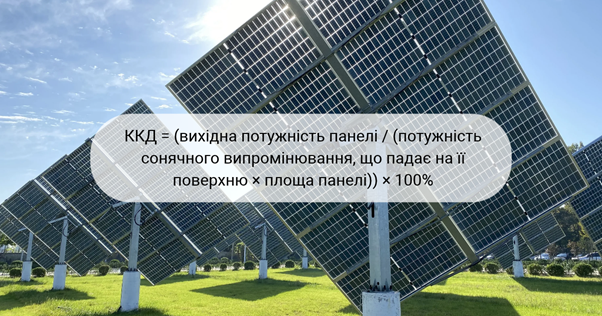
The calculation is based on a simple mathematical proportion. The formula is: Efficiency = (panel output power / (power of solar radiation falling on its surface × panel area)) × 100%. The area is calculated from the module dimensions given in the technical data sheet. The rated power of the solar panels is also stated there. For the STC standard, radiation intensity is taken as a constant 1000 W/m².
Take a typical 400 W panel with an area of 2 square metres. The calculation is: 400 / (1000 × 2) = 0.2. Multiply by 100%. So the actual figure is 20%. Data sheet specifications usually match this maths to within tenths of a percent. If a manufacturer states 400 W on two square metres but promises 25% efficiency, you are looking at marketing manipulation.
What solar panel efficiency depends on: the main factors
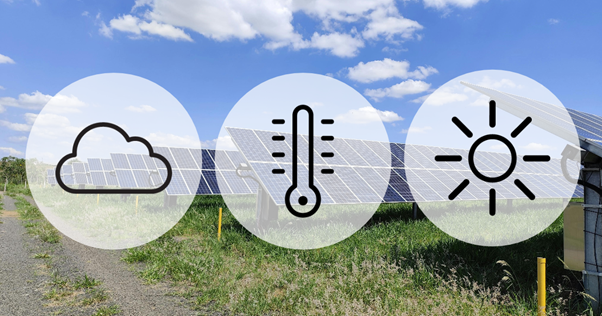
Chemical composition sets the basic generation limit. Monocrystalline cells lead the market thanks to the purity of their silicon, polycrystalline cells are cheaper and weaker, while thin-film cells are flexible but rarely break the 12% barrier. Baseline solar intensity is dictated by geography. In southern regions, modules work more intensively. The vagaries of the weather change the rules of the game every day. Dense cloud cover cuts output by a factor of five to seven.
When the surface heats up to +50°C, a module loses up to 10–15% of its rated power. The temperature coefficient clearly shows how fast this drop occurs. Even the best monocrystalline cell will not save the situation if it is assembled on a cheap substrate with poor contact insulation. The quality of materials directly affects the stability of operation and the efficiency of solar panels.
How do installation and operating conditions affect panel efficiency?
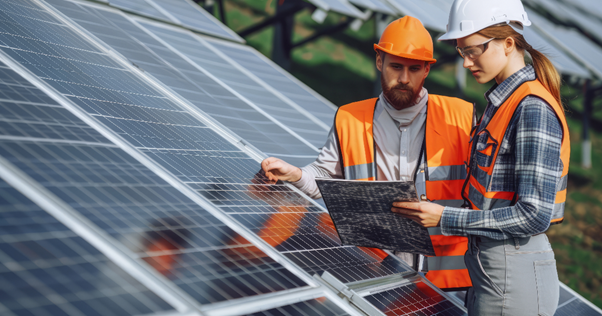
A south-facing orientation remains the gold standard. The tilt angle is selected according to local latitude, usually 30–35 degrees for a year-round balance.
Shade kills generation disproportionately. A tree branch or chimney covering just 5% of the area can shut down a third of a module because the cells are connected in series. Dust, bird droppings and autumn leaves act as a dense filter. Snow cover reduces output to zero altogether until it melts. Part of the energy is inevitably dissipated on its way to the grid. Cable resistance and losses from converting direct current to alternating current take up to 15% of the energy collected, especially if the installation is careless.
How much electricity does a solar panel generate and how can its actual performance be assessed?
A rating of 400 W is only peak potential. Actual output is measured in kilowatt-hours and depends on total insolation, which is the main indicator of what determines the amount of solar energy in real conditions. In Ukraine, one such panel will deliver about 2 kWh on a sunny summer day and barely 0.3 kWh on an overcast December day. The regional difference between Odesa and Chernihiv reaches 20% over the year. The installation angle and temperature regime shape the final generation curve and the actual performance of solar panels.
A high data sheet percentage does not guarantee record results in winter. A module with lower efficiency but a better temperature coefficient will produce more energy per day on a scorching metal roof.
How to increase and preserve solar panel efficiency?
The choice of components decides a project's fate at the outset and determines the future efficiency of solar panels. A cheap inverter will quickly negate the advantages of premium photovoltaic cells. MPPT controllers and microinverters extract the maximum from each string, getting around the problems of partial shading. Solar trackers physically turn the array to follow the sun, adding up to 30% more output. However, the mechanics require expensive maintenance, which often eats into the profit.
A dirty panel needs to be washed regularly. A layer of spring pollen imperceptibly steals up to 10% of power. Photovoltaic cells inevitably degrade over time. In the first year, silicon loses about 2–3% of its performance, and then 0.5% annually. When choosing equipment, look at the power retention warranty: the industry norm is at least 80% after 25 years of operation.