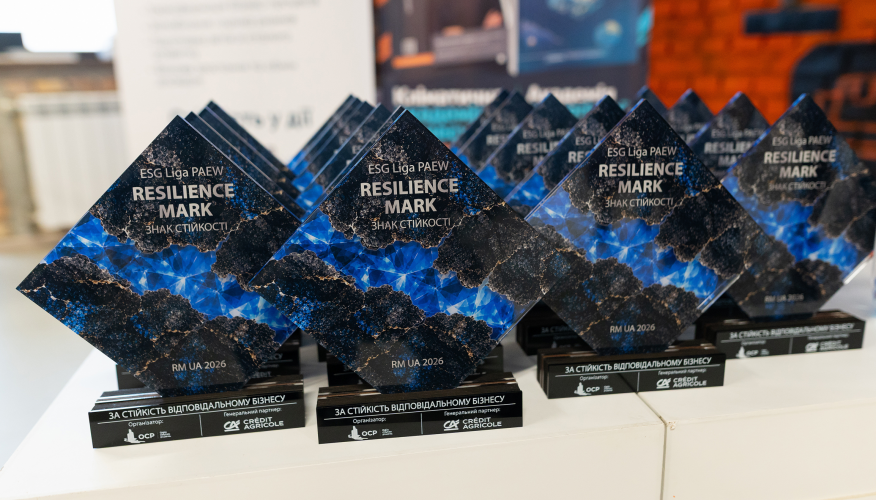
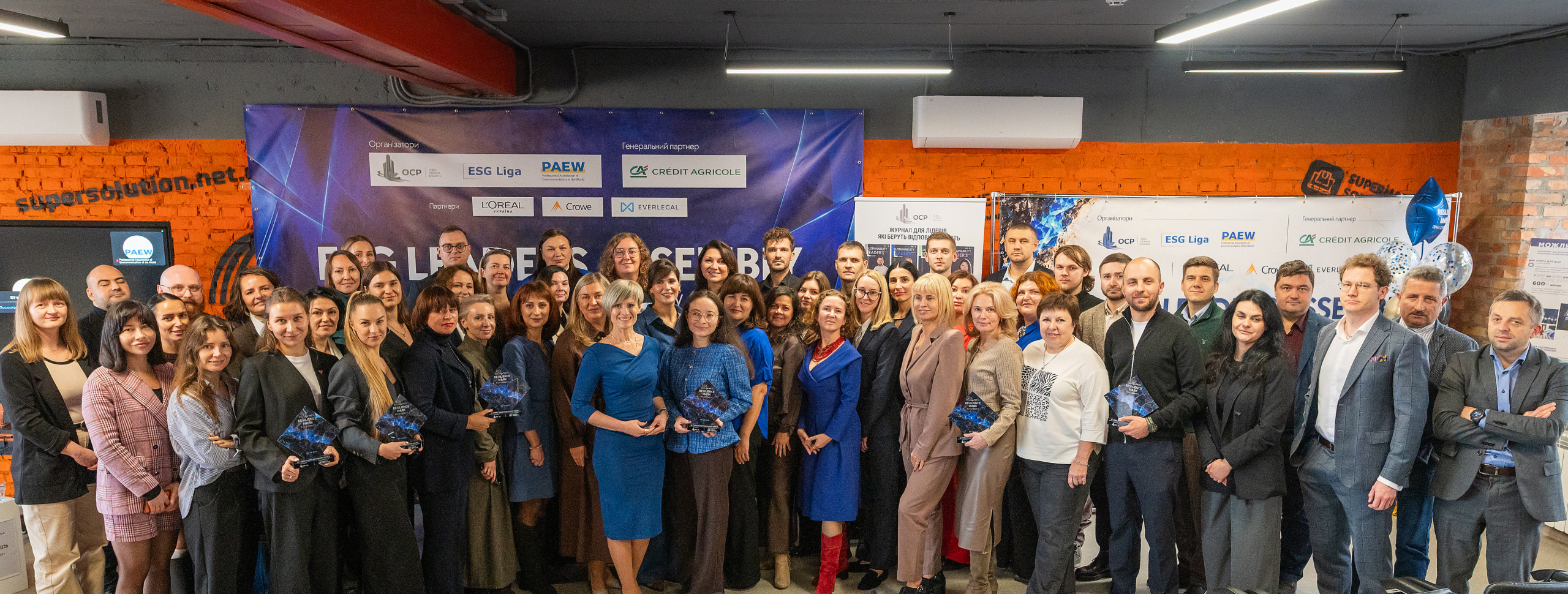
On 22 October, the RESILIENCE MARK 2026 awards were presented as part of the ESG Leaders Assembly "Responsibility That Has a Price". RESILIENCE MARK is a new professional award for Ukrainian teams that, amid the full-scale war, not only keep operating but also continue to invest, modernise production, protect people, support communities, introduce environmental and social solutions and build businesses with a horizon longer than today's crisis.
The ESG Leaders Assembly was organised by the Office of Sustainable Solutions and ESG Liga PAEW. The general partner was Crédit Agricole Ukraine. The partners were L'Oréal Ukraine, Crowe Ukraine and EVERLEGAL.
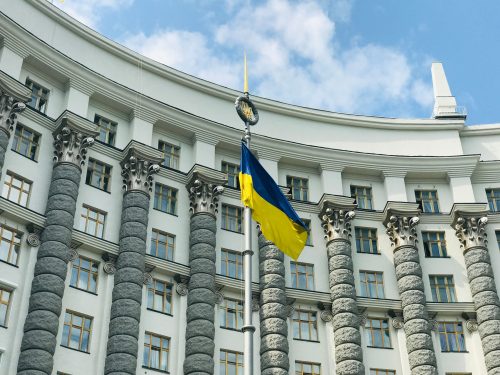
The event brought together representatives of large and medium-sized businesses, energy, industry, the agricultural sector, retail, FMCG, pharmaceuticals, IT, professional services and other sectors. A separate part of the programme was a dialogue with the Ministry of Finance of Ukraine on future European sustainability reporting requirements, accountability for ESG data and the readiness of Ukrainian business for the new regulatory reality.
However, the central theme of the ESG Leaders Assembly was not reporting as such. The focus was on the decisions that companies are already making today in the real conditions of war.
Source: ESG Liga PAEW
RESILIENCE MARK: new professional recognition of exemplary strong practices
What criteria can be used to determine business resilience during war? And if companies are not ranked from first to last place, why do these particular teams receive the award? This is a fundamental question for the RESILIENCE MARK concept.
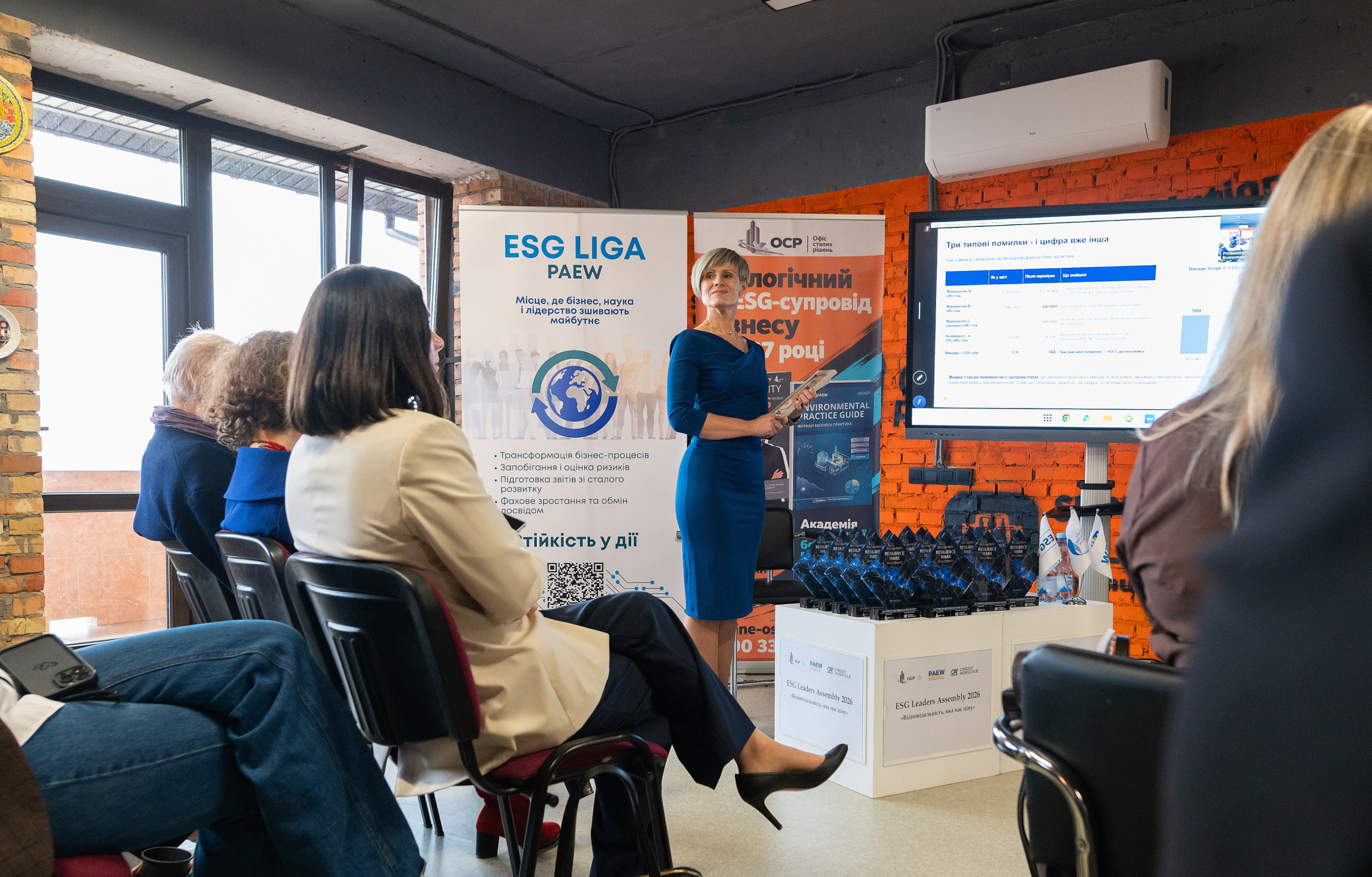
RESILIENCE MARK does not measure who had it harder. The award assesses something else: how a team responded to its challenge, what solution it found, whether it managed to deliver a result, whether this result can be confirmed and whether the experience gained is valuable for others. It is professional recognition for teams that can demonstrate a solution, a result and evidence, and whose experience is strong enough to become a benchmark for others.
Source: ESG Liga PAEW
In 2026, the following teams received the RESILIENCE MARK.
NPC "Ukrenergo": ESG not for a report, but for managing critical infrastructure
The NPC "Ukrenergo" team was recognised for laying the foundation for systemic ESG management of critical energy infrastructure amid the full-scale war. The company carried out a comprehensive double materiality assessment in line with European ESG approaches. It analysed 86 impacts, risks and opportunities, 30 of which were identified as material.
Importantly, the assessment did not remain an exercise for future reporting. Its results are used in work on policies, risks and strategic planning. The material issues include the resilience of the power system, the safety and well-being of employees, engagement with communities and the continuity of electricity supply.
The company also calculated its direct greenhouse gas emissions and indirect emissions from purchased energy in line with the GHG Protocol for the first time, laying the groundwork for further decarbonisation and climate governance targets.
The value of this case lies precisely in the shift from ESG as a set of indicators to ESG as information for management decisions.
JSC "Ukrgasvydobuvannya": energy independence, people's safety and support for communities
"Ukrgasvydobuvannya" received the RESILIENCE MARK for its ability to continue hydrocarbon production, which is critical for the country, under constant threats, while strengthening the protection of its employees and supporting communities.
The company is equipping shelters, providing protective equipment and training employees in first aid. A separate area is the integration of 484 veterans, in particular through the "Veterans – the Backbone of Safety" project, in which combat experience is transformed into knowledge that can improve the safety of colleagues.
Since 2022, the company has joined more than 350 social and infrastructure initiatives in 69 communities across eight oblasts, and its support for the Security and Defence Forces amounted to about UAH 2.2 billion.
This case is about the resilience of a critical business, measured not only by production results, but also by the ability to protect the people and territories on which these results depend.
Kyivstar: communications as critical infrastructure
For Kyivstar, resilience means responsibility for communications that millions of people, businesses and the state need every day. The company is restoring damaged infrastructure, investing in the energy independence of its network and developing technologies that can maintain access to communications even where the traditional terrestrial network is unavailable. One of these areas is cooperation with SpaceX on the introduction of Starlink Direct to Cell. In parallel, technological resilience is complemented by social solutions: from supporting defence initiatives to the "Ambitious" programme, aimed at creating educational opportunities for Ukrainian youth.
It was precisely the combination of critical infrastructure, technological investment and responsibility for future human capital that became the basis for recognising the team.
"Metinvest": helping people return to work and feel support nearby
Returning from war continues long beyond the first working day. A person will need to restore their health, receive psychological support and have time for professional and social adaptation. Colleagues and managers, in turn, need to understand how to support a veteran, respect their experience and take their needs into account without prejudice or excessive paternalism. For "Metinvest", one of Ukraine's largest employers, this issue is particularly important: according to the company, more than 8,300 of its employees are serving in the Armed Forces of Ukraine, and more than 1,000 veterans have already returned to work at its enterprises.
"Metinvest" is recognised for its comprehensive veteran policy, which combines assistance to employees and their families with preparing teams for the return of their colleagues. The "Heroes Nearby" and "Leadership in Wartime" programmes help managers and teams build interaction with veterans, take their needs into account and create a supportive working environment. Rehabilitation through swimming, an extended medical insurance programme and veteran camps support physical and mental recovery, while psychological counselling, "Pobratym" group meetings and other targeted assistance provide the necessary support in difficult life circumstances.
Importantly, the company creates opportunities not only for returning to a previous job but also for further professional development. Mentoring, adaptation and retraining programmes help veterans restore their skills or master new professions. Through the "Metinvest Polytechnic" university, they can obtain higher education at the company's expense.
Additional support comes from veteran spaces at the enterprises and the "Spilkui. Veteran" initiative, which brings together former military personnel, specialists and communities to jointly address pressing issues.
The particular value of this approach lies in taking responsibility for the entire path of return. "Metinvest" does not limit its veteran policy to individual assistance programmes, but integrates it into its corporate culture and daily management processes. For a company whose enterprises continue to operate, including in frontline regions, this is a way to retain experienced specialists, maintain production and strengthen the resilience of industrial communities.
The RESILIENCE MARK for "Metinvest" is recognition of its responsibility for the people who defend the country and return to civilian life. For a veteran, it is an opportunity to recover, work and develop with support nearby. For the team, it is the ability to support a colleague and maintain trust. For Ukraine, it is an example of a systemic veteran policy that helps people return to professional life, enterprises retain human capital and communities become stronger.
DTEK Grids: data on stork migration for safer energy
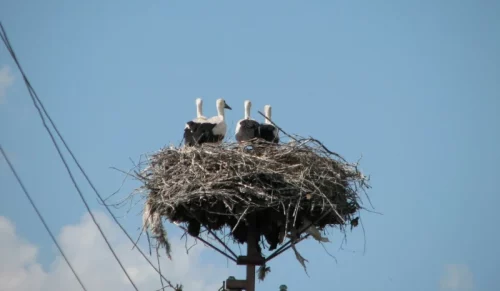
"Stork Track" became one of the most unconventional cases of RESILIENCE MARK 2026. In 2026, the DTEK Grids distribution system operators, together with Ukrainian ornithologists and PAEW, launched Ukraine's first initiative for systematic GPS monitoring of white stork migration.
At the pilot stage, ten young birds in Odesa and Dnipropetrovsk oblasts were fitted with trackers. Data on routes, stopover sites and wintering grounds are to be used to map areas where migration routes intersect with power grids and to plan targeted protective measures.
This is an important change in logic: from responding to individual incidents to preventive, data-driven risk management.
It is particularly telling that this project is being developed during the large-scale restoration of energy infrastructure. Restoring quickly is a necessity. Restoring in such a way that the new infrastructure is safer for nature is already a sign of a different quality of management decisions.
DTEK Naftogaz: exploring the subsoil more precisely with less impact on the surface
The DTEK Naftogaz team was recognised for using a cableless seismic survey system. The technology makes it possible to obtain high-quality geological data, reduce uncertainty when planning wells and more accurately identify promising drilling sites. At the same time, it is deployed faster, requires less transport and puts less pressure on ecosystems.
According to the company, the carbon footprint of such surveys is 60% lower compared with cable systems.
This is one of those cases where environmental efficiency is not set against production efficiency. On the contrary, technological modernisation simultaneously gives the business more accurate data, reduces the operational burden and lowers the environmental impact.
Naftogaz Group: not letting the war shorten the planning horizon to tomorrow
Naftogaz Group was recognised for combining day-to-day responsibility for the country's energy security with strategic transformation.
In September 2026, the Supervisory Board approved a decarbonisation strategy until 2050, developed with the support of the European Investment Bank. It envisages reducing methane emissions and technological gas losses, developing the company's own generation and introducing low-carbon solutions.
For RESILIENCE MARK, the very context of this decision is fundamental: strategic transformation is not being postponed "until the end of the war".
Resilience here is the ability to serve as the country's energy backbone today while making decisions with a horizon of decades.
"ZAKHIDNADRASERVIS" Group of Companies: energy investments that take biodiversity into account
The Group was recognised for an approach in which energy development is accompanied by systematic management of environmental and social risks.
The company is investing in three wind farms with a total capacity of 132.5 MW and 15 solar power plants with a capacity of 128.33 MW.
Its wind energy projects apply the approaches of IFC Performance Standard 6: critical natural habitats are studied, seasonal bird monitoring is carried out, protected areas are taken into account and biodiversity conservation measures have been developed.
This is an example of the fact that ESG in large infrastructure projects begins not after construction and not with a report, but at the investment planning stage.
Atmosfera: from a solar plant to a new infrastructure of energy resilience
Atmosfera received the RESILIENCE MARK for its practical contribution to strengthening the energy resilience of businesses and communities.
The company has completed more than 3,000 solar power plants, and the total capacity of installed photovoltaic modules has exceeded 600 MW.
The Energy as a Service and "Station for Rent" models deserve special attention, as they allow businesses to use their own solar generation without large upfront capital investments.
For social infrastructure, Atmosfera, together with partners, implemented 27 projects providing autonomous power supply to administrative service centres (TsNAPs) and shelters for internally displaced persons in five oblasts. These are communities with a combined population of about 1.5 million people.
Another level of impact is human resources. In 2026, the professional standard "Solar (Photovoltaic) Power Plant Installer", developed by the Academy Atmosfera team, was approved.
In other words, the company is working simultaneously on technology, the accessibility of the financial model, the resilience of communities and the professional capacity of an entire industry.
Farmak: modernisation that works for both environmental performance and production continuity
Farmak was recognised for consistently strengthening the operational and environmental resilience of its production.
Its practical solutions include solar power plants, cogeneration units, and modern industrial wastewater filtration and ventilation systems.
The principle itself is important in this case: environmental modernisation does not operate separately from production resilience. Reducing dependence on traditional energy sources, energy efficiency, wastewater control and the quality of production infrastructure simultaneously work to reduce impact and enable the enterprise to continue operating in crisis conditions.
Enzym Group: wastewater turned into an energy resource
Enzym Group received the award for one of the most illustrative examples of industrial resource efficiency.
The company invested more than EUR 10 million in the construction and modernisation of treatment facilities that combine the treatment of industrial wastewater with biogas production.
Last year, the company's own biogas replaced 1.93 million m³ of natural gas. The average annual substitution rate was 64.5%, reaching 75% in some months.
This is no longer just environmental protection infrastructure. Production process waste becomes a source of energy, the environmental investment reduces dependence on fossil fuels, and resource efficiency directly strengthens operational resilience.
In parallel, the company continues to develop the innovative LinkCell production, its own R&D division and new biotechnological products, preserving high-tech industrial potential in Ukraine.
IMC: responsibility for the next season
IMC was recognised for combining productive agricultural production with land conservation, support for people and the resilience of communities.
The company operates in Chernihiv, Sumy and Poltava oblasts. It supports employees whose property was damaged by the war, as well as landowners and their families, co-financed shelters for 146 children from seven villages and helps communities repair roads.
At the same time, in 2025, IMC produced 838,000 tonnes of grain and oilseeds. The company is introducing soil fertility conservation practices, installing solar panels at its elevators and using grain processing by-products as fuel.
The essence of the case lies in responsibility not only for this year's harvest, but for the ability of the land, people and communities to work next year and further into the future.
BTU biotechnology company: Ukrainian science as a tool for the climate resilience of the agricultural sector
BTU was recognised for developing Ukrainian biotechnologies aimed at restoring soil fertility, reducing dependence on certain chemicals and adapting agricultural production to climate change.
The company has its own research centre, more than 60 biological products and a production capacity of 10,000 tonnes per year. Its solutions are applied on an area of about 4.5 million hectares.
The particular value of the case is the ability to bring a Ukrainian scientific development to practical application in the field. Amid soil degradation, droughts, temperature changes and rising resource costs, this is no longer just a matter of environmental friendliness but also of the long-term capacity of agricultural production.
Continental Farmers Group: investing in production without separating it from the development of territories
"Continental" cultivates about 190,000 hectares of land and continues to invest in production infrastructure, technology and logistics during the war.
However, the RESILIENCE MARK also recognises the link between these investments and the territories where the company operates.
The small grants programme supports local initiatives, "Grant for a Start" supports sports clubs in small towns and villages, and the educational projects "Smart Garden", "Smart Garden. Microgreens" and "Smart with Continental" introduce children to modern agricultural production and the responsible use of resources.
The environmental initiatives "Insect House" and "Linden Marathon" are aimed at biodiversity and supporting pollinators.
This is an example of a model in which investments in agricultural production should leave value not only on the company's balance sheet, but also in the territories where it operates.
"Landex Agro": bringing land back to life after occupation
One of the strongest cases in terms of context was presented by "Landex Agro", which operates in the de-occupied territories of Kharkiv Oblast.
With the participation of a state programme and international donors, the company ensured the demining of more than 17,000 hectares of arable land, returning these areas to safe agricultural use.
In parallel, the basic infrastructure of communities is being restored. In particular, a well in Nova Ivanivka has provided clean water to more than 1,000 people, and the company's activities create jobs in eight de-occupied communities.
This is perhaps one of the most precise examples of why Ukrainian ESG cannot be mechanically copied from peaceful European practice today. Here, the restoration of land, the economy, water supply and community life are effectively parts of a single solution.
Danone Ukraine: preserving not only the plant, but the entire chain
After losing access to its enterprise in Kherson, Danone Ukraine restructured its operating model and continued production.
However, the team worked not only on its own continuity. Guaranteed purchases of raw materials and advance payments gave local farmers the resources to continue working. Support for employees, energy-efficient solutions and the donation of products to hospitals, frontline and de-occupied territories complemented this model.
Therefore, the RESILIENCE MARK in this case is recognition of responsibility for the entire chain: from the farmer who needs to continue production to the person who needs food today.
Carlsberg Ukraine: sustainable practices within the daily operating model
Carlsberg Ukraine continues to implement the global Brewing Tomorrow strategy even in wartime.
The company is reducing the amount of plastic in its packaging and aluminium in its cans, reusing returnable glass bottles where the security situation allows, and introducing regenerative farming practices in the cultivation of malting barley.
The social dimension is also integrated into the business model: 50% of board positions are held by women, the segment of non-alcoholic and low-alcohol beverages is being developed, and the company communicates responsibly with consumers.
A separate area is humanitarian drinking water for the regions where it is needed most, as well as support for reconstruction and rehabilitation.
The company was recognised precisely because sustainability is not placed in a separate charity block but is present in production, packaging, raw materials, people and product solutions.
METRO Ukraine: supporting the ecosystem in which business can operate
METRO Ukraine received the award for systematic support for people, entrepreneurship and communities. During the war, the company kept its retail infrastructure running, supported suppliers and professional customers, and during blackouts its shopping centres served as additional charging points.
As of 1 September 2026, the amount of charitable assistance, according to the company, exceeded UAH 86 million.
However, the significance of the case goes beyond charity. It is about supporting small and medium-sized enterprises, employment, professional customers, inclusiveness and human capital – that is, the ecosystem without which economic recovery is impossible.
"Epicentr K": restoring the business without leaving people alone with the consequences of the war
More than 30 facilities of the "Epicentr" group have been destroyed or damaged as a result of Russian attacks.
The company is restructuring its logistics, strengthening its energy independence, and installing solar power plants and backup power sources. Employees who lost their jobs due to the destruction are offered employment in other divisions.
At the same time, in 2022–2026, the "Ukrainians Together" programme gave its participants almost 3 million discounted purchases worth a total of about UAH 500 million.
More than UAH 200 million under the "Saving Lives" project was allocated to ambulances for medical evacuation. The company also supports prosthetics and sports rehabilitation for veterans, children of fallen Heroes, school shelters and resilience centres.
The award here is for the ability, after its own losses, not to limit its responsibility exclusively to restoring the business.
SOCAR Energy Ukraine: safety must be part of the infrastructure itself
SOCAR became the first network in Ukraine to start creating comfortable protected shelters directly at its filling station complexes. They are free of charge, operate around the clock during air raid alerts, and their locations are integrated into the company's mobile app.
However, the strength of the case lies not only in the infrastructure built. The company has restructured staff training: for cashiers, operators and filling station managers, it has created algorithms for action during alerts, practical workshops and gamified training sessions simulating real situations.
In other words, safety has become not an instruction on the wall, but a system that the team must be able to apply at a critical moment.
Nemiroff: energy independence as a competitiveness factor
In 2025, Nemiroff's own gas cogeneration unit generated 1,139,200 kWh of electricity and covered 47% of the plant's needs. The company has modernised its cooling and heat supply, arranged for the reuse of heat from cogeneration and is introducing other energy efficiency measures.
Making the 0.5-litre glass bottle lighter by about 35 grams makes it possible, according to the company's estimates, to save about 7.5 tonnes of glass and avoid about 4.5 tonnes of CO₂ every year. In 2025, 99% of the waste generated was handed over to specialised contractors for recycling or treatment. The next step is a biogas complex using post-distillation stillage.
At the same time, after a forced shutdown at the beginning of the invasion, the company resumed production, restructured its international logistics and maintained its presence in more than 50 countries.
This case shows a direct link between resource efficiency, energy autonomy and international competitiveness.
"AVE Uzhhorod" LLC: when sorting becomes city infrastructure
The company was recognised for consistently building a municipal system for separate waste collection. As of September 2026, there were eight eco-islands in Uzhhorod, and another one opened in October.
The result is clearly visible in the dynamics: while in 2013, 22.7 tonnes of sorted waste were sent for recycling, in 2024 the figure exceeded 300 tonnes.
In parallel, the company works with people's behaviour: in the first nine months of 2026 alone, more than a thousand children took part in 34 excursions and eco-lessons.
The value of the case lies in the combination of physical infrastructure, measurable results and many years of work to change the habits of city residents.
Maven Group: furniture as an asset, not future waste
Maven Group presented ReMaven, a model for systematic management of the furniture life cycle. A digital passport is created for each item with information on materials, technical condition, maintenance and repairs. Instead of automatically replacing furniture, the company offers restoration, reupholstery and extending its service life.
In 2026 alone, more than 2,000 pieces of furniture were restored, keeping 18 tonnes of materials in use. According to the company's calculations based on EPDs and GHG Protocol principles, this made it possible to avoid 61 tonnes of CO₂ emissions.
The importance of this case lies in the attempt to turn circularity from a general environmental idea into a clear business model for managing assets, costs and future investments.
Suziria Group: from relocating production to new capacities in Ukraine
Suziria Group received the RESILIENCE MARK for restoring and expanding Ukrainian production and for its systematic assistance to animals affected by the war.
After the start of the invasion, part of the production was relocated from Kharkiv, but the company did not limit itself to preserving its existing capacities. In September 2022, it launched the production of dry food, in November 2023 – meat treats, and in February 2026 – a new wet food production facility with a capacity of up to 5,000 tonnes per year.
Even after losing a modern distribution centre in Kyiv Oblast, the company continued its investments and restructuring of logistics.
The second dimension of the case is Suziria Charity. Since the start of the full-scale invasion, more than 100,000 animals have received assistance, and more than 500 tonnes of food have been donated for charitable needs.
This is an example of a team that, after its own losses, not only restores its business but also continues to take responsibility for those who particularly depend on human help.
"Interpipe": responsibility does not end at the factory gates
"Interpipe" was recognised for its work with communities and the creation of an animal shelter. In this case, what matters is not the scale of technological investment, but the company's choice itself: even at a time when resources are needed to protect people, production and recovery, to leave room for the needs of the community and the most vulnerable.
War leaves not only people homeless. Creating an animal shelter reduces the burden on the community and at the same time shows employees that the company's declared values do not disappear at a moment of crisis.
It was precisely the ability to preserve humanity when there are enough problems of one's own that became the basis for professional recognition.
D.SERVICE: employee health as business resilience infrastructure
The D.SERVICE case deliberately shifts the social component of ESG from the plane of "caring for staff" to the plane of business risk management.
Using the example of the comprehensive health and resilience support system for DTEK Group employees – Health & Resilience Infrastructure – the team shows that in wartime, health, working capacity, recovery, staff retention and workforce capacity directly affect a business's ability to keep operating. This becomes especially important amid staff shortages and a protracted crisis.
Here, the RESILIENCE MARK recognises the management approach itself: the social component of ESG becomes not an additional corporate programme, but an element of operational resilience.
SoftServe: technological expertise as a national resource
SoftServe was recognised for the systematic use of its own technological expertise to support people and Ukraine. More than 510 of the company's employees have joined the Defence Forces. Their jobs are retained and they receive financial support, while veterans are offered programmes for medical recovery, psychological assistance, retraining and return to civilian work.
The "Open Eyes" charitable foundation has donated more than 400 ambulances, and LifeWaves is working on protecting frontline medical crews from drones.
Through OpenTech, the company's specialists create digital solutions for public needs free of charge. In 2025 alone, 16 solutions were implemented and more than 27,850 volunteer hours were contributed.
This is an example of how the company's core competence – technology – becomes a resource for societal resilience.
EVERLEGAL: legal expertise that turns into recovery infrastructure
EVERLEGAL received the RESILIENCE MARK for legal solutions for people, communities, humanitarian organisations and Ukrainian business. In 2022–2025, the team performed more than 6,500 hours of legal work for more than 20 organisations that help Ukraine.
One of the particularly important cases is a study of the possibilities of using escheated inheritance and ownerless property to provide housing for internally displaced persons. The work covered 82 communities, and the practical guide that was prepared gave local self-government bodies algorithms and document templates.
The team also supports compensation for war damage, defends Ukrainian companies, helps introduce ESG approaches and attract international financing. In 2025–2026, more than 540 hours of pro bono legal assistance were provided.
The particular value of this experience lies in turning professional legal expertise into a practical tool for recovery.
L'Oréal Ukraine: from assistance to long-term opportunities for people
L'Oréal Ukraine received the RESILIENCE MARK for its long-term programmes supporting women and women's entrepreneurship, for humanitarian aid and for its contribution to the resilience of medical infrastructure.
The "Beauty for a Better Life" programme has been operating in Ukraine since 2017, helping women who have survived violence, lost their jobs or homes, been forced to relocate or are returning to civilian life after military service to acquire professional skills and economic independence. More than 650 women have already completed the training.
In 2026, the company extended its partnership with UNFPA until 2029 and launched a grant programme for women's entrepreneurship – five grants of UAH 500,000 each.
Since the start of the full-scale invasion, about a million hygiene products have been delivered to more than 60 settlements, and the assistance has reached more than 400,000 people.
Energy resilience deserves a separate mention: with the company's support and in cooperation with non-profit organisations, seven Ukrainian hospitals have received solar power plants. This case shows the difference between one-off assistance and building long-term capacity – professions, own income, entrepreneurship, science and resilient social infrastructure.
What really unites these teams
At first glance, these cases can hardly be placed side by side. A GPS tracker on a stork and Naftogaz's decarbonisation. The reintegration of veterans and biogas from industrial wastewater. Satellite communications and a digital passport for a sofa. Demined fields in Kharkiv Oblast and solar plants at hospitals. A legal algorithm for communities and shelters at filling stations.
That is exactly why the RESILIENCE MARK is not a ranking. But all these solutions have one thing in common: they did not emerge in ideal conditions.
The teams chose them at a time when resources are limited, infrastructure is being destroyed, people are exhausted, the investment horizon is shrinking, and every long-term decision competes with dozens of urgent needs today. It is in such circumstances that the difference between a declaration and real value is most visible. Resilience is not the absence of problems. It is the ability of a team to get through them, adapt and not lose responsibility for the consequences of its own decisions.
That is why the RESILIENCE MARK is not just another statuette for a good corporate case. It is an attempt by the professional community to record exemplary Ukrainian practices of this time: those that have already been tested by reality, have a confirmed result and deserve to be known by others.
Perhaps, in a few years, it is these stories that will help explain much more precisely what the resilience of Ukrainian business during the war was really made of. Not slogans about invincibility, but concrete decisions that someone had to propose, defend, finance, implement – and deliver to a result.
Resilience through sustainability. Sustainability through concrete solutions. Evidence instead of declarations. This is the experience that the RESILIENCE MARK makes visible.