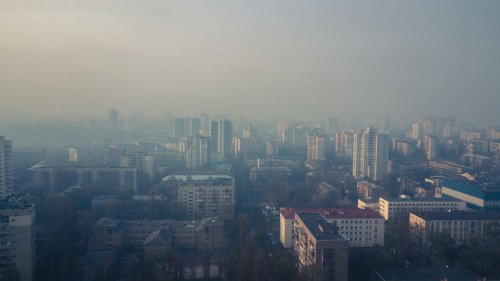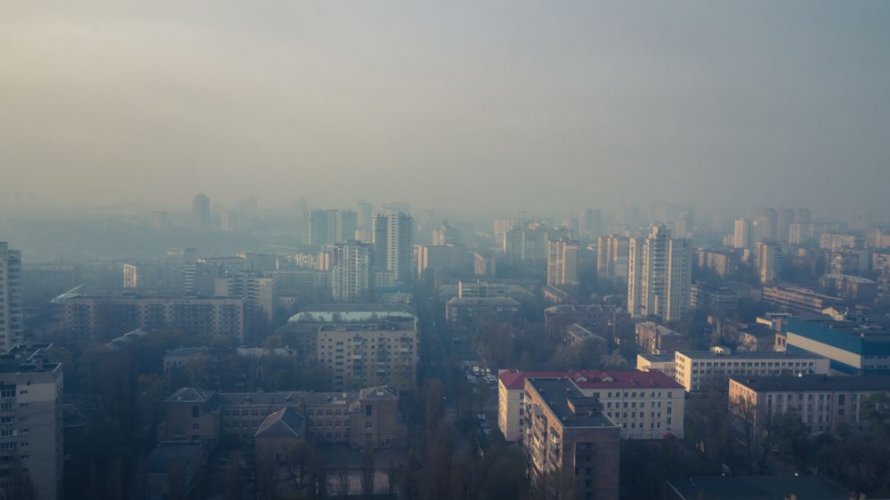
As of the morning of 6 October, the vast majority of major cities have moderate levels of pollution, which is fairly harmless to humans. However, there are exceptions.
This is evidenced by data from the international monitoring platform IQAir.
People in Kyiv are currently breathing air with an average level of pollution. It is not entirely healthy for humans, but it does not pose a high risk either. The most significant pollutant is PM2.5 fine particulate matter, with a concentration of 11.1 µg/m³. This is exactly twice the upper limit set by the World Health Organisation – 5.5 µg/m³.
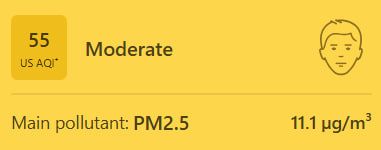
Locally, areas with moderate levels of pollution are the most common in the capital. For example, on Konovaltsia Street, the dust concentration is 19.6 µg/m3, on Sichovykh Striltsiv Street – 15.9 µg/m3, and on Horlivska Street – 12.1 µg/m3.
However, in some towns and villages near Kyiv, the situation is more serious. For example, in Irpin, pollution levels are unhealthy for sensitive groups, with dust levels at 41.6 µg/m3, whilst in Velyki Dmytrovychi, they are hazardous for everyone. The dust concentration there reaches 92.7 µg/m3.

According to the average figures, air quality in Ivano-Frankivsk corresponds to the ‘orange’ level – it is unhealthy for people with sensitive respiratory or cardiovascular systems. The dust concentration there is 37.1 µg/m3.
In most large cities, air pollution is moderate:
- Ternopil – 23.3 µg/m3;
- Kherson – 20.9 µg/m3;
- Odessa – 19 µg/m3;
- Vinnytsia – 18.6 µg/m3;
- Rivne – 18.2 µg/m3;
- Chernivtsi – 16.7 µg/m3;
- Lutsk – 15.8 µg/m3;
- Lviv – 14.5 µg/m3;
- Zaporizhzhia – 12.4 µg/m3;
- Khmelnytskyi – 11.5 µg/m3;
- Cherkasy – 11 µg/m3;
- Mykolaiv – 11 µg/m3;
- Dnipro – 10.3 µg/m3.
In these towns, air quality is good, with minimal impact on people’s health:
- Zhytomyr – 7.9 µg/m3;
- Chernihiv – 7.9 µg/m3;
- Poltava – 6.6 µg/m3;
- Kharkiv – 5.1 µg/m3;
- Uzhhorod – 3.3 µg/m3.
As a reminder, air quality may deteriorate in areas hit by Russian shelling. As Ukrainian scientists have found, in some places levels exceed the norm by up to ten times.