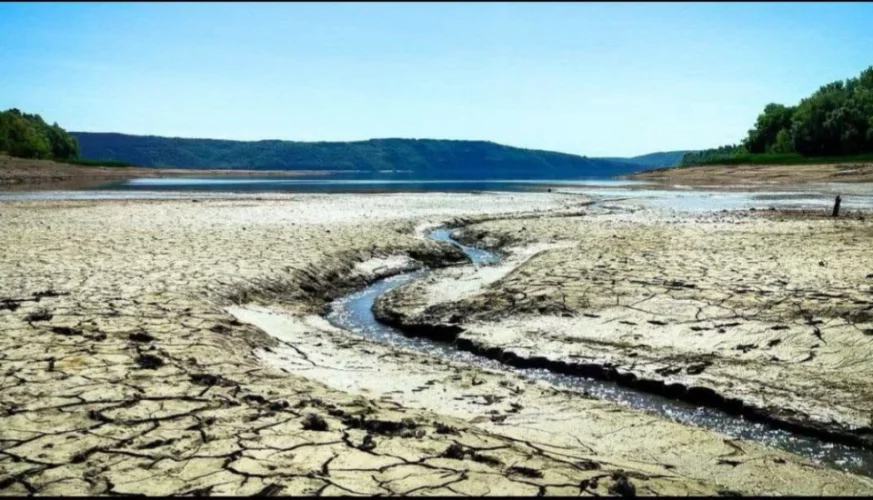
The inflow of water into the Dniester Reservoir in September was the lowest in the reservoir’s history. The forecasts for October are not encouraging – even if the hydrometeorological conditions are normal, the inflow will increase by an average of 5 per cent.
This was reported by the Ministry of Economy and the Environment.
During the first month of autumn, the inflow fluctuated between 24 and 31 m³/s. Ukrainian meteorologists recorded the lowest average daily inflow in the reservoir’s history on 17 and 20 September – 24 m³/s, which is just 11 per cent of the normal level.
However, there is virtually no chance of the situation improving significantly in October. If hydrometeorological conditions develop as normal, the average flow will be 20–40 m³/s. The midpoint of this range is around 16 per cent of the normal level.
Officials from Ukraine and Moldova discussed the water crisis during an extraordinary meeting of the Commission on the Sustainable Use and Protection of the Dniester River Basin. The Moldovan side stated, in particular, that there is already concrete evidence of the depletion of water resources. However, the key challenge is how, under such circumstances, to provide the population with sufficient water for drinking purposes.
"The Ukrainian side gave the Moldovan side advance notice of the switch to inflow-based allocation, and this is currently the necessary approach given the actual water levels in the Dniester. Should a critical situation arise regarding the supply of drinking water to settlements in Moldova, Ukraine is prepared to consider this matter at the level of the relevant competent authorities,” said Iryna Ovcharenko, Deputy Minister of Economy and Environment of Ukraine.
The Ministry of Economy has noted that the low water levels in the Dniester are already affecting the water supply to towns and villages. For example, in Chernivtsi and Novodnistrovsk, water is now being supplied on an hourly basis, whilst in Khotyn, the water intake is being operated manually.
The problem of low water levels has affected not only the Dniester, but also other rivers in Ukraine and across Europe. For Ukraine, this consequence of climate change is further exacerbated by a full-scale war. This is causing the destruction of water infrastructure and widespread pollution of water bodies.
As a reminder, due to critically low water levels in the rivers, water abstraction was restricted for 300 businesses, including municipal water supply companies.
In the Lviv region, the September rains failed to remedy the situation.
At the same time, experts reported that over the past 30 years, Ukraine has already lost around 30 per cent of its rivers. These have either disappeared completely or have been artificially fragmented.