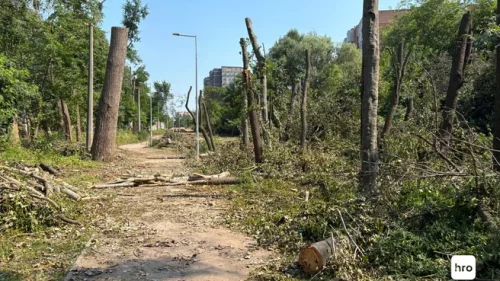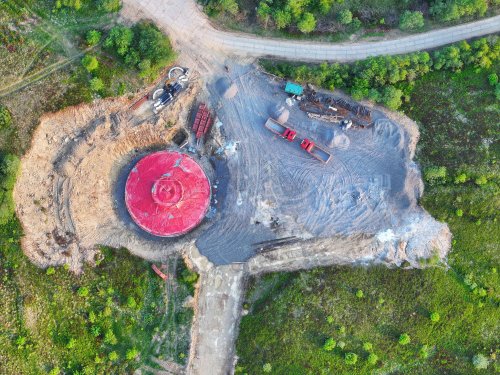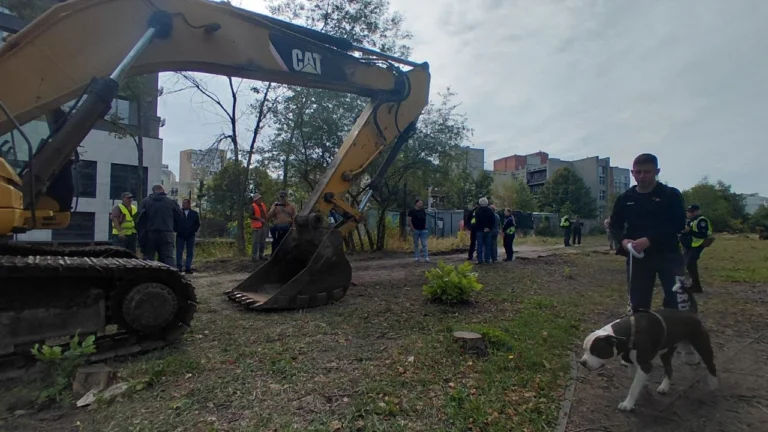
On 14 September, the contractor’s heavy machinery was spotted on the grounds of Teremky Park in Kyiv, following protests and a hiatus reportedly spent searching for an alternative route for the heating pipeline. At the same time, the public discovered that the Kyiv City State Administration was acting in breach of the law – relying on a Sustainability Plan that had not been approved in accordance with the statutory procedure.
This was reported by the ‘Golka’ civic initiative.
"We spotted the machinery this morning in the spot where ancient oak trees had recently been felled. That morning, a tractor was actually digging a trench for the heating pipeline. And this despite the fact that Maksym Myatko, a member of the National Union of Architects of Ukraine, had demonstrated that the heating pipeline could be laid along the gravel path closer to the ‘Respublika’ residential complex. There are far fewer trees there,” said local resident Natalia Chernyshova.
The authorities are acting unlawfully
As a reminder, the plan for laying the backup heating supply line involved felling 662 trees. To avoid having to seek approvals, including environmental ones, the authorities invoked Government Resolution No. 393. As an experiment, they permitted the construction process for such projects to be simplified – without the need for permits or land allocation.
Such construction must be included in the local ‘Resilience Plan’. However, there is a caveat. This plan must be approved not only by the community council, but also by a decision of the National Security and Defence Council of Ukraine. This is specified in paragraph 4 of the procedure for implementing the pilot project.
For weeks, “Holka” tried to find out who had approved Kyiv’s Comprehensive Sustainability Plan. A month later, the capital’s authorities finally provided a response and an explanation. And they do not reflect well on the administration.
"Kyiv’s Comprehensive Resilience Plan must be approved by a designated official and endorsed by a decision of the National Security and Defence Council. The Kyiv City State Administration’s response shows that this has not been done: the plan has been approved only by the Kyiv City Council. In other words, the city authorities can implement this plan, but cannot use Resolution No. 393 as a pretext to circumvent the general requirements of land and urban planning legislation,” explained Heorhii Mohylnyi, an analyst with the civic initiative.
According to him, the lawful procedure for constructing the heating pipeline would be as follows: the Kyiv City Council transfers the plot of land to ‘Kyivteploenergo’, which, in turn, obtains a building permit.
In other words, whilst using the project as a pretext, the Kyiv City State Administration has failed to fulfil its terms. The current actions bear all the hallmarks of unauthorised occupation of the site and unauthorised construction.
Furthermore, according to ‘Holka’, the construction project contravenes the Kyiv Master Plan and the detailed plan for the Teremky-3 area.
The organisation has stated that, due to the unlawful nature of the Kyiv City State Administration’s actions, Kyiv residents are preparing to take legal action.
The Kyiv authorities recently announced that they are optimising the heating pipeline route. This is said to save 160 trees from being felled.
Previously, the Kyiv City State Administration rejected alternative proposals drawn up by engineer Maksym Myatko of the National Union of Architects of Ukraine. Even if utilities were to be laid through the park, there was an option to minimise the number of trees affected.
According to the tender for the design of the heat supply line, it was to be laid along Teremkivska Street. Citing technical impossibility, the authorities changed the route. The public has not seen any documents justifying this decision.