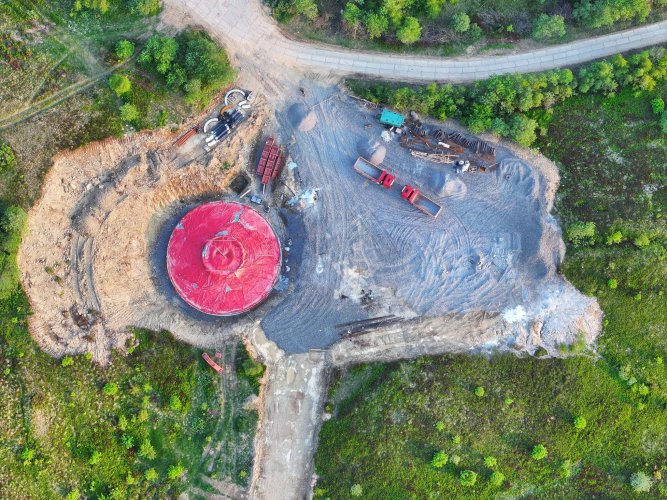
After the Ministry of Economy refused to take measures to protect rare species on the Runa mountain pasture in Zakarpattia, activists decided to appeal to the State Environmental Inspectorate. The aim was simple: to check whether the construction of the wind farm complied with the requirements of the environmental impact assessment. However, the environmental community was once again turned down.
This was reported by the Ukrainian Nature Conservation Group (UNCG).
Can the requirements be ignored?
When, in the face of opposition from the public, experts and members of parliament, the Ministry of Economy issued an environmental impact assessment report for the construction of the wind farm, former Minister Oleksiy Sobolev wrote:
"Next, the key point is compliance with all environmental conditions and transparent post-project monitoring. The Ministry will ensure that compliance with the requirements is monitored."
One of these requirements is precisely the conservation of plants and animals listed in the Red Data Book. UNCG points out that locations with similar species have been recorded on numerous occasions, providing photographic evidence and coordinates.
"Since May, we have written to the ministry on several occasions, demanding that measures be taken to ensure their preservation. The ministry sent a form letter in response. We have therefore approached the State Environmental Inspectorate to request an unscheduled inspection to verify compliance with the requirements of the EIA report," the community stated.
Is something that used to be lawful no longer so?
Environmental campaigners maintain that the practice of submitting such complaints is nothing new. The Environmental Inspectorate has carried out inspections in response to complaints from civil society organisations, including UNCG. However, in this instance, the group’s request was rejected. The reason given was that civil society organisations are not citizens, and therefore inspections cannot be carried out in response to their complaints.
However, the legality of an inspection carried out on the basis of a request from a civil society organisation has even been confirmed in court. Last year, similar findings were considered in case No. 420/38011/24.
Environmental campaigners are therefore surprised by this change of course by the DEI, as, according to this new logic, all its previous work in response to organisations’ appeals was unlawful.
"All in all, when it comes to protecting the Carpathians from development, we have found ourselves in a sort of bureaucratic dead end. We carry out dozens of expeditions and scientific studies, and write hundreds of letters, appeals and complaints. But officials at all levels keep coming up with new and ever more absurd excuses and pretexts time and again, so that they can do nothing and continue to favour the developer,” the activists write.
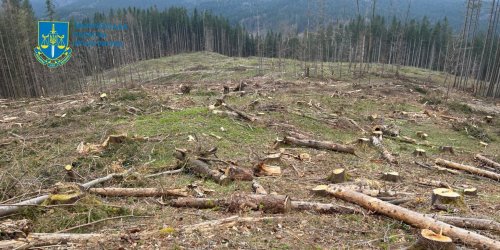
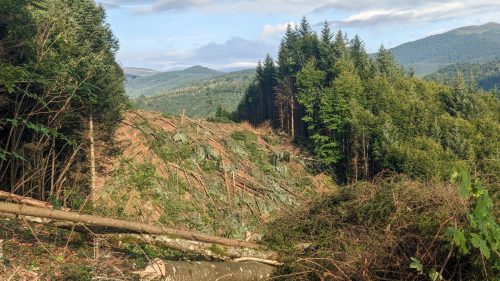
One particularly controversial aspect of the construction of the Runa wind farm is the felling of trees to make way for the power line, which the state-owned enterprise ‘Forests of Ukraine’ is carrying out in the Zhdeniivska community. A survey carried out in March quite clearly failed to identify any rare species under the snow, so the felling began. Activists had to document the presence of salamanders on several occasions in order to halt the felling. The authorities agreed to this, but without further inspections, the destruction of trees and animal habitats continued.
In Transcarpathia, there are also plans to clear the forest to make way for the construction of a road up Mount Gostra.
The court had previously ruled that primeval forests had been unlawfully cleared to build a road to the wind farm on the Runa mountain pasture.