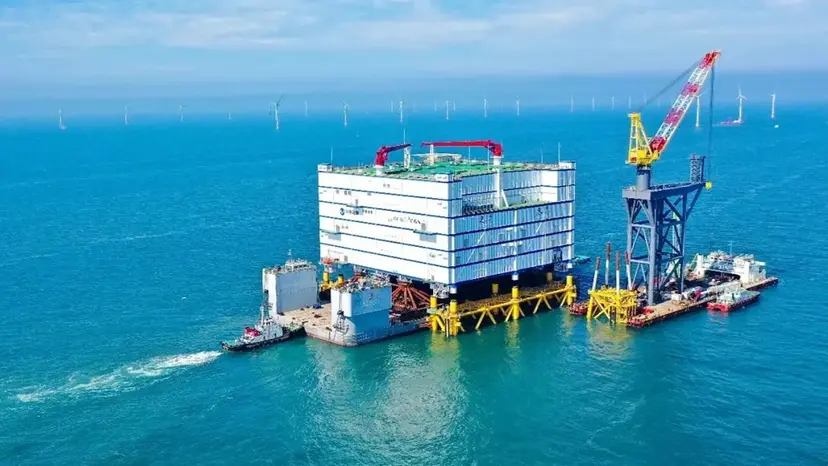
The world’s largest offshore power conversion station has recently been installed off the coast of Guangdong, China. It is capable of transmitting around 6 TWh of electricity each year, converting it from offshore wind farms.
This was reported by Interesting Engineering.
The large-scale platform was installed at the end of July 2026. Known as the ‘Heart of Offshore Wind Power’, it will collect energy from offshore wind farms and supply it to the mainland. The station is located approximately 100 km off the coast of Yangjiang in the South China Sea.
A global breakthrough
The facility is billed as the world’s first offshore direct-current converter station with a capacity of 2,000 MW. The project has already entered the final phase of laying the subsea cable. Testing of the connection between the offshore and onshore circuits is also currently underway ahead of the start of commercial operation.
The platform is expected to have a massive environmental impact, with CO₂ emissions set to be reduced by over 5 million tonnes annually.
Record-breaking converter station
The State-owned Assets Supervision and Administration Commission of China (SASAC) has revealed details of the construction of the largest offshore converter substation. The engineering complex consists of two separate structural units: a surface-mounted process platform and a massive support base mounted directly on the seabed.
The surface section is a seven-storey metal structure measuring 85.5 × 82.5 metres and 44 metres high. It weighs almost 25,000 tonnes. The lower module, which ensures the stability of the entire structure, measures 82 × 57 × 69 metres and weighs around 17,000 tonnes. It is this module that anchors the platform to the seabed and bears the main load during the facility’s operation.
EcoPolitics recently reported that the world’s largest solar-hydrogen substation has been built in China. The driving force behind this system is a 400 MW solar power station installed above coastal shoals. It is expected to generate 486 GWh of energy per year. This is enough to power 200,000 households.