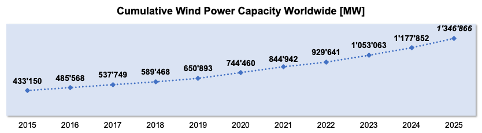
In 2025, the global wind energy sector added another 169 GW of capacity, which is 35% more than the increase in 2024. As a result, global wind energy capacity now exceeds 1,346 GW.
This is according to a recent report by the World Wind Energy Association (WWEA).
"The electrification of the transportation, heating, and cooling sectors further enhances the potential of wind energy. As demand for renewable energy is growing rapidly, driven by electric vehicles, data centers, and industrial decarbonization, wind is poised to become the backbone of a renewable-energy-based future," experts emphasize.
Growth rates are rising
The analysis shows that in 2025, the growth rate of the wind energy sector was the highest since 2020.
Already, wind provides humanity with 3,000 TWh of energy, accounting for 11% of global consumer demand.
In 12 countries, wind energy accounts for more than 20% of consumption. The leaders are Denmark, Germany, the United Kingdom, the Netherlands, Ireland, and Uruguay.
Source: WWEA
China dominates
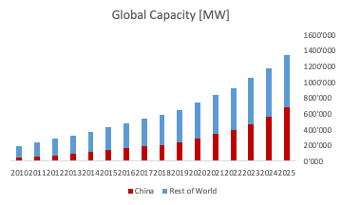
A colossal 77% of the global market for new wind energy is accounted for by China. Last year, China installed 130 GW of capacity, which is 49% more than the previous year.
China's share of global wind power capacity now stands at 50%.
The rest of the world
Outside China, wind energy is growing unevenly. New capacity reached 38.7 GW, which is higher than in 2024, but still less than in 2023.
India added 6,300 MW of generation, the United States – 6,272 MW, Germany – 4,602 MW, Vietnam – 2,493 MW, Brazil – 2,244 MW, and Turkey – 2,142 MW.
Traditional markets are stagnating, including the United States and Germany. In contrast, the wind boom is more active in India, Chile, Turkey, and Vietnam.
Source: WWEA
Highest and lowest growth rates
Analysts found that only 5 out of the 30 leading countries showed growth rates above the global average:
- China – 23.2%;
- Turkey – 15.5%;
- Vietnam – 50.8%;
- Chile – 23.9%;
- India – 13.1%.
However, many previously strong markets showed very modest growth or even a decline compared to 2024:
- United States – 4.1% versus 2.8%;
- Germany – 6.3% compared to 4.6%;
- United Kingdom – 3.1% versus 6.4% in 2024;
- Brazil – 6.7% compared to 17.7% the previous year;
- France – 5.2% versus 5.8%.
EcoPolitic earlier reported that in the EU, renewables covered 47% of demand in 2025.
The data for Ukraine are more modest. Last year, the share of renewables in energy consumption amounted to 10.7%.