The amount of environmental tax paid by Ukrainian enterprises showed a slight increase in 2025. However, like other resource payments, it increasingly depends on a limited number of large enterprises.
This is evidenced by the results of a joint study by KNEU professor and financial analyst Roman Kornilyuk and the YouControl R&D center in collaboration with the Open Data Association NGO.
In addition to the environmental tax, resource payments include rent and lease payments and land tax. Most of them have their own taxation and targeted use mechanisms.
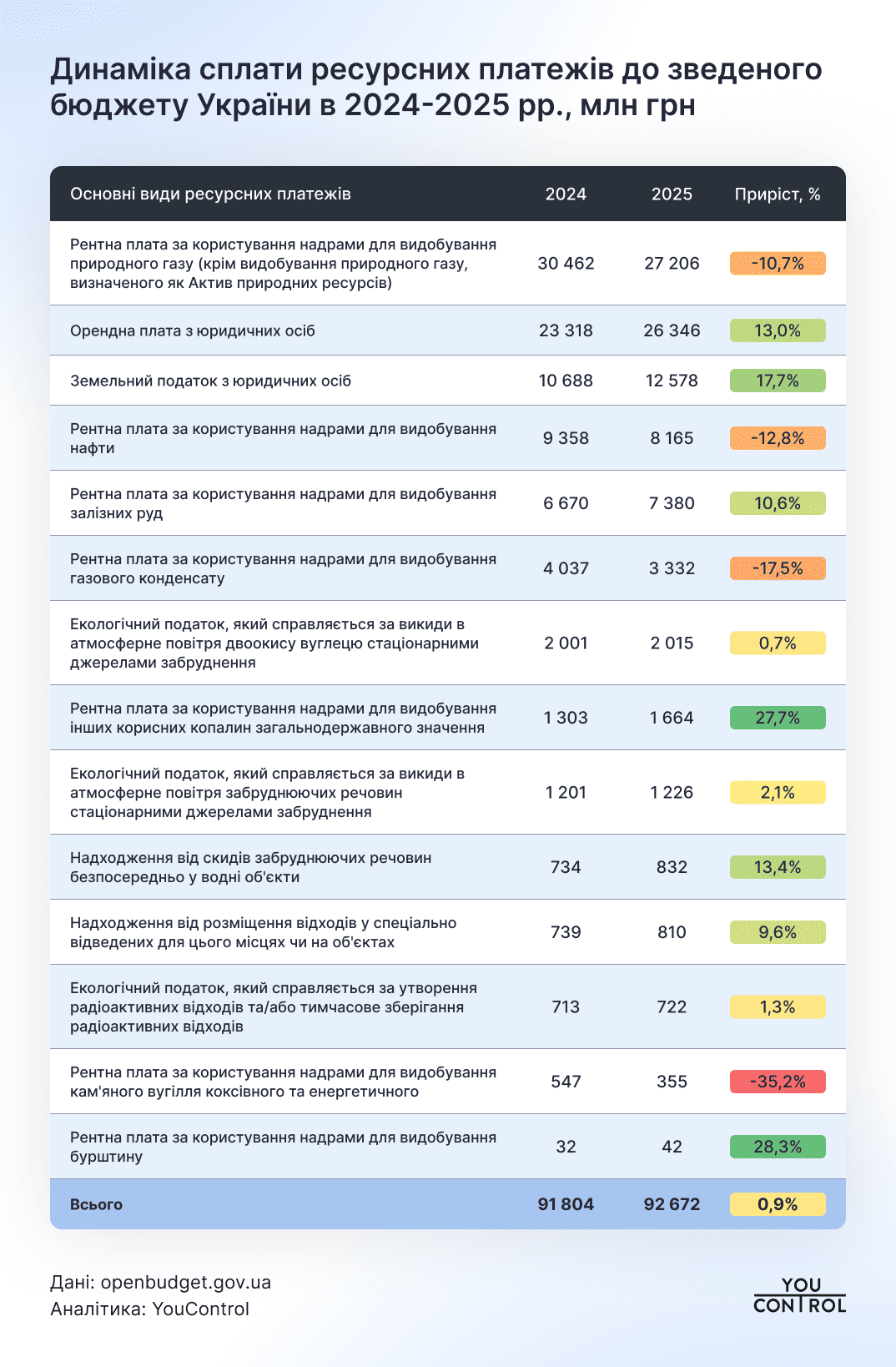
In total, Ukrainian businesses paid almost UAH 92.7 billion in resource payments in 2025, which is 0.9% higher than in 2024. The amount of eco-tax exceeded UAH 5.6 billion, which is 4.1% more than in the previous year.
However, the dynamics of eco-tax payments differed depending on the type of pollution:
- The environmental tax on CO2 emissions into the atmosphere increased by just 0.7%, from UAH 2,001 million to UAH 2,015 million.
- The environmental tax for emissions of atmospheric pollutants showed a 2.1% increase. In 2024, businesses paid UAH 1,201 million, while in 2025 this rose to UAH 1,226 million.
- The environmental tax levied for the generation or temporary storage of radioactive waste saw a 1.3% increase – UAH 722 million in 2025 compared with UAH 713 million in 2024.
- Receipts from the placement of waste in designated sites grew by 9.6%, rising from UAH 739 million to UAH 810 million.
- The largest increase was seen in payments for the discharge of pollutants into water bodies – 13.4%. Enterprises paid UAH 734 million for this in 2024 and UAH 832 million in 2025.
Source: youcontrol.com.ua
Regional unevenness
The researchers used data on resource payments recorded in the "Environmental Tax" section of the Ukrainian extractive industry data portal, as well as information from the State Budget Web Portal for Citizens openbudget.gov.ua. The geography and sectoral structure of payments were studied using the YC.Market tool.
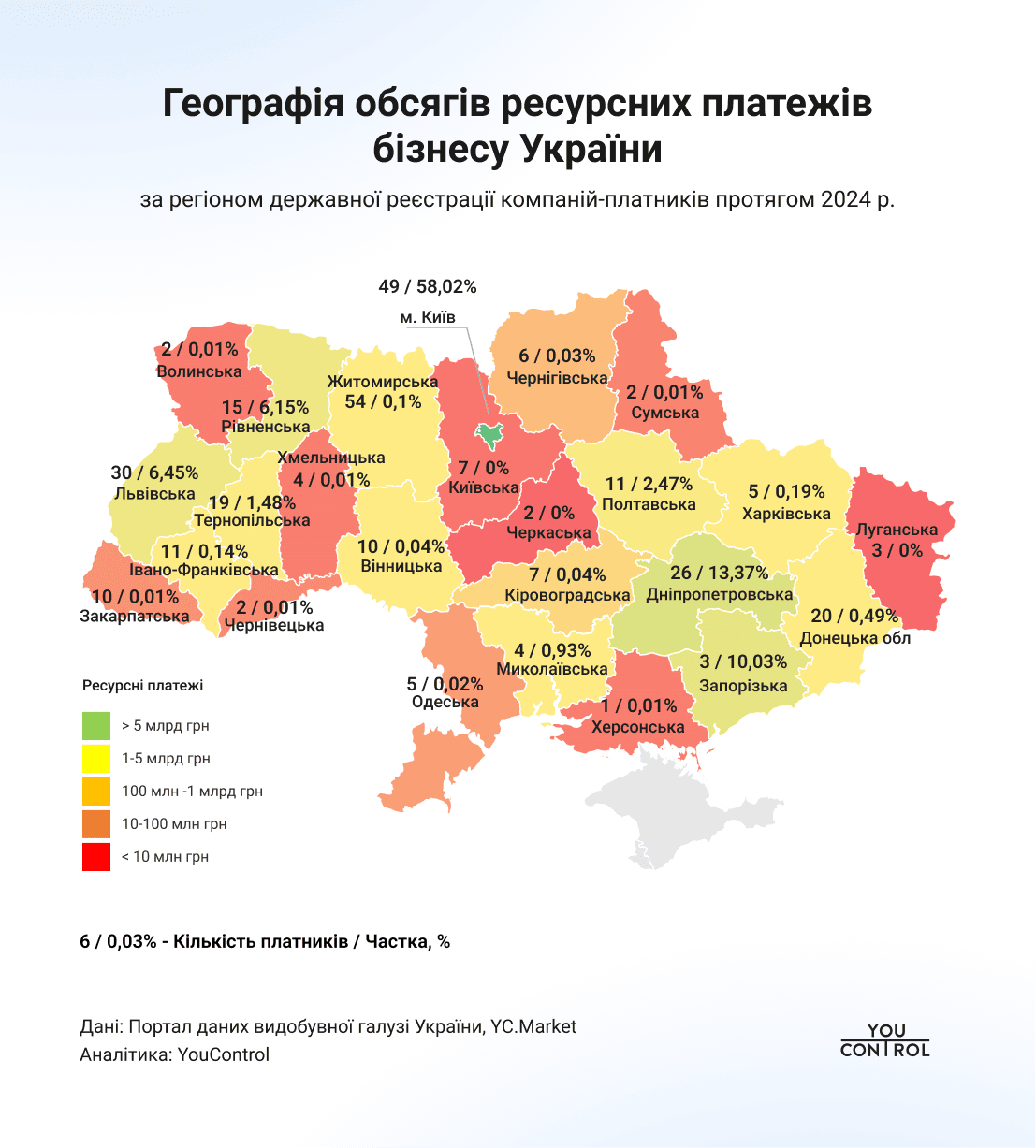
Data from the Ukrainian extractive industry data portal, which contains information on 308 payers, showed a contrast in resource payment revenues from different regions.
Source: youcontrol.com.ua
The capital city leads the way, with 49 companies registered in Kyiv paying 58% of all resource payments. These are mainly the headquarters of energy corporations and giant state-owned enterprises. It is noteworthy that resource extraction actually takes place in other regions.
Next in terms of resource payments are industrial regions – Dnipropetrovsk region (13.4%) and Zaporizhzhia region (10%).
Lviv region (6.5%) and Rivne region (6.2%) also have a significant share. This is primarily due to the extraction of non-metallic minerals and amber, as well as wood processing.
Imbalance across sectors
More than 79% of all resource payments came from extractive industries. The gas industry leads the way here, with 44 companies accounting for 36.1% of revenues. The most massive sector is the non-metallic industry, where 167 businesses paid 22.9% of payments. More than 20% was paid by nine producers from the oil sector. Another 15.3% was paid by 22 companies from the metallurgical industry.
Leaders are large steel and oil and gas companies
The analysis shows that about 65% of all resource revenues were provided by only 20 companies. The largest payers were the state-owned JSC Ukrgazvydobuvannya and JSC Ukrnafta, companies of the Metinvest holding, PJSC ArcelorMittal Kryvyi Rih, and DTEK.
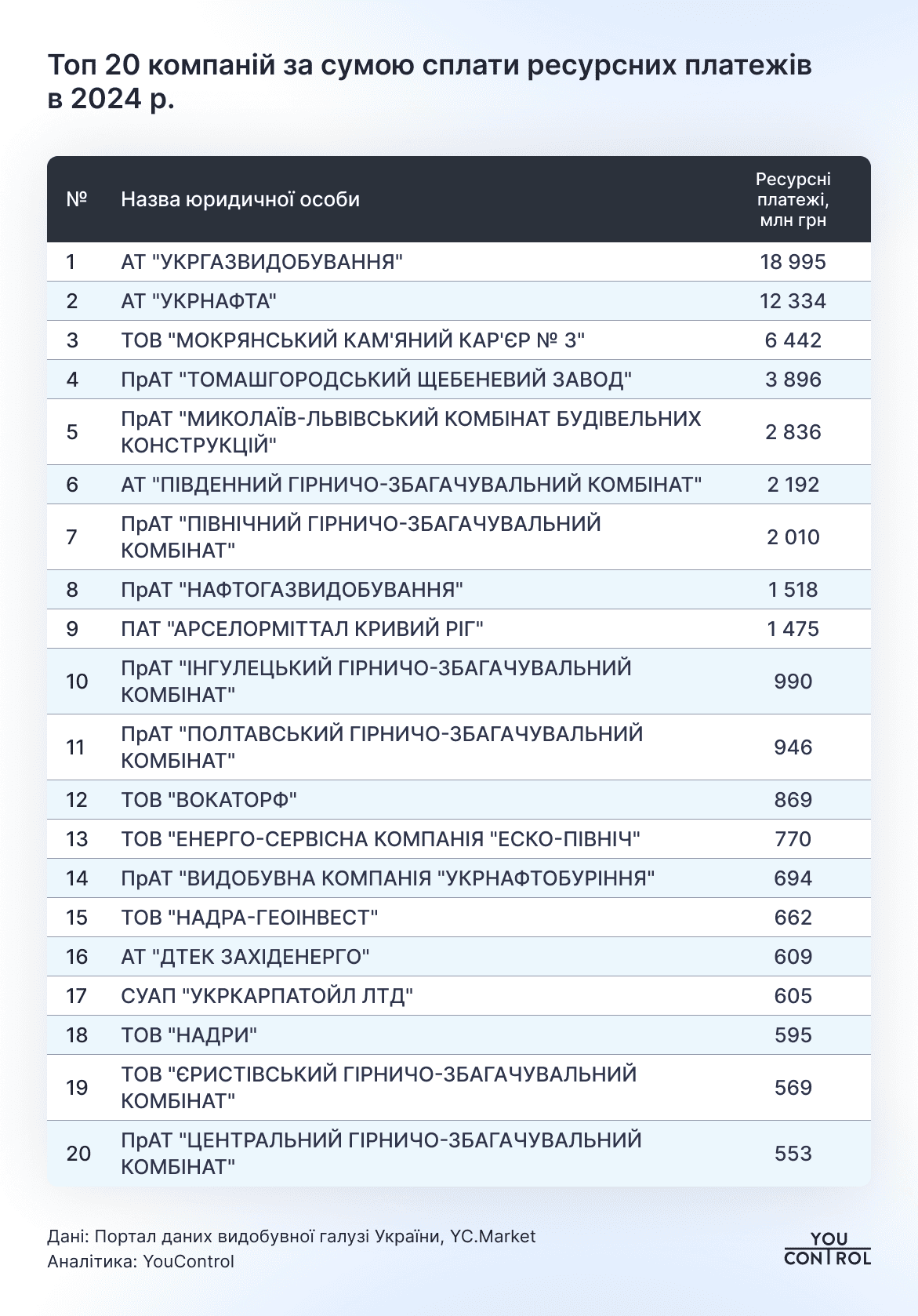
Source: youcontrol.com.ua
Locally, funds from the environmental tax are not always used as intended, as is the case, for example, in the Zhytomyr and Cherkasy regions.
EcoPolitic has also analyzed why the environmental tax does not work as it should.