Ukrainian cities and regions are quite free in shaping their environmental programs. Therefore, across the country, environmental tax revenues, which partially go to special local budget funds, are often spent on purchasing trash cans and flowers rather than on combating pollution or protecting nature. This trend may be even worse at the local community level.
EcoPolitics has observed a similar situation in the Odesa region. While the regional environmental program genuinely attempts to promote environmentalism, local communities unabashedly use environmentalism to cover up municipal issues.
Eco-tax in the Odesa region
The region is far from being a leader among eco-tax payers. Nevertheless, in just 10 months of 2025, its businesses paid UAH 25.4 million in eco-tax to the state budget. The State Tax Service noted that this figure was 9.4% higher than in the same period of the previous year.
In general, the eco-tax must be paid by all businesses that harm the environment in one way or another — pollute the air, soil, and water, or generate and dispose of waste on their territory.
These funds then go to a special fund of the state and local budgets – the region and its settlements.
The community uses the special fund to implement its environmental programs. As in the case of Odesa, these funds are often insufficient, so the program is supplemented from other sources – the state budget and the general fund of local budgets.
Regional environmental program
The regional comprehensive environmental protection program for the Odessa region sets out measures to be implemented by the authorities between 2024 and 2028.
The document opens with a section on climate policy. However, it only provides for one measure. It concerns the promotion of strategies and measures for the management of the Lower Danube. The goal is to prevent the consequences of climate change.
The Odessa region's environmental program also includes measures related to air quality monitoring and the purchase and operation of appropriate equipment.
However, the next item on the list is the traditional regional program measures for the development and maintenance of sewage networks. In the Odesa region, at least they are not placed at the very beginning of the eco-program, which gave false hope for a truly balanced approach to the creation of the document. In the section "Measures to prevent industrial pollution of wastewater," we see the construction and reconstruction of domestic sewage systems, the reconstruction and overhaul of pumping stations and treatment facilities, and the construction of a collector for storm sewers. In total, there are 14 measures, for which almost UAH 1.4 billion was planned to be spent over five years. In most of the measures, the main contractor for sewage works is the Department of Ecology and Natural Resources of the Odessa Regional State Administration.
Of course, waste was not left out. After literally three measures related to hazardous waste, such as mercury, biocides, or pharmaceuticals, the next seven are "dedicated" to household waste. The Department of Ecology in Odesa Oblast is responsible for the reclamation of landfills, including the development of projects, the reconstruction of the discharge channel, and the creation of a complex for the management of solid household waste.
Odesa region also plans to restore and reconstruct dams, clean rivers to restore the hydrological regime, carry out the certification of water bodies, liquidate the oil residue storage facility "Lebyazhe Lake," and implement environmental measures for salt extraction from the Kuyalnik estuary. In general, the section "Restoration of small rivers, lakes, and other reservoirs" is an example of truly balanced and important measures.
The eco-program includes the development of documentation for land management in a number of nature reserves and scientific research on the conservation of the region's nature.
Overall, we must admit that, in contrast to previously studied environmental protection programs, the one in the Odesa region is quite reasonable. Yes, there are still sewage and garbage problems, but these issues are much less significant and are simply lost against the backdrop of truly ecological work.
Smaller cities and their view of ecology
The Pivdenivska municipal community's program for 2024-2026, following the regional one, is like a cold shower. There are simply no measures that are purely environmental. All of them are in one way or another related to housing and communal services and public amenities, except for the elimination of illegal landfills. Of the other 12 measures:
- 1 involves construction of stormwater drainage networks with landscaping near the building;
- 5 concern waste-purchasing household waste containers, developing waste removal schemes, and even drafting standards for the provision of solid waste removal services;
- 6 relate to landscaping, delivery of chernozem (rich black soil) for educational institutions, purchase of equipment for planting street flowers, and inventory of municipal green spaces.
It should be noted that all measures were planned to be financed from the city budget. But what does this have to do with ecology?
The Black Sea eco-program for 2024-2028 was nevertheless diluted with measures that can be considered unquestionably ecological.
These include measures to improve air quality, such as installing monitoring stations and conducting laboratory research. However, there are many controversial points in this section. In particular, the eco-modernization of enterprises and the introduction of international environmental management standards, where implementation is entrusted solely to industrial enterprises and their budgets.
It should be noted that, for some reason, it was within the framework of the environmental program that Chornomorsk decided to develop a network of charging stations for electric vehicles. The authors of the document, of course, appeal to the lower pollution produced by these cars. This ensured that the transport infrastructure development measure was included in the section on "Air Protection."
In our view, the “Water Resources Protection” section should be renamed “Sewerage.” Nearly 50 of its measures concern the construction, repair, and renovation of sewer networks and equipment.
Chornomorsk’s environmental program also provides for combating landslides and flooding, which relates more to civil protection from natural disasters.
At the same time, the city included a touch of landscaping in its environmental initiatives. The program envisions creating an electronic register of green spaces, building an irrigation system, and renovating greenhouses in the local “Zelengosp” municipal greenhouse. In Chornomorsk, even constructing dog walking areas is considered an environmental measure.
Here, fighting climate change is considered to include removing dry and hazardous trees, developing an irrigation system, and even optimizing the route structure for special transport services.
We would also like to point out that, in developing their environmental protection programs, these two cities relied on different lists of legislative acts, which we show in the screenshots from the websites of the local councils.
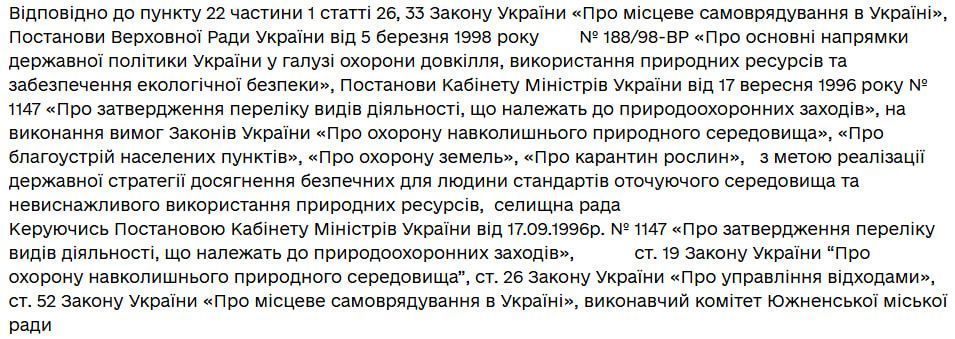
Regulatory framework for developing the environmental program in Pivdenne. Source: ymtg.gov.ua
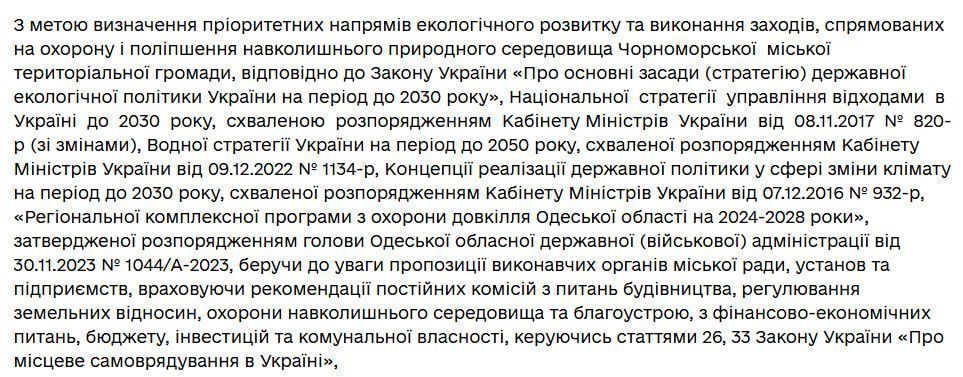
Regulatory framework for developing the environmental program in Chornomorsk. Source: od.cmr.gov.ua
The example of Odesa region provides yet another confirmation that Ukrainian communities have full carte blanche to shape the measures in their environmental programs. Nominally, they refer to a range of legislative acts, but interpretation is often too broad or even outdated. Yes, once again we refer to the Cabinet of Ministers’ resolution from 1996, “On Approval of the List of Activities Classified as Environmental Protection Measures.”
So until the state updates its regulatory mechanisms, communities will continue spending both environmental tax revenues and local budget funds on pseudo-environmental activities.
As we see, under such circumstances, funds from polluting enterprises will be spent on flowers, sewers, electric vehicle charging stations, and the removal of deadwood, rather than on measures that truly prevent industrial pollution or reduce its impact.
Previously, EcoPolitic examined how environmental funds are spent in Vinnytsia, Rivne, Zhytomyr, Ivano-Frankivsk, Cherkasy and other regions.