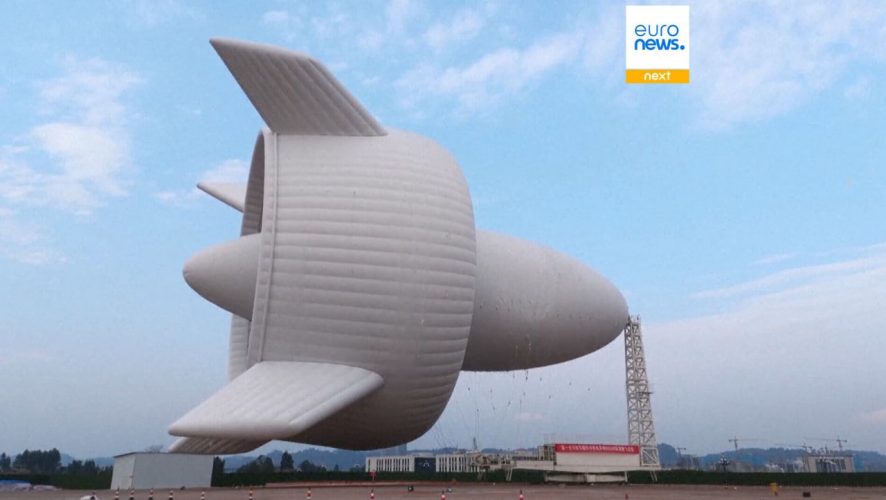
The world's first high-altitude wind turbine has successfully completed a test flight in Sichuan Province, China. Similar to an airship, the S2000 Stratosphere (SAWES) system features a wind turbine and is designed to generate 1 MW of power.
According to Euronews, at an altitude of 2 km above the ground, the airborne wind turbine successfully transmitted the generated energy to the ground.
"Extracting" energy high in the air can be even more efficient than with conventional wind turbines. After all, the higher above the ground, the stronger and more stable the winds. The developers said that the principle of electricity generation is similar to that of ground-based turbines – through the rotation of blades.
"This generator works in the same way, except that energy is generated in the air rather than at ground level. It uses wind energy to rotate its blades and produce electricity, which is then transmitted via aerial cables from the air to the ground," said Weng Hank, co-founder and chief technical officer of Beijing Linyi Yunchuan Energy Technology.
An airborne breakthrough in wind energy
The wind power airship is quite large – 60 m long and 40 m in diameter. During the test, the airborne wind turbine remained aloft for about 30 minutes. During this time, the turbines generated 385 kWh of energy. The total rated capacity of the installation is 1 MW.
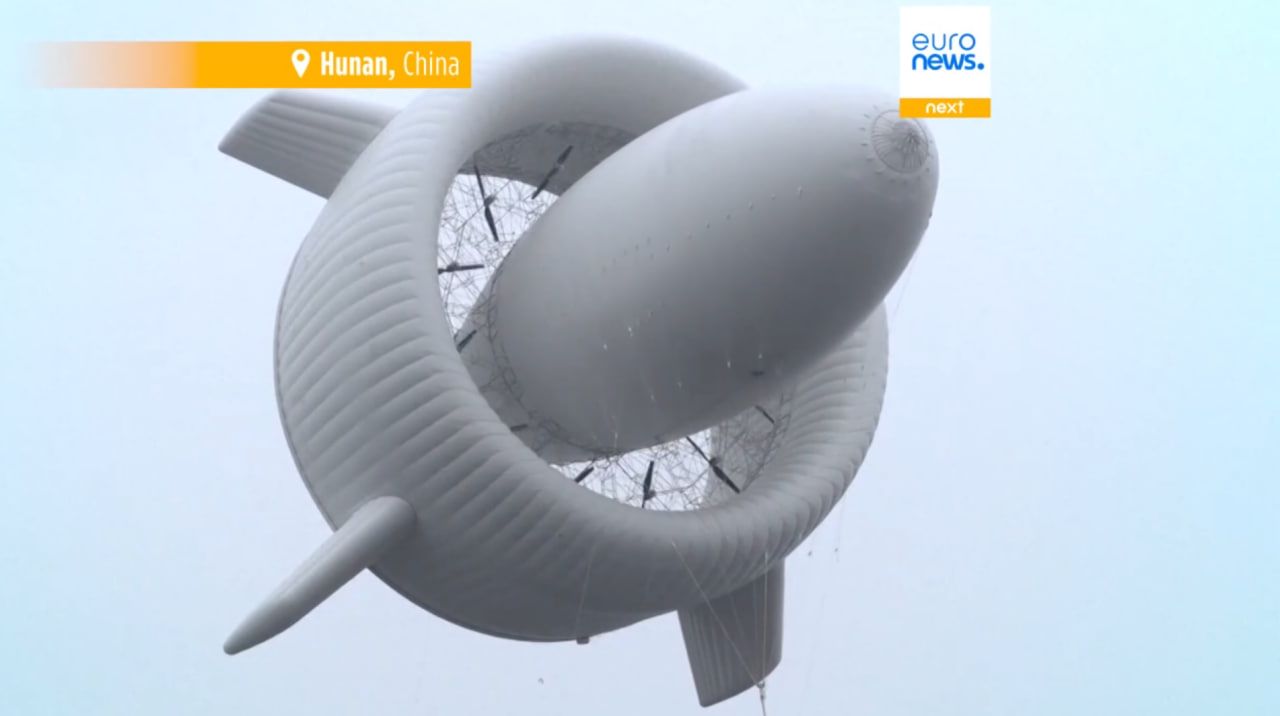
Source: euronews.com.
The developers believe they have achieved a breakthrough in the structural and aerodynamic design of these aerial devices. One of the most challenging tasks was transmitting power to the ground.
“The entire power generation system overcame the challenges of medium-voltage direct current transmission technology with high power density, which made it possible to keep the construction lightweight while ensuring higher transmission efficiency,” Weng noted.
The flying power station has several additional functions. In addition to energy generation, it can serve as a platform for communications equipment and surface monitoring devices.
EcoPolitic previously reported that in Ukraine, the first wind turbine blade was manufactured. Now the country has a full production cycle for wind turbines.
In the European Union, “green” energy already covers 47.5% of demand. Wind energy ranks first among renewable energy sources with 38% of clean generation output.