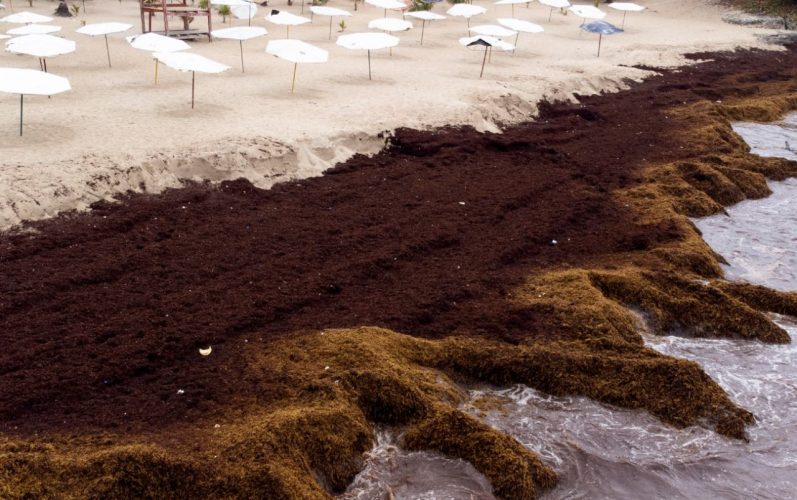
Colonies of macroalgae in the oceans are growing at an alarming rate. Over the course of a year, the volume of marine plants increases by more than 13%. This aquatic "greening" can change everything from the biochemical composition of water to the living conditions of living creatures.
Research by scientists at the University of South Florida, reported by The Guardian, identified 2008 as a turning point. It was then that an increase in the area covered by algae blooms began to be recorded, as did a steady rise in the temperature of the world's oceans.
"Until 2008, there were no significant blooms recorded except for sargassum in the Sargasso Sea. On a global scale, we seem to be seeing a change in the ocean regime," said Chuanming Hu, professor of oceanography at USF's College of Marine Sciences.
Capturing water in motion
Scientists have noted persistent reports of expanding algae blooms in the Pacific and Atlantic oceans.
Among the most notable examples is not only the well-known Great Atlantic Sargasso Belt. Smaller blooms have formed a ring around the Chatham Islands off the coast of New Zealand. This phenomenon was recorded by NASA satellites. The "red tide" off the coast of Florida was also a sign of the problem.
The research team analyzed satellite images of the ocean from 2003 to 2022. In total, there were 1.2 million images, which made it possible to create the first global "map" of algae in the oceans. During the study period, the area of blooms increased by an average of 13.4% each year. In contrast, microalgae, known as phytoplankton, increased in volume by only 1%.
"It is noteworthy that the largest increase in the number of floating macroalgae and microalgae has occurred in the last decade, which corresponds to the accelerated global warming of the ocean since 2010," the authors write.
How will this change the ocean?
Dense algae blooms create persistent shade, making it increasingly difficult for sunlight to reach the lower layers of the ocean. This will have a direct impact on organisms living at medium depths.
At the same time, plants also influence chemical processes—carbon absorption and the biochemical composition of ocean waters. This impact needs to be studied separately and in more detail, but the change in the oceans is already evident.
EcoPolitic reported that "marine reserves" will be created in international waters around the world. This is one of the points of the global agreement on the high seas, which came into force on January 17.